Cruise Ship Pool Deck Slip and Fall Injury Claims | Norwegian Cruise Line
Norwegian Pool Deck Slip and Fall Lawyer | Miami Attorney
By Alex Perkins, Founding Attorney, Perkins Law Offices — Miami, Florida | Representing Injured Cruise Passengers Nationwide
This page is not a general overview of cruise ship slip and fall law. It is about the claim itself: what evidence actually proves a Norwegian Cruise Line pool deck case, how NCL and its defense lawyers try to defeat it, which deadlines control it, and what you should ask any lawyer before you hire one. If you were hurt on an NCL pool deck and you are trying to decide whether you have a case and who should handle it, this is written for you.
One point up front, because it affects everything else: it does not matter where you live. NCL’s ticket contract sends passenger injury lawsuits to federal court in Miami. Passengers from Illinois, Texas, Ohio, California, New York, and every other state end up in the same courthouse. That is the court where I practice.
Why the Pool Deck Is the Most Contested Ground on a Norwegian Ship
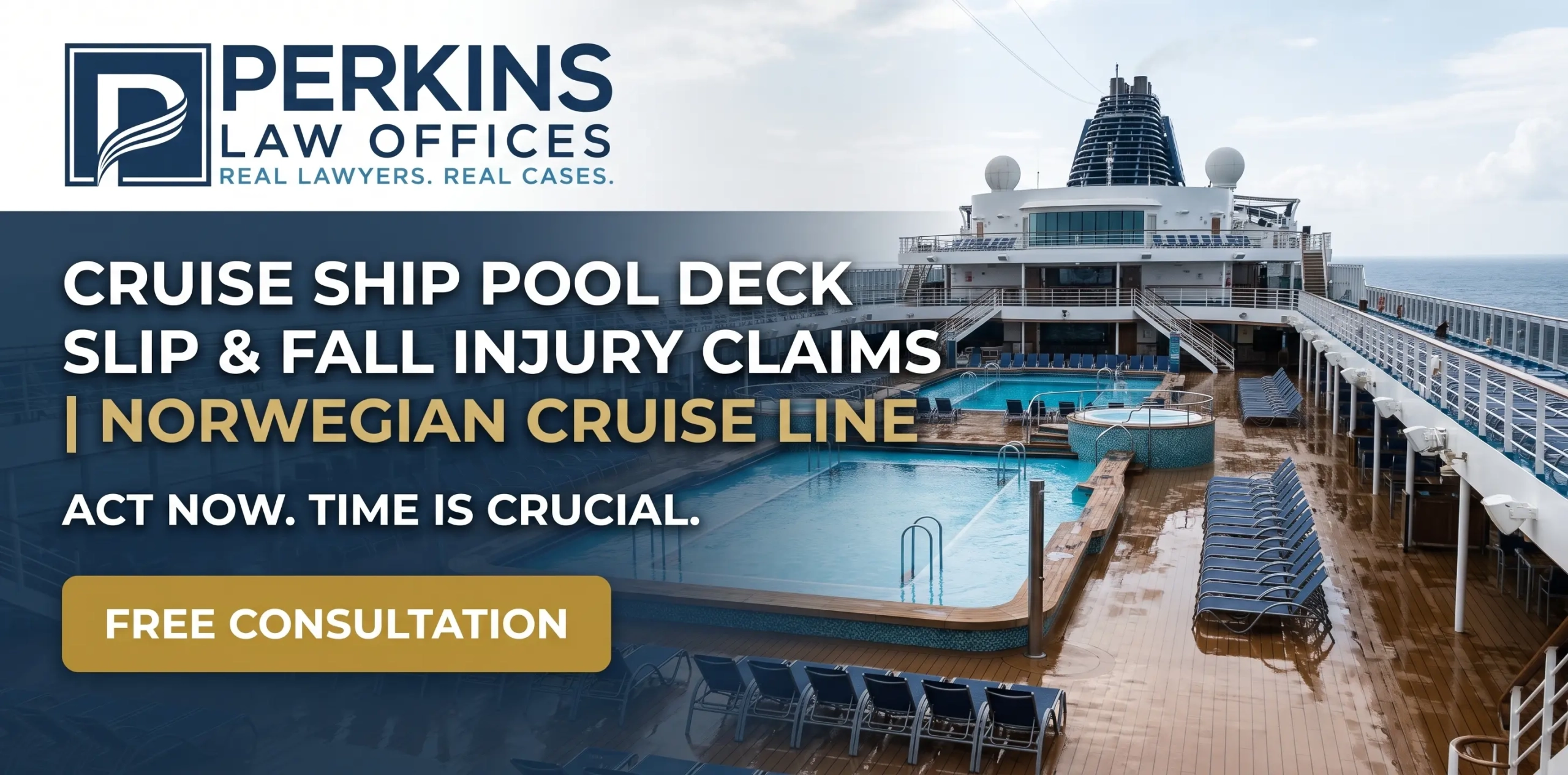
Think of a cruise ship pool deck as a kitchen floor with a swimming pool in the middle and a bar at each end, left outside in the rain, and walked on by thousands of people in bare feet. Every factor that makes a floor slippery is concentrated there.
The volume is enormous. According to Cruise Lines International Association (CLIA), roughly 37 million people took an ocean cruise in 2025, and more than 20.5 million of them came from the United States. CLIA’s figures place the Caribbean at 37 percent of global ocean-going passenger days, which means warm-weather itineraries where the pool deck is the center of the day. On a ship like the Norwegian Escape, which carries more than 4,200 guests at double occupancy, the main pool deck is the busiest outdoor surface on the vessel.
Where the water and residue come from
When I investigate an NCL pool deck fall, I am looking for the source of the slippery condition, because the source often decides who is legally responsible. The usual sources are:
- Pool and hot tub overflow — water displaced by swimmers, splash from slides and play areas, and spillover from infinity-edge designs on newer ships.
- Dripping passengers — guests walking from the pool to the buffet, bar, or elevators, leaving trails of water across walkways.
- Bar and food service spills — drinks, ice, and food dropped in high-traffic paths between the pool and service areas.
- Sunscreen and tanning oil — a residue that mixes with water and makes even a slip-resistant surface behave like glass.
- Rain and sea spray — open decks get wet whether anyone swims or not.
- Crew cleaning and deck washing — mopping, hosing, or chemical cleaning done while passengers are still walking through.
The last category matters more than most people realize. If a crew member created the wet condition, the legal analysis can shift in your favor, which I explain below.
The surface itself
Pool decks are built from teak, synthetic decking, tile, or poured composite systems. Each material behaves differently when wet, and each wears down over time. Anti-slip coatings get polished smooth by foot traffic. Textured surfaces fill with residue. Mats curl at the edges. A surface that tested safely when the ship was delivered may not be safe years later. In one NCL case I handled, a central fight in discovery was over the maintenance of the ship’s synthetic deck flooring — because how a deck is maintained can matter as much as what it is made of.
The Legal Standard Norwegian Cruise Line Is Held To
Pool deck falls on NCL ships sailing in navigable waters are governed by federal general maritime law, not your home state’s slip and fall statute. The Supreme Court set the baseline in Kermarec v. Compagnie Generale Transatlantique (1959): a shipowner owes passengers reasonable care under the circumstances.
The Eleventh Circuit, whose decisions control in Miami federal court, adds a requirement that defeats many unprepared claimants. Under Keefe v. Bahama Cruise Line, Inc., 867 F.2d 1318 (11th Cir. 1989), the passenger must generally prove the cruise line had actual or constructive notice of the dangerous condition. In plain terms, you have to show NCL knew, or should have known, that the deck was dangerously slippery before you fell.
You must also prove the four elements of negligence: duty, breach, causation, and damages. The Eleventh Circuit spelled these out in the context of an NCL pool deck fall in Sorrels v. NCL (Bahamas) Ltd., 796 F.3d 1275 (11th Cir. 2015) — a case I will return to, because it is one of the most important decisions in this area of law.
When a crew member caused the condition: direct versus vicarious liability
The notice requirement is not the only path. In Yusko v. NCL (Bahamas) Ltd., 4 F.4th 1164 (11th Cir. 2021), the Eleventh Circuit held that a passenger suing a cruise line for the negligence of its crew member, under a theory of vicarious liability, does not have to prove the cruise line had notice of a dangerous condition.
Why does that matter on a pool deck? Because if a deck steward hosed down a walkway and left it wet, a bartender spilled a tray of drinks and walked away, or a cleaning crew mopped a path without blocking it off, the claim may be framed around what that employee did. That changes the evidence you need. Identifying which theory fits your facts is one of the first decisions I make on a new NCL case.
How Notice Is Actually Proven Against Norwegian Cruise Line
Most pool deck cases are won or lost on notice. NCL’s lawyers will argue that the water appeared moments before your fall and no one could have known about it. Here is the evidence I use to answer that argument.
Warning signs as evidence of knowledge
Passengers often assume that a “caution: wet floor” sign near their fall destroys their case. The courts do not see it that way. A sign is evidence that the cruise line knew the area became slippery. In Guevara v. NCL (Bahamas) Ltd., 920 F.3d 710 (11th Cir. 2019), the court treated a warning sign posted near the hazard as evidence that NCL knew of the danger. In Brady v. Carnival Corp., 33 F.4th 1278 (11th Cir. 2022), a wet pool deck case, the court held that evidence of warning signs in the area could support notice and sent the case back for trial.
The question then becomes whether the warning was adequate for the real danger. A sign that says “watch your step” does not necessarily tell a passenger that a deck becomes as slick as ice when wet. That distinction is often decisive.
NCL’s own safety messaging
In Frasca v. NCL (Bahamas) Ltd., 654 F. App’x 949 (11th Cir. 2016), the court considered a safety video NCL played on cabin televisions warning that the ship’s decks could be very slippery. When a cruise line tells its passengers the decks are slippery, it is difficult for that same cruise line to argue it had no idea the decks were slippery. I look for every announcement, video, daily program notice, and posted placard NCL used on that ship.
Prior similar incidents
Prior falls in the same or a substantially similar location can establish that NCL knew of a recurring problem. Courts require the prior incidents to be substantially similar — same area, same surface, similar conditions — and Sorrels discussed this standard directly. Getting those records requires formal discovery, because NCL does not hand them over voluntarily. In the publicly filed 2026 Norwegian Escape case discussed below, the passenger’s complaint cited an earlier fall aboard the same ship.
Crew testimony, cleaning logs, and deck attendant schedules
Cruise lines have written procedures for inspecting and drying pool decks. Those procedures tell me what NCL knew was necessary. The logs and staffing records tell me whether it was actually done on the day of your fall. Testimony from deck crew about how often the area gets wet, and what they are told to do about it, can be powerful evidence of constructive notice — though Sorrels also shows the testimony must come from someone with real knowledge of the practice, not secondhand impressions.
Slip-resistance testing
Sorrels is the leading case on this point. Teresita Sorrels slipped on the rain-wet pool deck of the Norwegian Sky in 2012 and fractured her wrist. The case turned in significant part on expert testimony about the deck’s coefficient of friction — the measured slip resistance of the surface. Later courts have read Sorrels to mean that a delay between the fall and the testing normally goes to the weight of the evidence, not whether the jury hears it at all.
That matters because you will rarely get an engineer on board within days of your fall. An expert can test the surface later through the discovery process. But the sooner the inspection is requested, the stronger the evidence.
How Norwegian Cruise Line Defends Pool Deck Claims
I tell every potential client the same thing: I will not sugarcoat the defenses. NCL is a well-funded defendant with experienced in-house and outside counsel. Understanding their playbook is part of evaluating your claim honestly.
“The water was open and obvious”
NCL will argue that a wet pool deck is an obvious condition and it had no duty to warn you of it. Courts analyze this from the viewpoint of a reasonable person, not the injured passenger. In Carroll v. Carnival Corp., 955 F.3d 1260 (11th Cir. 2020), the Eleventh Circuit reversed a ruling for the cruise line and cautioned against resolving these disputes too early. The answer to this defense is usually that the danger was not the presence of water — it was the degree of slipperiness, which a passenger cannot see by looking at the deck. Clear water on a light-colored surface is often nearly invisible.
“No one could have known”
This is the notice defense. It is strongest when the condition was truly brief and isolated. It is weakest when the evidence shows a recurring problem, a known high-traffic area, signs posted in the past, or a crew member nearby who should have seen it.
“Look at the passenger’s shoes”
Expect NCL to photograph or ask about your footwear. Flip-flops, sandals, wedges, and bare feet will be raised as evidence of your own carelessness. My response is direct: NCL designed and marketed a pool deck where bare feet and sandals are the normal attire. A reasonable surface for that environment must account for how people actually use it.
“The passenger had been drinking”
Bar receipts and onboard purchase records will be requested. Alcohol consumption alone does not prove a passenger fell because of impairment, but it will be argued. Honest facts, consistently stated from the first day, are the best protection.
Comparative fault
Under maritime law, your own fault does not automatically bar recovery. It reduces it proportionally. If damages are valued at $200,000 and you are found 25 percent at fault, the recovery is reduced by $50,000. That is why the details of your fall — where you were looking, how fast you were walking, what you were carrying — matter, and why careless statements onboard can be costly.
The honest limitation
Not every fall on a pool deck is a lawsuit. If you slipped in a puddle that formed seconds before, in an area with no history of falls, with no crew nearby, on a surface that tests within accepted slip-resistance ranges, I may tell you the claim is not worth pursuing. I would rather tell you that at the start than take your case and waste a year of your life. A lawyer who promises you a win before reviewing the facts is not giving you legal advice.
A Real Public Filing: The 2026 Norwegian Escape Pool Deck Case
Public court filings show how these claims are presented. On March 2, 2026, an Illinois passenger filed suit against NCL in the Southern District of Florida, alleging she fractured her left femur after slipping on a wet, clear substance near the main pool on Deck 16 of the Norwegian Escape in January 2025 while walking toward the Garden Café buffet. The complaint alleges NCL failed to inspect the high-traffic pool area, failed to clean and dry it, and failed to use proper non-skid mats or coverings. It also cites a prior fall aboard the same ship.
These are allegations, NCL has not publicly commented, and nothing has been proven. I do not represent that passenger. I mention the case for three reasons that apply to your claim:
- The passenger lives in Illinois and the case is in Miami — the forum clause applies to everyone.
- The complaint emphasizes that the substance was transparent — the answer to the “open and obvious” defense.
- The complaint cites a prior incident on the same ship — the foundation of a notice argument.
The Claim Timeline: From the Fall to the Federal Courthouse in Miami
The deadlines in an NCL pool deck claim are far shorter than in an ordinary land-based injury case. Federal law, 46 U.S.C. § 30508, allows cruise lines to require written notice of a claim within as little as six months and a lawsuit within as little as one year. NCL’s Guest Ticket Contract uses that authority. The sequence generally looks like this:
- Day of the fall. Medical care in the ship’s medical center, an incident report, and photographs. Everything said onboard is being documented by the cruise line.
- The first weeks. A preservation demand should go to NCL quickly. Shipboard CCTV systems do not keep footage forever, and deck conditions, mats, and signs change.
- Within 185 days. Written notice of the claim must reach NCL in the form its ticket contract requires. The onboard incident report is not a substitute. A notice that lacks required particulars can be challenged as insufficient.
- Pre-suit evaluation. Medical records are gathered, treatment progresses, and the claim is valued. Some claims resolve at this stage. Many do not, because NCL’s adjusters know the one-year clock is running.
- Within one year. The lawsuit must be filed in the U.S. District Court for the Southern District of Florida in Miami. A case filed one day late, or in the wrong court, can be dismissed.
- Discovery. Exchange of documents, depositions of crew and corporate representatives, prior incident records, deck testing, and expert reports.
- Mediation and resolution. The Southern District routinely requires mediation before trial. Many cases resolve there. Those that do not proceed toward trial.
I have spoken with passengers who spent months exchanging emails with a cruise line claims department, believing a settlement was coming, only to watch the one-year deadline pass. Once that happens, there is usually nothing any lawyer can do.
National Representation: Why Your Home State Does Not Decide Your Lawyer
Injured passengers often call a local personal injury attorney first. That instinct makes sense on land. On an NCL claim, it can be a serious mistake, for reasons that have nothing to do with the local lawyer’s ability.
The case must be filed in Miami federal court. The lawyer filing it must be admitted to practice in the Southern District of Florida. The governing law is federal maritime law, with Eleventh Circuit precedent that differs from many state rules. And the six-month notice and one-year filing deadlines are traps for lawyers who do not handle cruise cases regularly.
I am admitted to the Southern District of Florida and licensed in Florida, Illinois, and Washington, D.C. My firm represents NCL passengers from across the country. In practice, that means:
- Your consultation can happen by phone or video from your home.
- Medical records are collected from your providers wherever you are treating.
- Many depositions and court conferences in federal cases are conducted remotely.
- Travel to Miami, if needed, is usually limited to key events such as a medical examination requested by NCL, mediation, or trial — and we plan for it well in advance.
What a Norwegian Pool Deck Injury Claim Is Worth — and What Moves the Number
No honest lawyer can give you a dollar figure for your case before reviewing the evidence, and no prior result guarantees a future one. What I can tell you is what drives value in these cases.
The categories of damages
- Past and future medical expenses, including the ship’s medical center charges, emergency transport, surgery, therapy, and follow-up care.
- Lost wages and loss of future earning capacity.
- Pain and suffering, mental anguish, disfigurement, inconvenience, and loss of capacity for the enjoyment of life.
- Out-of-pocket costs tied to the injury, such as disrupted travel and assistance at home.
The factors that increase or decrease value
- Severity and permanence. Pool deck falls frequently cause lower-extremity fractures — ankles, tibias, fibulas, hips — and wrist fractures from bracing the fall. Surgical repair with hardware, and any permanent limitation, substantially affect value.
- Age and life circumstances. An older passenger’s hip fracture can mean a lasting loss of independence.
- Strength of the notice evidence. Prior incidents, warning signs, NCL’s own safety messaging, and failing slip-resistance tests move NCL toward fair offers.
- Comparative fault exposure. Footwear, alcohol, and inconsistent statements reduce value.
- Medical liens and insurance. Who paid your bills, and whether they have repayment rights, affects your net recovery.
You can review some of my firm’s past outcomes on our case results page. Every case is different, and results depend on the specific facts and law involved.
Questions to Ask Before You Hire a Cruise Ship Injury Lawyer for an NCL Claim
When you search for a lawyer after a cruise ship slip and fall, you are making a decision that controls the outcome of your case. These are the questions I would ask if I were in your position, and what a strong answer sounds like.
“Are you admitted to practice in the Southern District of Florida?”
The answer should be yes. If the lawyer plans to refer your case to someone else once it needs to be filed, you should know that now and know who that lawyer is.
“What is my notice deadline and my filing deadline?”
A lawyer who handles NCL cases should explain the 185-day notice requirement and the one-year suit deadline without looking them up, and should commit to reviewing the specific ticket contract for your sailing.
“How will you prove NCL knew about the condition?”
Listen for specifics: prior incident discovery, warning sign evidence, safety messaging, crew procedures, slip-resistance testing, and whether a crew member created the hazard. A vague answer like “cruise lines are always responsible” is a warning sign of its own.
“What are the weaknesses in my case?”
You want a lawyer willing to tell you about the open-and-obvious defense, the footwear argument, and comparative fault as they apply to your facts. If you only hear good news, you are not getting a full evaluation.
“Will I deal directly with you?”
At my firm, clients speak with me. Ask any lawyer you consider whether the attorney handling your case will be reachable, or whether you will be passed to a call center.
“How is the fee structured, and who pays the case costs?”
Cruise injury cases are typically handled on contingency. Get the percentage, how costs such as expert fees are handled, and what happens if there is no recovery — in writing, before you sign.
“Have you litigated against Norwegian Cruise Line before?”
Experience with NCL’s procedures, defense counsel, and corporate witnesses saves time and avoids mistakes. Ask for the lawyer’s general experience; specific client information is confidential and should not be disclosed to you.
What You Can Do Today If You Were Hurt on an NCL Pool Deck
If your cruise has ended, the steps that matter most now are about preserving what you already have:
- Write a short timeline while your memory is fresh: ship name, sailing dates, deck number, approximate time, what the surface looked like, and who was nearby.
- Gather every photo and video from your phone and your travel companions’ phones, including images taken before the fall that show the deck.
- Keep your ticket confirmation and booking documents. They identify which version of the Guest Ticket Contract applies.
- Keep the shoes you were wearing, unwashed and unaltered.
- Save every medical bill, including the ship’s medical center charges — those can be significant. See our guide on NCL medical center costs.
- Stop posting about the cruise or your injury on social media. Defense lawyers review public profiles.
- Do not negotiate with NCL’s claims department on your own, and do not let the 185-day or one-year deadlines approach without legal advice.
If you are still on the ship, read should I sign a cruise ship incident report and can cruise ship staff take pictures of my shoes after a fall before you give a statement. You can also call me from the ship.
For more on specific NCL pool deck conditions and injuries, see our Norwegian pool deck slip and fall injury lawyer page and our guide to slip and falls on Norwegian Aqua. For deadlines in detail, read how long you have to sue Norwegian Cruise Line.
Frequently Asked Questions: Norwegian Cruise Line Pool Deck Slip and Fall Claims
Can I sue Norwegian Cruise Line for slipping on a wet pool deck?
Yes, if you can prove NCL was negligent. Under general maritime law, NCL owes passengers reasonable care under the circumstances. For a wet-deck fall, that usually means showing NCL knew or should have known the deck was dangerously slippery and failed to fix it or adequately warn you, or that a crew member created the condition. A wet deck alone is not enough; the evidence of notice and breach is what makes the claim.
How long do I have to file a pool deck slip and fall claim against NCL?
NCL’s Guest Ticket Contract generally requires written notice of the claim within 185 days of the injury and a lawsuit filed within one year. Federal law, 46 U.S.C. § 30508, allows cruise lines to shorten deadlines to no less than six months for notice and one year for suit. Missing either deadline can end the case regardless of how serious the injury is. Always have a lawyer review the exact ticket contract for your sailing.
Where is a lawsuit against Norwegian Cruise Line filed?
NCL’s ticket contract requires passenger injury lawsuits to be filed in the United States District Court for the Southern District of Florida in Miami, with a narrow exception for cases that court cannot hear. That applies whether you live in Texas, New York, California, or anywhere else, and regardless of the port your cruise left from.
I don’t live in Florida. Can a Miami lawyer handle my NCL claim?
Yes. Because NCL cases must be filed in Miami federal court, the lawyer who files your case needs to be admitted to practice in the Southern District of Florida. Perkins Law Offices represents injured NCL passengers from across the United States. Consultations, document exchange, and many depositions can be handled remotely.
Does a wet floor sign on the pool deck mean I have no case?
No. A sign can cut both ways. NCL may argue the sign warned you. But the Eleventh Circuit has recognized that evidence of warning signs placed in the area can show the cruise line knew the deck was slippery when wet, as in Brady v. Carnival Corp. (2022) and Guevara v. NCL (Bahamas) Ltd. (2019). Whether the warning was adequate for the actual danger is often a question for the jury or judge.
What if I was wearing flip-flops or had been drinking?
NCL will raise both. Under maritime law’s comparative fault rules, any fault assigned to you reduces your recovery by that percentage; it does not automatically bar the claim. Footwear is normal attire on a pool deck, and the cruise line chose the deck surface knowing passengers walk it barefoot and in sandals. The facts of your fall control how much weight these arguments carry.
How much does it cost to hire a lawyer for an NCL pool deck injury claim?
Perkins Law Offices handles cruise ship injury claims on a contingency fee basis. The consultation is free, there is no upfront fee, and no attorney’s fee is owed unless money is recovered. The fee percentage and how case costs are handled are set out in a written agreement before any work begins.
How long does an NCL slip and fall case take to resolve?
It depends on the injury, whether surgery and recovery are complete, and whether NCL makes a fair offer. Some claims resolve before suit. Cases that are filed in the Southern District of Florida generally move through written discovery, depositions, expert disclosures, and court-ordered mediation, and that process commonly takes a year or more from filing.
Should I sign the incident report or give a statement to NCL security?
Report the fall so there is a record, but be careful. Stick to facts: where, when, and what the surface was like. Do not guess, apologize, or speculate about your own fault. Ask for a copy of anything you sign. Statements taken onboard are routinely used by the cruise line’s defense lawyers later.
How many people cruise each year, and why does that matter for my claim?
According to Cruise Lines International Association, roughly 37 million passengers took an ocean cruise in 2025, and more than 20.5 million came from the United States. The Caribbean accounted for 37 percent of global ocean-going passenger days in 2026 projections. High passenger volume on outdoor pool decks means falls in the same areas are foreseeable, which matters when proving the cruise line should have anticipated and addressed the hazard.
Speak With Me Directly About Your Norwegian Cruise Line Pool Deck Injury
If you were injured in a slip and fall on a Norwegian Cruise Line pool deck, the clock started the day you fell. I review these claims personally. The consultation is free and confidential, and my firm handles cruise ship injury cases on a contingency fee basis — no fee unless we recover money for you.
Call or text (305) 741-5297, email perkins@perkinslawoffices.com, or contact us online. We represent injured cruise passengers nationwide from our Miami office, with an additional office in Boca Raton.
Alex Perkins
Founding Attorney, Perkins Law Offices
Licensed in Florida, Illinois, and Washington, D.C. | Admitted to the U.S. District Court for the Southern District of Florida
This page is attorney advertising. It provides general information only and is not legal advice for any individual case. Reading this page, or contacting Perkins Law Offices by phone, text, email, or online form, does not create an attorney-client relationship. Case law and statutes are cited for general educational purposes; the law may change and its application depends on the facts of each case. Ticket contract terms vary by sailing and should be reviewed by an attorney. Descriptions of publicly filed lawsuits summarize allegations that have not been proven. Past results do not guarantee or predict a similar outcome in any future case. The hiring of a lawyer is an important decision that should not be based solely upon advertisements.