 Can Cruise Ship Staff Take Pictures of My Shoes After a Fall?
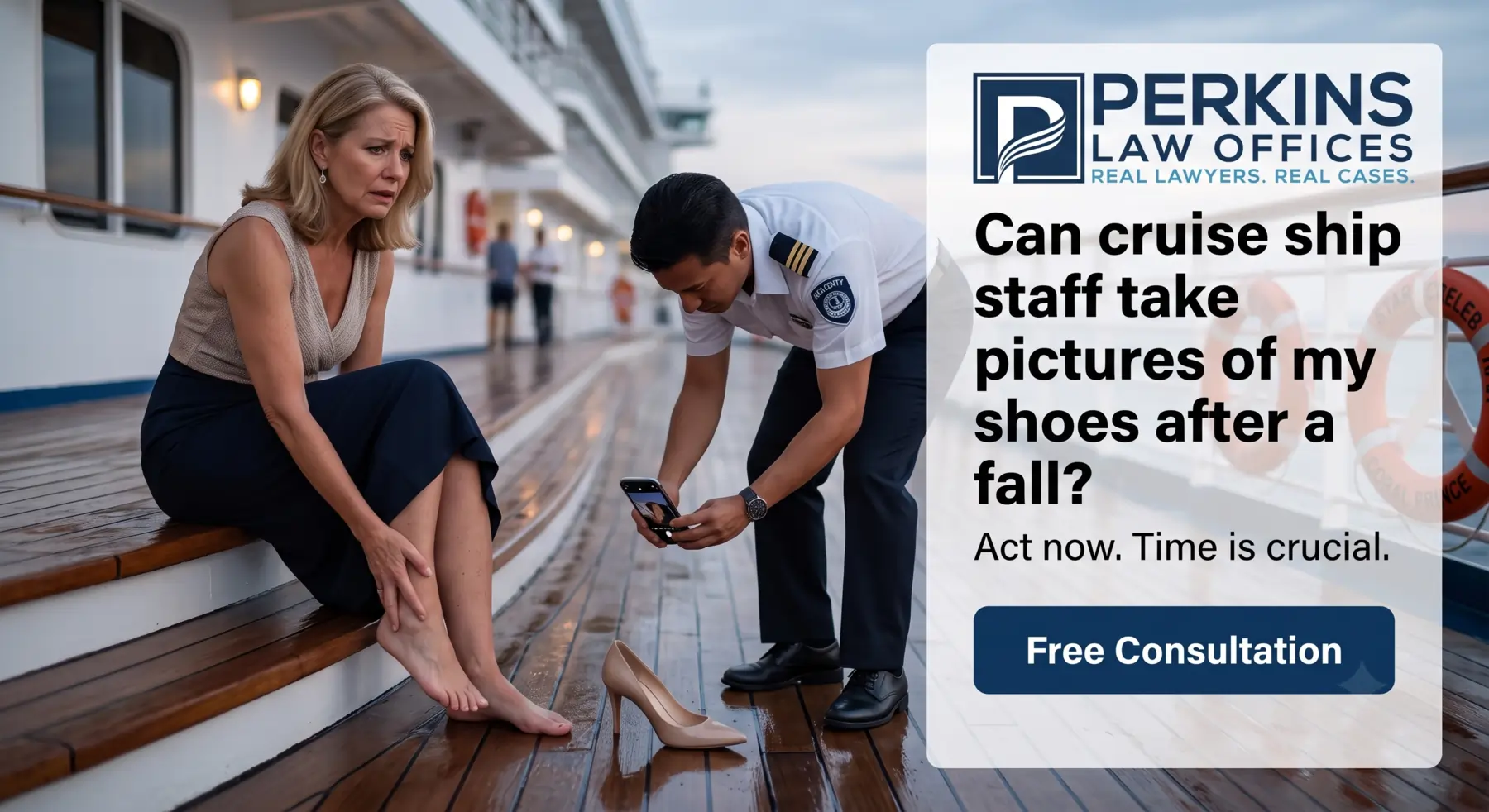
Yes, and they almost certainly will. Within minutes of a slip and fall being reported, ship security arrives with a phone or body camera and photographs the deck, the surrounding area, and your footwear before you have had time to process what happened, let alone speak with a lawyer. Passengers frequently assume this is standard accident documentation performed for their benefit. It is not. Cruise line security protocols exist to build an evidentiary record the carrier’s defense team will use later, and footwear is one of the first things photographed because it is the foundation of the cruise line’s primary defense: comparative negligence.
This page explains why cruise ship staff photograph passenger footwear after a fall, what that documentation means for a slip and fall claim, and what an injured passenger should do to protect a case that may be worth pursuing against a major cruise line.
Why Ship Security Photographs Your Shoes
Under federal maritime law, a cruise line is held to a duty of reasonable care toward its passengers as a common carrier. To prevail on a slip and fall claim, a passenger must establish duty, breach, causation, and damages, and must also show the cruise line had actual or constructive notice of the hazardous condition that caused the fall. This notice requirement was established in Keefe v. Bahama Cruise Line, Inc., 867 F.2d 1318 (11th Cir. 1989), and has been reaffirmed by the Eleventh Circuit in Sorrels v. NCL (Bahamas) Ltd., 796 F.3d 1275 (11th Cir. 2015), and Chaparro v. Carnival Corp., 693 F.3d 1333 (11th Cir. 2012). The underlying obligation of a shipowner to its passengers traces back to Kermarec v. Compagnie Generale Transatlantique, 358 U.S. 625 (1959).
Cruise lines understand this legal standard better than most passengers ever will, and they build their claims-handling procedures around defeating it. We cannot stress that enough. The cruise line and their lawyers handle hundreds of claims a year and are very in tune to all of the different court decisions down to the judge who issued the orders.They will count on any technicality or very narrow or specific fact based decision that went favorably for the cruise line and will use it against their passengers in litigation strategically.
In a slip and fall, if the cruise carrier cannot dispute that dangerous accumulation of water on a pool deck was present, or anti-skid strip or tape was missing on a gangway, one of the first line defenses is to argue that the passenger’s own footwear, whether flip-flops, sandals, wedges, or worn-tread shoes, caused or contributed to the fall. If you didn’t know, Flip-flops are extremely dangerous and you are irresponsible for wearing them on your Caribbean cruise. At least that’s what the cruise line thinks, even though they sell them in the gift shop. A photograph of your shoes taken within minutes of the incident, before you have retained counsel and before that footwear can be examined by an expert on your behalf, becomes a ready-made exhibit for that argument.
What This Means for Your Slip and Fall Claim
Comparative negligence does not automatically defeat a claim, but it can reduce the compensation a passenger recovers, and in some jurisdictions applying maritime comparative fault principles, it can substantially diminish an otherwise strong case if left unanswered. A photograph of your footwear, standing alone and without context, tells a jury nothing about how long the hazardous condition existed, whether warning signage was present, or what the deck surface itself was designed to do under wet conditions. The cruise line’s photograph is one piece of evidence. It is not the whole record, and it should never be treated as the final word on liability. However, The cruise line will hire an expert to say that the tread at the bottom of your shoe was worn out making it ultra slippery, or that the plastic or rubber thong connection was was deteriorated and broke because the flip-flops were old.
This is precisely why an injured passenger needs independent documentation and, ultimately, independent legal representation. They fight these cases hard.
Protecting Your Claim After Ship Security Photographs the Scene
Create Your Own Photographic Record
Do not rely on the cruise line’s documentation as the only account of the incident. I cannot tell you how many times potential clients to call my office. Tell me that they did not take pictures, but the cruise line did when I asked them for the dangerous condition that they slipped on or tripped on. Many do not seem to understand that the cruise line is not going to cooperate unless until a judge forces them to once a lawsuit is filed. A personal injury lawyer who handles cruise cases has no ability to get any photographs from the cruise line that they do not want to give us with out the power of discovery or subpoena. And trust me, they do not want to help us make our case by voluntarily handing over photographs that implicate liability against them. Once in a while, it cruise line will provide us the photographs or screenshots of CCTV footage, but mostly to show us that our version of events is not as the client described, hoping we will stand down. But even then they, like to wait until we file suit and spring it on us. Otherwise, a cruise injury lawyer like Alex Perkins does not have discovery or subpoena power until a lawsuit is filed, which is putting the cart before the horse because if we don’t have documentation of the dangerous condition, photographically is very difficult to evaluate the liability against a cruise line and whether the condition is one that we can sue for. When we get a call from a client still on the ship we instruct to photograph the deck or floor surface, any wet floor signage present or conspicuously absent, the surrounding area, and their own footwear from multiple angles. We also ask for continuing photographs your injuries as they progress through treatment and recovery.
Preserve the Footwear Itself
Do not discard the shoes or sandals you were wearing at the time of the fall. Cruise line defense counsel routinely requests production of the actual footwear for inspection, and your attorney will need it intact, in its post-incident condition, to counter any argument about tread wear or improper fit.
Request a Copy of the Incident Report
You are entitled to ask for a copy of the written statement taken from you and the official incident report generated by ship security. Cruise lines are not always forthcoming with this documentation voluntarily, but a written request creates a record that you asked.
Avoid Statements That Suggest Self-Blame
Ship security and medical staff are often trained to ask questions designed to elicit comments about your footwear, your attentiveness, or whether you were looking at your phone. These responses are recorded and can later be used to support a comparative negligence defense. Stick to the objective facts of what happened and avoid speculating about fault.
Demand Preservation of CCTV Footage
Surveillance footage from the area of the fall is frequently the most important evidence in the entire case, because it can show how long the hazardous condition existed before you fell, a fact central to proving the cruise line had constructive notice. Most cruise ships retain CCTV footage for only a matter of weeks before it is overwritten. A formal written demand to preserve this footage, sent promptly and ideally by an attorney, is essential.
When the Cruise Line’s Own Evidence Disappears: Spoliation
Cruise lines do not always turn over the photographs, footage, or reports they generate. When a carrier had an obligation to preserve evidence relevant to a known or reasonably anticipated claim and that evidence is destroyed, altered, or never produced, a passenger’s attorney can move for spoliation sanctions. To prevail on such a motion, the passenger must generally establish that the cruise line had a duty to preserve the evidence at the time it was lost or destroyed, that the loss occurred with a culpable state of mind, and that the evidence was relevant to the claim. Federal courts in the Southern District of Florida have addressed this issue in cruise ship litigation on multiple occasions, and the outcome depends heavily on the specific facts of how and why the evidence went missing. This is one more reason an early, well-documented preservation demand from an experienced maritime attorney matters, because it forecloses the cruise line’s ability to later claim the footage was lost through routine, good-faith practice.
National Representation Against Every Major Cruise Line
Perkins Law Offices represents injured passengers across the entire United States, not only Florida residents, because nearly every major cruise line’s ticket contract routes personal injury litigation to a specific federal court regardless of where the passenger lives or boarded. Attorney Alex Perkins has litigated cruise ship slip and fall claims for more than 25 years against:
- Carnival Cruise Line — Southern District of Florida (Miami)
- Royal Caribbean International — Southern District of Florida (Miami)
- Norwegian Cruise Line — Southern District of Florida (Miami)
- Celebrity Cruises and Princess Cruises — Southern District of Florida (Miami)
- MSC Cruises — Southern District of Florida for U.S. departures; non-U.S. itineraries may require analysis of a foreign forum clause
- Disney Cruise Line — Middle District of Florida
- Holland America Line — Western District of Washington (Seattle)
Because the forum and applicable law vary by cruise line, confirming the correct venue from your specific ticket contract is one of the first things that must happen after a fall, and it is a step that is easy for an unrepresented passenger, or a lawyer unfamiliar with cruise ship litigation, to get wrong.
Frequently Asked Questions
Can cruise ship staff take pictures of my shoes after a fall?
Yes. Ship security routinely photographs a passenger’s footwear immediately after a slip and fall, and cruise line ticket contracts give the vessel broad authority to document an incident aboard the ship. The purpose is not to help your claim. It is to build a record the cruise line’s defense team can later use to argue your shoes, not the deck, caused the fall.
Do I have to let ship security photograph my footwear?
In most cases you cannot practically prevent it once you have reported the fall and security has responded, and outright refusal can itself be mischaracterized in the incident report. The better approach is to allow the documentation while separately creating your own photographic record of the same footwear, the deck condition, and any warning signage present or absent.
Why does the cruise line care so much about what shoes I was wearing?
Comparative negligence is the cruise line’s primary defense in nearly every slip and fall claim. If the carrier persuades a judge or jury that inappropriate footwear contributed to the fall, any damages award can be reduced or eliminated even where the deck condition itself was hazardous.
What should I do if I think the cruise line altered or lost the footwear photos?
This raises a potential spoliation issue. A cruise line with a duty to preserve evidence relevant to a known or reasonably anticipated claim that destroys or fails to produce it can face sanctions if a court finds the destruction was done with a culpable state of mind and the evidence was material to the claim. A maritime attorney can send a formal preservation demand and pursue sanctions where warranted.
Do I need a lawyer to sue a cruise line after a slip and fall?
Cruise ship injury claims are governed by federal maritime law, not the personal injury law of your home state, and carry strict six-month notice deadlines and one-year filing deadlines set out in the ticket contract. An attorney admitted to practice in the federal district specified in your ticket is necessary to preserve evidence, meet these deadlines, and counter the cruise line’s comparative negligence defense.
How long do I have to file a claim after a cruise ship slip and fall?
Most cruise ticket contracts require written notice to the cruise line within six months of the incident and require any lawsuit to be filed within one year. These deadlines are strictly enforced and missing either one can permanently bar an otherwise valid claim.
Can I still bring a claim if I already let security photograph my shoes and made a statement?
Yes. Most injured passengers speak with ship security or medical staff before they understand how that information will be used. A prior statement or photograph does not end a claim; it means your attorney must account for it while building the rest of the evidentiary record, including CCTV footage, maintenance logs, and prior incident reports, to establish the cruise line’s notice of the hazard.
Speak With a Maritime Attorney Before You Say More Than You Have To
If a cruise line’s security team has already photographed your shoes and taken your statement, the record against you may already be forming. Perkins Law Offices represents injured passengers nationwide, on a contingency fee basis, in claims against Carnival, Royal Caribbean, Norwegian, Celebrity, Princess, MSC, Disney, and Holland America. Alex Perkins has litigated maritime personal injury cases in federal court for more than 25 years and is licensed in Florida, Illinois, and Washington, D.C. Call our office directly to discuss what the cruise line has already documented and what needs to happen next to protect your claim.
Perkins Law Offices
Miami Office: 1728 Coral Way, Suite 702, Miami, FL 33145 — (305) 741-5297
Boca Raton Office: 6560 W. Rogers Circle, Suite 15, Boca Raton, FL 33487 — (561) 621-1776
Email: perkins@perkinslawoffices.com
Licensed to practice law in Florida, Illinois, and Washington, D.C. Free consultation. No fee unless we win.
The information on this page is for general informational purposes only and does not constitute legal advice for any individual case or situation. Viewing this page does not create an attorney-client relationship.