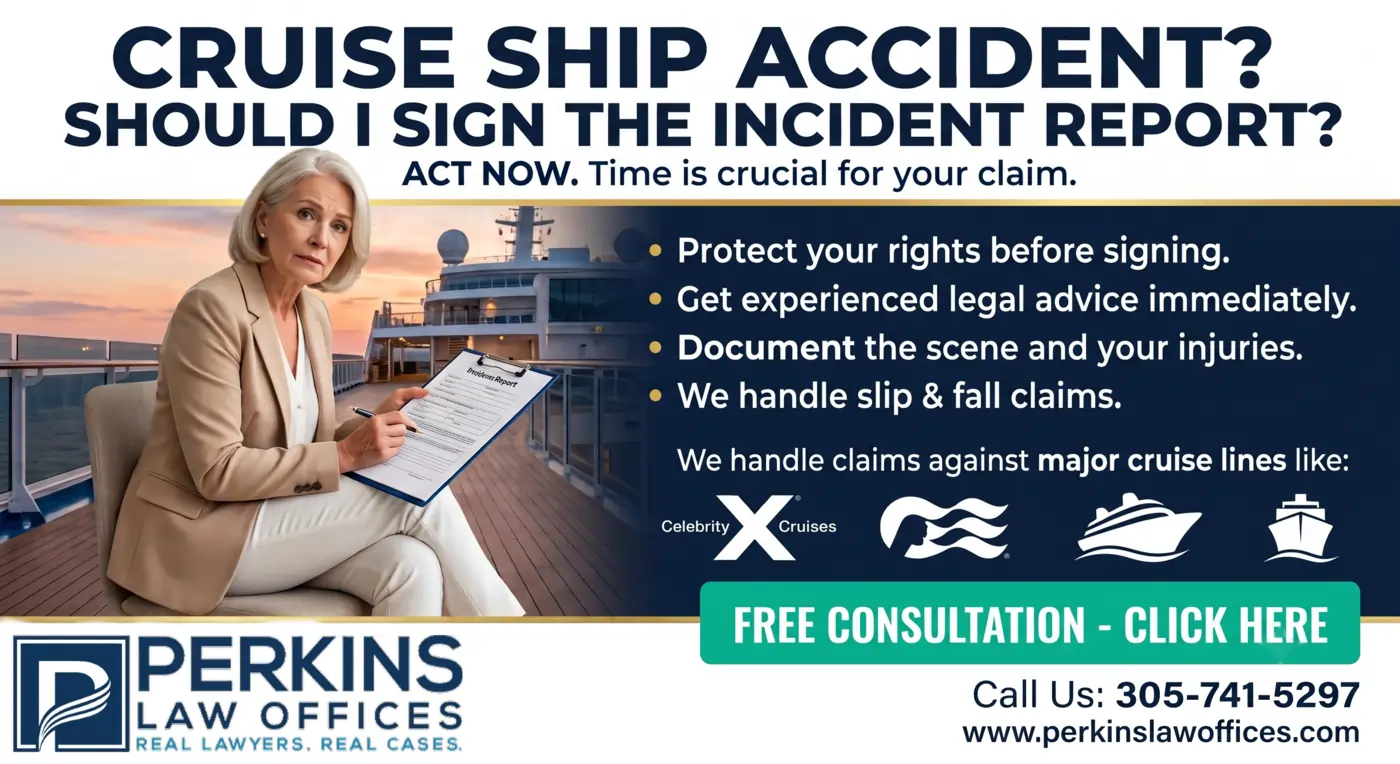
 Should I Sign a Cruise Ship Incident Report? What Injured Passengers Nationwide Need to Know Before Putting Pen to Paper
Every day, cruise lines hand injured passengers a form and ask for a signature before that passenger has spoken to a single attorney. The question is not whether you should report an injury. You should. The question is whether you should sign the cruise line’s written version of what happened, on the cruise line’s timeline, without legal advice. As a maritime trial lawyer who has litigated against Carnival, Royal Caribbean, Norwegian, Celebrity, Princess, MSC, Disney, and Holland America, my answer is direct: report the incident, but do not sign anything beyond a basic acknowledgment that an accident occurred until your claim has been reviewed by counsel.

Alexander Perkins Are You Signing Away Rights
Reporting an Incident and Signing a Statement Are Two Different Acts
Passengers often conflate two separate obligations. The first is reporting the accident to ship security or guest services so that an official record exists. This is necessary, and I recommend doing it before you leave the scene if you are physically able. The second act is signing a detailed written statement, incident report narrative, or release drafted by the cruise line. That second act is not required by law, and it carries risk that most passengers do not appreciate in the moments after a fall, an assault, or a medical event.
The distinction matters because a cruise line’s onboard security officer does not work for you. Security personnel are trained to gather facts efficiently, and their employer has a financial interest in the outcome of that fact-gathering. An incident report drafted by ship staff, and then handed to an injured, medicated, or shaken passenger for signature, is a document built primarily to protect the vessel operator, not the passenger.
Why Cruise Lines Want a Signature Fast
Speed benefits the defense. The sooner a cruise line obtains your signed account of the incident, the sooner it has a fixed narrative to compare against your later medical records, deposition testimony, and legal claim. If any detail shifts later, such as the exact location of a spill or how long a hazard had been present, the cruise line’s lawyers will highlight the discrepancy to attack your credibility, even though it is normal for memory and detail to sharpen once you are no longer in acute pain.
There is also a financial incentive tied to timing. Notice and filing deadlines in most cruise ticket contracts are considerably shorter than standard personal injury deadlines. Passengers are frequently required to give the cruise line written notice of an intended claim within roughly six months, and to file suit within one year of the incident, compared to the two to four year windows typical of ordinary land-based injury claims in most states. A cruise line that can lock in a favorable onboard statement early, before you understand these deadlines, gains leverage it would not otherwise have.
What a Premature Signature Can Cost You
Comparative Fault Language
Florida and most states that apply general maritime law recognize comparative negligence, meaning your recovery can be reduced by the percentage of fault attributed to you. An incident report that includes a line suggesting you were not watching your step, had consumed alcohol, or ignored a posted warning sign can be used to argue for a reduced settlement or verdict, regardless of the cruise line’s own failure to maintain a safe walkway, clean a spill promptly, or post adequate warnings.
Waivers Disguised as Goodwill
Some cruise lines offer a partial refund, onboard credit, or a discount toward a future voyage in the same conversation where they present a report or release for signature. Accepting that benefit alongside a signature can, in some circumstances, be argued as a waiver of further claims. Federal law does prohibit cruise lines from contractually disclaiming liability for their own negligence causing injury or death, but a poorly worded release signed in the moment can still create confusion and delay that works against an injured passenger during negotiation.
Locked-In Details That Do Not Match Your Injuries
Adrenaline and shock routinely mask the severity of an injury in the first hours after an accident. A passenger who signs a report describing a “minor bump” may later be diagnosed with a fractured hip, torn labrum, or traumatic brain injury. Defense counsel will highlight that gap between the signed report and the eventual diagnosis to argue the injury did not happen the way, or with the severity, the passenger later claims.
What You Should Do Instead, Step by Step
1. Get Medical Attention First
Go to the ship’s medical center immediately. Request a copy of the medical report before you leave the ship if at all possible, since cruise lines have been known to delay or limit access to these records later.
2. Report the Incident Without Volunteering Fault
Tell security what happened factually: where you were, what you saw, and what occurred. Do not speculate about why the hazard existed or offer an opinion on whether you could have avoided it. Ask for a copy of whatever you sign, even if the crew member tells you a copy is not available.
3. Document Everything Yourself
Photograph the hazard, the surrounding area, any warning signs present or absent, and your injuries. Photograph again as your injuries change over the following days. If security places a new “wet floor” sign after your fall, photograph that too, along with the absence of any sign beforehand if you can capture it.
4. Preserve Witnesses
Collect names, cabin numbers if offered, and contact information from anyone who saw the incident. Witnesses scatter to different countries once the cruise ends, and a name jotted on a napkin can be the difference between a provable case and a disputed one.
5. Call a Maritime Lawyer While You Are Still Aboard
Most ships have wifi. A short phone or email consultation before you sign anything costs nothing and can change how the rest of your interaction with ship staff unfolds. If you are asking yourself whether you should sign a form the crew has placed in front of you, that hesitation is itself a signal to pick up the phone first.
6. Send Formal Written Notice Within the Contractual Deadline
An onboard incident report is not a substitute for the formal notice of claim your ticket contract requires. That notice must typically be sent in writing to the cruise line’s claims or legal department within a matter of months, and a qualified maritime attorney should prepare it to make certain it satisfies the specific contractual language of your cruise line.
National Reach: We Handle Claims Against Every Major Cruise Line
Because nearly every major cruise line requires litigation in federal court in Miami, Los Angeles, or Seattle regardless of where the passenger boarded or resides, an experienced cruise litigation firm can represent injured passengers from anywhere in the country. Our practice is built around that reality, with dedicated case strategies for each carrier’s ticket contract, forum selection clause, and claims-handling pattern, including:
- Carnival Cruise Line incident report and claims review
- Royal Caribbean International incident report and claims review
- Norwegian Cruise Line incident report and claims review
- Celebrity Cruises incident report and claims review
- Princess Cruises incident report and claims review
- MSC Cruises incident report and claims review
- Disney Cruise Line incident report and claims review
- Holland America Line incident report and claims review
Each cruise line drafts its own incident report forms and handles onboard documentation differently. A passenger injured on a Holland America vessel, for example, faces a mandatory venue in the Western District of Washington in Seattle, while a Disney Cruise Line claim routes to the Middle District of Florida in Orlando. Knowing which contract language and which federal court applies before you sign anything is part of what separates a firm that only handles cruise cases occasionally from one that lives in this area of law every day.
Addressing the Other Side of the Argument
Cruise lines and their counsel will point out, correctly, that some form of incident documentation protects everyone, including the passenger, by creating a contemporaneous record instead of relying on memory alone months later. That is a fair point, and it is exactly why reporting the accident is still the right first move. The distinction this article draws is narrower: creating a record is appropriate, while signing the cruise line’s characterization of fault, severity, or circumstances, without the benefit of legal advice, is a separate and avoidable risk.
Frequently Asked Questions
Should I sign a cruise ship incident report before speaking to a lawyer?
No. Report the accident so a record exists, but avoid signing a detailed statement, release, or settlement offer until an attorney has reviewed it.
What happens if I refuse to sign the incident report?
The incident will still be documented by ship security. You are simply declining to put your own signature on the cruise line’s narrative before you understand your rights.
Is an onboard incident report the same as the written notice my ticket contract requires?
No. Most ticket contracts require a separate formal notice of claim sent to the cruise line’s claims department within roughly six months, which an incident report alone does not satisfy.
How long do I have to file a lawsuit against a cruise line?
Typically one year from the date of the incident, following written notice within about six months, both considerably shorter than standard state personal injury deadlines.
Can statements in an incident report be used against me later?
Yes. Language suggesting you were partly at fault can be used to reduce or challenge your compensation later in the claim.
Do I need a lawyer while I am still on the ship?
You can contact a maritime attorney by phone or email from the ship itself, and doing so before you sign anything is often the most valuable call you will make during the entire claim.
Speak With a Maritime Lawyer Before You Sign Anything
If you were injured on a cruise and are being asked to sign paperwork, call Perkins Law Offices at (305) 741-5297 before you put your name on anything. Consultations are free and we represent injured passengers nationwide on a contingency fee basis, meaning there is no cost to you unless we recover compensation on your behalf.