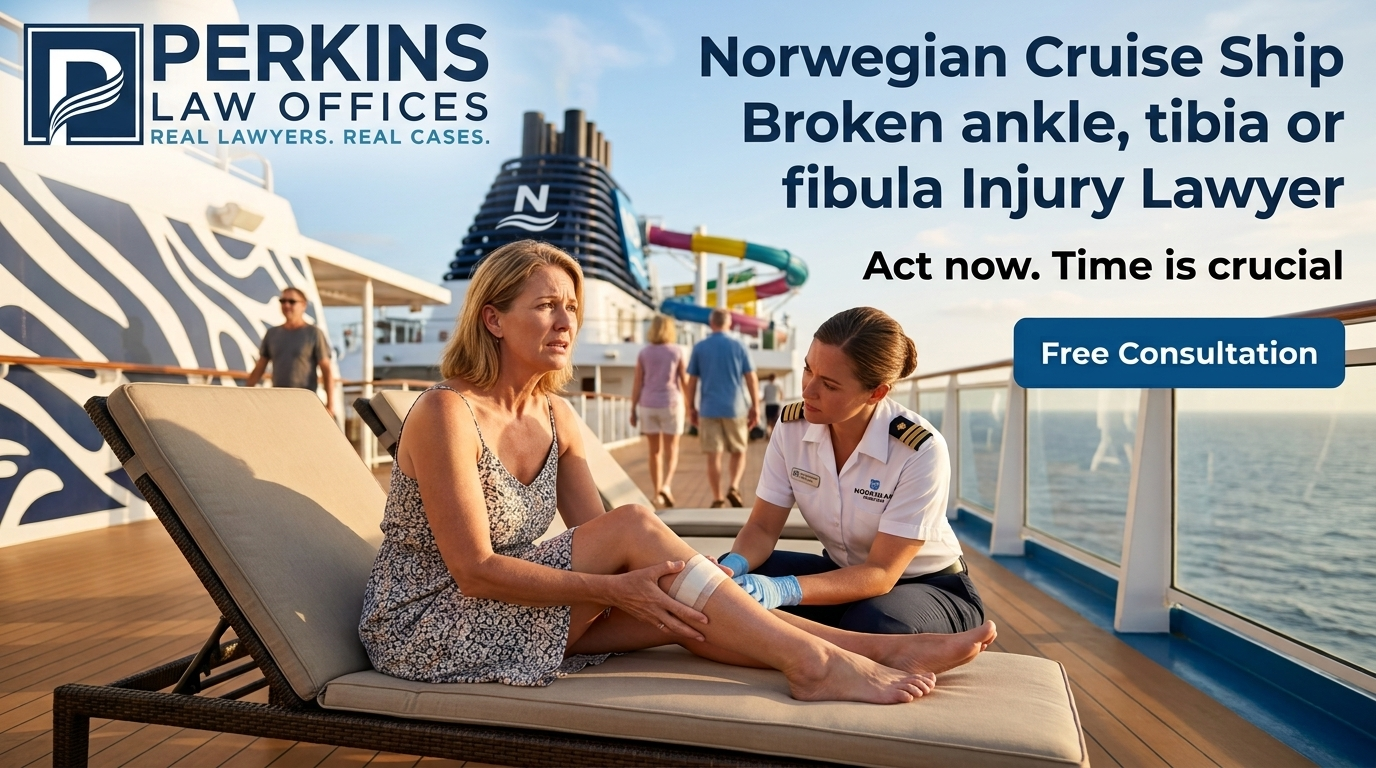
 Norwegian Cruise Ship Broken Ankle, Tibia or Fibula Injury Lawyer
By Alex Perkins, Perkins Law Offices
A fractured ankle, tibia or fibula does not happen because a passenger was clumsy. It happens because a ninety-thousand-ton vessel operated by Norwegian Cruise Line put a foot in a position it was never designed to withstand: on a wet teak deck with no traction, over a raised threshold hidden in shadow, down a companionway stair with a tread that was never replaced after years of salt-air corrosion. I have represented passengers with trimalleolar fractures who needed three surgeries to walk again, and I have represented passengers with a single hairline fibula fracture who lost a summer of work. Every one of those cases turned on the same question: could Norwegian Cruise Line, exercising ordinary reasonable care, have prevented the hazard that broke that bone. If the answer is yes, the cruise line is liable, and it owes compensation.
This page explains how ankle, tibia and fibula fractures happen aboard Norwegian ships, the medicine behind these injuries, the maritime law that controls your claim, and the deadlines that will destroy your case if missed. If you were injured on the Norwegian Aqua, Prima, Viva, Encore, Bliss, Escape, Getaway, Breakaway, Epic, Gem, Jade, Pearl, Dawn, Star, Sun or Sky, call our office before you speak with Norwegian’s claims department.
Why Lower-Leg Fractures Are Different on a Cruise Ship
An ankle, tibia or fibula fracture on land is bad enough. At sea, it is compounded by distance from a trauma center, a shipboard medical facility that is not equipped to perform orthopedic surgery, and a defendant that controls the evidence. The ship’s infirmary can splint the leg and administer pain control, but it cannot perform an open reduction internal fixation (ORIF), cannot run an MRI in most cases, and cannot manage a compartment syndrome emergency the way a Level I trauma center can. That gap in care is precisely why early disembarkation and medical transfer decisions matter so much in these cases, and why we scrutinize the ship’s medical log line by line.
How These Fractures Typically Occur Aboard Norwegian Ships
- Pool deck and Vibe Beach Club transitions — sudden elevation changes between teak decking and tile around the pool, often slick with sunscreen and splashed water, are a frequent source of ankle inversion injuries.
- Cabin and balcony thresholds — the raised metal threshold at balcony doors on Breakaway and Escape-class ships is a documented tripping hazard, particularly at night when cabin lighting is dim.
- The Waterfront and outdoor promenade decks — uneven teak seams, warped boards, and drainage grates that sit proud of the deck surface can catch a shoe and twist the ankle violently.
- Stairwells between decks — worn anti-skid nosing on stair treads, particularly in high-traffic stairwells near the atrium or buffet, is a recurring theme in incident reports we have reviewed in litigation.
- Gangways and tender platforms — the transition point between ship and tender boat, or ship and floating dock, often has a gap or a step-down that is not properly bridged, especially in swell.
- The Ropes Course, Aqua Park and go-kart track (Prima and Viva classes) — recreational features marketed as thrill activities carry their own premises liability exposure when safety briefings or harnessing are inadequate.
Understanding the Medicine: What “Broken Ankle, Tibia or Fibula” Actually Means
Not all lower-leg fractures are equal, and the classification matters both medically and for valuing your claim.
Types of Ankle Fractures
An ankle fracture can involve one, two, or three of the bony prominences that stabilize the joint. A bimalleolar fracture involves two of the three malleoli and is almost always surgical. A trimalleolar fracture involves all three and typically requires open reduction with plates and screws, followed by six to twelve weeks of non-weight-bearing recovery. A pilon fracture, which involves the weight-bearing surface of the tibia where it meets the ankle joint, is among the most severe lower-extremity injuries we handle and often results in permanent post-traumatic arthritis regardless of how well the surgery goes.
Tibia and Fibula Fractures
The tibia is the primary weight-bearing bone of the lower leg; a tibial shaft fracture from a fall down stairs or a twisting mechanism can require an intramedullary rod. A fibula fracture in isolation is sometimes treated non-surgically with a walking boot, but when it occurs alongside ligament damage or a syndesmotic (high ankle) injury, surgical fixation with a syndesmotic screw or suture button is often necessary. Combined tibia-fibula fractures — sometimes called “both-bone” fractures — carry elevated risk of compartment syndrome, a surgical emergency that must be caught quickly to avoid permanent nerve and muscle damage.
Open Versus Closed Fractures
A closed fracture stays under the skin. An open (compound) fracture breaks through the skin and carries a materially higher risk of infection, particularly relevant aboard a ship where the wound may be exposed to pool water, seawater, or an unsanitary deck surface before it can be properly irrigated and debrided. Open fractures are also documented more aggressively in medical records because of the infection-control protocol required, which can actually help build your case if the shipboard medical team followed procedure.
Norwegian Cruise Line’s Duty of Care to Passengers
Norwegian Cruise Line, as a common carrier operating from U.S. ports, owes its passengers a duty of reasonable care under the circumstances. This is the standard set out by the U.S. Supreme Court in Kermarec v. Compagnie Generale Transatlantique and refined by the Eleventh Circuit, which governs the Southern District of Florida where most Norwegian passenger litigation is filed. Under Keefe v. Bahama Cruise Line, the cruise line does not automatically become an insurer of passenger safety, but it must act as a reasonably prudent operator would under similar conditions.
Critically, in a premises-based fracture case — a defective deck, a hazardous threshold, a worn stair tread — you generally must prove that Norwegian had actual or constructive notice of the dangerous condition, consistent with Sorrels v. NCL (Bahamas) Ltd. and Guevara v. NCL (Bahamas) Ltd. Constructive notice can be established through evidence such as prior similar incident reports, maintenance logs showing the condition existed for a period of time before your fall, or the sheer nature of the hazard (for example, a recurring drainage problem that repeatedly created a slip zone). This is why our firm moves quickly to send preservation letters demanding maintenance records, prior incident reports for the same location on the same vessel, and CCTV footage before Norwegian’s routine document retention cycle can erase it.
Building the Notice Case for a Fracture Claim
Because notice is often the fulcrum on which these cases turn, we focus discovery on:
- Prior guest complaints or incident reports involving the same deck, stairwell, or threshold on the same vessel
- Deck maintenance and inspection logs for the thirty, sixty and ninety days preceding your fall
- Photographs and video, including your own post-incident photos and any ship CCTV that Norwegian’s security department reviewed
- Weather and sea-state logs, since a fall attributed to “rough seas” is a common defense that often does not hold up against the actual logged conditions
- Footwear worn at the time of the fall, which Norwegian’s security team will frequently photograph in an attempt to shift blame to the passenger under Florida’s comparative negligence framework
Jurisdiction and Venue for Norwegian Cruise Line Claims
Every Norwegian Cruise Line passenger ticket contains a forum selection clause. As of this writing, that clause requires suit to be filed exclusively in the United States District Court for the Southern District of Florida, in Miami. This clause has been repeatedly upheld as enforceable so long as it was reasonably communicated and not the product of fraud or overreaching. It does not matter where you live, where you purchased your ticket, or which port you boarded from — if you sail on a Norwegian vessel and suffer an ankle, tibia or fibula fracture caused by the ship’s negligence, your lawsuit almost certainly belongs in federal court in Miami, and your attorney must be admitted to practice there. This is a central reason our national fracture practice concentrates its Norwegian litigation in the Southern District of Florida regardless of where the client resides.
Deadlines That Will Destroy Your Claim
The Six-Month Notice Requirement
Norwegian’s ticket contract requires written notice of your injury claim within six months of the incident. This notice letter is not the same as the incident report you filled out on the ship. It is a separate, formal document that must be sent to Norwegian’s claims or legal department describing the incident with sufficient particularity. Missing this deadline can be fatal to an otherwise strong fracture claim.
The One-Year Statute of Limitations
Suit must be filed within one year of the date of injury. Unlike Florida’s typical two-year negligence statute, maritime passenger claims compress this window by half. We have seen passengers with legitimate trimalleolar fracture claims lose the right to recover entirely because they spent the first ten months negotiating informally with a Norwegian claims adjuster who let the clock run out. If you are speaking with anyone from Norwegian about your fracture without a lawyer, assume the clock is running regardless of what you are told.
What Compensation Looks Like in a Lower-Leg Fracture Case
Recoverable damages in a Norwegian fracture claim typically include:
- Past and future medical expenses — ORIF surgery, hardware, physical therapy, and, in many trimalleolar and pilon cases, a second surgery later to remove hardware or address post-traumatic arthritis
- Lost wages and lost earning capacity — particularly significant for passengers whose occupation requires standing, walking, or manual labor, where a fused or arthritic ankle can permanently limit duty
- Pain and suffering — under Florida law, this includes mental anguish, loss of capacity for enjoyment of life, scarring and disfigurement from surgical incisions, and the inconvenience of months in a boot, cast, or non-weight-bearing status
- Loss of consortium — for a spouse, in appropriate cases
The value of a fracture case is driven heavily by whether the injury required surgical fixation, whether hardware remains permanently in place, whether the fracture extended into the weight-bearing joint surface, and whether imaging shows early post-traumatic arthritic changes. A non-displaced fibula fracture treated in a boot is valued very differently than a trimalleolar or pilon fracture requiring ORIF and a second hardware-removal procedure.
Frequently Asked Questions
I broke my ankle on a Norwegian cruise ship. Do I actually have a case, or was it just an accident?
Not every fall is compensable. The question is whether Norwegian created or knew about the hazard that caused your fracture and failed to fix it or warn you. A fall on a dry, level, well-lit deck with no history of prior incidents is a hard case. A fall on a deck with a known drainage problem, a stairwell with worn anti-skid tape, or a threshold that has caused prior falls is a strong case. We evaluate this for free before you commit to anything.
How much does it cost to hire a cruise ship fracture lawyer?
Perkins Law Offices handles Norwegian fracture claims on contingency. You pay nothing out of pocket, and we are only paid a percentage of what we recover for you. If there is no recovery, you owe no attorney’s fee.
Can I still sue if I signed the incident report on the ship?
Generally yes, but what you wrote in that report matters. Passengers are frequently pressured by ship security to write statements that minimize the hazard or that suggest they were partly at fault. That report will be used against you if it contains admissions. Do not sign anything further, and speak with a maritime lawyer before you provide any additional statements to Norwegian.
What if I needed surgery after I got home instead of on the ship?
This is common. The ship’s medical center will splint and stabilize a fracture, but ORIF surgery is almost always performed after disembarkation at a hospital near your home or, if the injury is severe enough, after an emergency medical transfer to the nearest capable port. The surgical records from your home hospital become central evidence in valuing your claim.
Do I have to sue in Miami even though I don’t live in Florida?
In almost every case, yes. Norwegian’s ticket contract designates the Southern District of Florida as the exclusive venue for passenger injury claims, and that clause has repeatedly been enforced by federal courts. Our firm is admitted to practice there and represents passengers nationwide in this forum.
How long will my fracture case take to resolve?
It depends on the severity of the injury and whether your treatment has reached maximum medical improvement, along with the complexity of the liability dispute. Straightforward fibula fracture claims can sometimes resolve within a year. Trimalleolar or pilon fracture cases involving disputed notice or long-term arthritic sequelae can take longer, particularly if litigation and expert discovery are required.
Cruise Lines We Handle Fracture Claims Against
While this page focuses on Norwegian Cruise Line, Perkins Law Offices represents passengers with ankle, tibia and fibula fracture claims against every major cruise operator sailing from U.S. ports, including:
- Norwegian Cruise Line
- Carnival Cruise Line
- Royal Caribbean International
- Celebrity Cruises
- Princess Cruises
- MSC Cruises
- Holland America Line
- Disney Cruise Line
Each cruise line has its own ticket contract, its own forum selection clause, and its own claims-handling patterns. Holland America requires suit in the Western District of Washington. Disney requires suit in the Middle District of Florida. MSC’s ticket contract contains a bifurcated clause that can route claims arising from non-U.S.-port voyages to courts in Italy. Knowing which forum applies before you file is not optional — filing in the wrong court can result in dismissal and, if the one-year deadline has passed by the time the error is caught, a permanent loss of your claim.
Speak With a Norwegian Cruise Ship Fracture Attorney Today
If you or a family member suffered a broken ankle, tibia or fibula aboard a Norwegian Cruise Line vessel, do not wait to find out whether Norwegian’s six-month notice deadline applies to you. Consultations are free, and Perkins Law Offices charges no fee unless we recover compensation for you. Call (305) 741-5297, or contact our Miami or Boca Raton office to speak confidentially about your case.