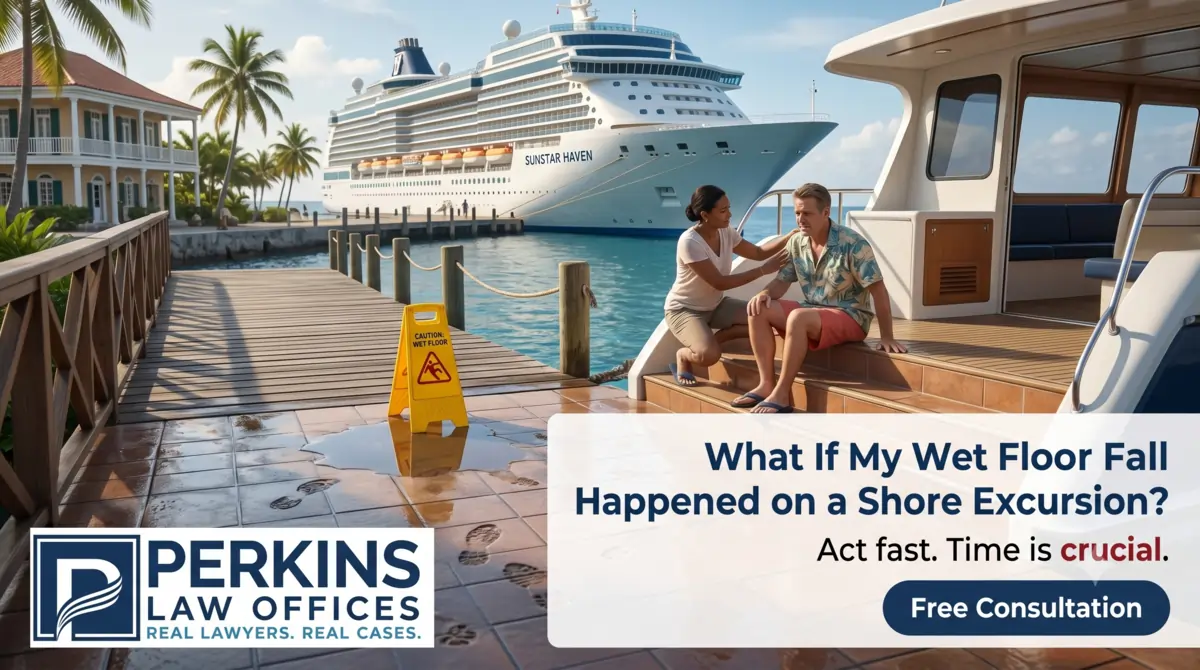
What If My Wet Floor Fall Happened on the way to a Shore Excursion?
A slip and fall on a wet floor ranks among the most frequently reported injuries on cruise vacations — and when the fall happens during a shore excursion or a transfer to a shore excursion, determining who bears legal responsibility becomes far more complex than a typical shipboard accident. The bottom line is that if you slipped on a wet floor at a hotel or restaurant that does not belong to the cruise line, there is no liability against the cruise line, even if they recommended the restaurant or hotel or other location. However, if the stop was at a private island of the cruise line, or you took an excursion on a ferry, tender or other type of boat where you slipped and fell on the way to the excursion due to a dangerous condition, then we can tie the cruise line in and have a claim for negligence against the cruise line. This is because transferring passengers from ship to shore is a uniquely maritime activity and under federal law.
Also nowadays, many of the cruise lines own, or at least control, their own private islands and beach clubs. If an injury happens at the private island or beach club, legally, we can hold the cruise line responsible. Interestingly, injuries that occur on private islands of the cruise line are handled typically by an outside insurance company like AIG or Chubb, rather than the cruise lines, in-house adjusters and lawyers
The cruise line is responsible to get passengers from ship to shore safely. Therefore, if you were injured after slipping on a wet floor during a shore excursion, for example aboard a tour boat, a catamaran, a water taxi, a tender, or at a cruise line private island, like inside a beach club run by the cruise line, a pool deck, a picnic area, a tiki hut, at an attraction run by the cruise it is a no moment that it occurred in a foreign country or an international waters. So if you were injured ima cruise and asking, Who can I hold responsible for my injury, even though it happened in another country off the ship, look no further than the well respected firm of Perkins Personal Injury Lawyers aka Perkins Law Offices in Miami and it’s owner experienced maritime attorney Alex Perkins, to hold the cruise line accountable.
Why Shore Excursion Accidents Raise Unique Liability Questions
When an injury occurs on the ship itself, the cruise line’s responsibility is usually the starting point of any investigation. A shore excursion changes that equation. The moment you step off the vessel and onto a tour boat, into a van, or through the doors of a beach club or attraction, at least one additional party — and often several — enters the picture. The cruise line will most certainly try to blame the third-party whether it’s their own contractor or vendor that they have a contract with or recommended. Even if you bought the excursion or transfer through the cruise line, they will initially claim to absolve themselves of liability, after all, they have all these pre-reactivity waivers in their terms and conditions of their ticket contract. But there are still ways to hold the cruise line accountable under federal law if your cruise touched a US port. despite ticket contract language to the contrary, there are certain terms and conditions that are not enforceable under the federal code, most importantly general waivers in a ticket contract for activities that occur on a ship or on the way to an excursion.
A cruise passenger injury on route to an excursion may involve the cruise line, the local tour operator, the property owner where the excursion took place, and sometimes a transportation company that moved you between locations. Each of these parties owes passengers a different scope of responsibility, and identifying which one failed in its duty is the first step toward holding the right party accountable. But the jurisdictional issue remains because many of these instances happen in foreign countries or international or foreign waters. Therefore, you need to be able to legally tie in the cruise line, to have a viable claim for injury. Fortunately, when a cruise touches a US port, United States General Maritime law applies to the cruise voyage. Also, the cruise line ticket contract allows for suit to be brought against most cruise lines in the state of Florida, which is their chosen venue.
The Cruise Line’s Role — and Its Limits
Cruise lines almost universally include language in their ticket contracts stating that shore excursions are operated by independent third parties, not by the cruise line itself. On its face, this language is designed to eliminate cruise line shore excursion liability altogether.
That disclaimer, however, is not the end of the analysis. Courts have repeatedly recognized that a cruise line can still be liable when it markets, sells, and brands an excursion through its own systems in a way that leads a reasonable passenger to believe the operator is part of the cruise line’s own team — a legal concept known as apparent agency. A cruise line can also face liability if it knew, or should have known, that a particular excursion operator had a history of unsafe conditions and continued to recommend that operator to passengers anyway. These are hard cases and must be analyze very closely on a fact, by fact, case by case basis.
The Excursion Operator’s Direct Duty of Care
Separate from any claim against the cruise line, the business that actually operated the excursion — the catamaran company, the beach club, the zip-line attraction, the museum, or the tour bus operator — owes its own independent duty of care to every visitor on its premises.
This duty includes keeping walkways, decks, restrooms, and common areas reasonably free of hazards such as standing water, recently mopped floors left without warning signage, or slick surfaces near pools and showers. However, in order to have jurisdiction in the United States, the cruise line must be involved and have a connection and bear some liability or agency.when a cruise line is not directly liable, there are circumstances where we can say it is vicarious liable under theories of agency and or employment relationships.
Proving Negligence After a Wet Floor Fall on a Shore Excursion
A shore excursion negligence claim is built on the same four elements that form the foundation of any premises liability case: duty, breach, causation, and damages. Each element must be established before a claim can move forward.
Duty of Care
Every business, including the cruise line, that invites paying customers onto its property — including private islands — owes those visitors a duty to maintain reasonably safe conditions. This includes a duty to inspect for hazards such as wet or slippery surfaces, to clean up spills within a reasonable time, and to warn visitors of any hazard that cannot be corrected immediately.
Breach of Duty
A breach occurs when that duty is not met. In a wet floor shore excursion accident, common breaches include a recently mopped or hosed-down floor with no warning sign or cone placed nearby, a pool deck or boat deck that collects standing water without adequate drainage or non-slip matting, a restroom floor left wet from a leaking fixture without prompt attention, and walkways near showers or rinse stations that become slick with no barrier or signage. Tripping Falls occur from failure to maintain equipment, flooring, level services, and walkways.
Causation
Causation connects the breach directly to your injury. This means showing that the wet or hazardous surface — not an unrelated factor — caused you to slip, fall, and sustain injury. Photographs of the surface taken shortly after the fall, witness statements, incident reports filed with the excursion operator or the ship’s medical staff, and your own account of what happened all play a role in establishing this connection.
Damages
The final element is damages — the actual harm you suffered as a result of the fall. In a shore excursion injury compensation claim, recoverable damages typically fall into several categories: medical expenses (including emergency treatment received in a foreign port, follow-up care after returning home, and physical therapy), lost income if the injury prevented you from working, pain and suffering, and, in cases involving lasting impairment, the long-term impact on your daily life and ability to work.
Why Your Location Doesn’t Limit Your Legal Options
One question we hear constantly from injured passengers is whether living outside Florida — or even being injured outside the United States — affects their ability to bring a claim. For most cruise-related injuries, including a wet floor accident abroad during a shore excursion, the answer is no, and the reason comes down to a clause printed in nearly every cruise ticket contract.
Major cruise lines have their operations based in Florida ports Despite being incorporated or flagged under another country, like, Bermuda, Bahamas, Liberia, and Panama. This list includes Carnival Cruise Lines, Royal Caribbean, Norwegian Cruise Lines, MSC, Virgin, Princess, Oceana, Rengent Seven Seas, Disney and others — include a forum-selection clause in their passenger ticket contracts. This clause requires that any lawsuit against the cruise line be filed in federal court in the Southern District of Florida, regardless of where the passenger lives or where the injury occurred. The U.S. Supreme Court upheld the enforceability of these clauses in Carnival Cruise Lines, Inc. v. Shute, a decision that continues to shape where a cruise excursion injury lawsuit can be filed decades later.
In practical terms, this means a passenger from California, Texas, New York, or anywhere else in the country who is injured during a shore excursion in Mexico, the Bahamas, Alaska, or any other port of call will typically need to pursue any claim against the cruise line in a Florida federal courtroom. A maritime lawyer for a shore excursion injury based in Miami — where these cases are filed and litigated regularly — is positioned to serve as a shore excursion accident attorney for passengers nationwide, not only those living in Florida.
The Filing Deadline You Cannot Afford to Miss
Shore excursion injury claims operate under a timeline that catches many passengers off guard. While personal injury claims under state law often allow two to four years to file suit, claims arising from cruise travel are governed by federal maritime law and the terms printed in the passenger ticket contract — and those terms are considerably shorter.
Federal maritime law permits cruise lines to limit the time to file a lawsuit to as little as one year from the date of the injury, and most major cruise lines do exactly that. Many ticket contracts also require written notice of a claim to be submitted to the cruise line within six months of the incident — well before the one-year filing deadline even arrives.
Missing either deadline can permanently bar a claim, regardless of how clear the evidence of negligence may be. Because these deadlines begin running from the date of the accident — not from the date you return home or finish medical treatment — early evaluation of a potential shore excursion injury claim is one of the most important steps an injured passenger can take.
Protecting Your Claim: What to Do After a Wet Floor Fall on a Shore Excursion
The steps taken in the hours and days following a fall can significantly affect a shore excursion injury claim. While medical care should always come first, the following actions help preserve the evidence needed to support a claim.
Seek medical attention immediately, even if the injury seems minor. Many soft-tissue injuries, fractures, and head injuries are not immediately apparent, and a documented medical record close to the time of the fall is important evidence.
Report the fall in writing. Notify the excursion operator’s staff and, once back aboard, the ship’s guest services or medical center, and request a written copy of any incident report.
Photograph the scene before conditions change. Images of the wet floor, the absence of warning signs or mats, lighting conditions, and your own footwear can all become important evidence later.
Identify witnesses. Other passengers on the same excursion, tour guides, or staff members who saw the fall — or the condition that caused it — may be able to corroborate your account.
Preserve your excursion documentation. Keep your excursion ticket, booking confirmation, and any receipts, as these help establish whether the excursion was booked through the cruise line or independently — a detail that directly affects who may be liable.
Be cautious with claims representatives. Cruise lines and excursion operators often have representatives reach out shortly after an incident. Speaking with an attorney before providing a recorded statement helps protect your interests as you pursue a claim for being injured on a cruise shore excursion.
Common Settings for Wet Floor Accidents During Shore Excursions
A cruise vacation slip and fall is not confined to any single setting. Some of the most frequently reported locations include the following.
Boat decks on catamaran, snorkeling, or sailing excursions, where seawater, sunscreen, and foot traffic combine to create persistently slick surfaces — particularly near boarding ladders and cabin entrances.
Beach clubs, pool decks, outdoor showers, and walkways between changing areas and dining spaces are frequently wet and heavily trafficked.
Indoor attractions such as aquariums, water parks, and where condensation, splash zones, and recently cleaned floors create hazards that are not always marked.
Restroom and changing facilities receive heavy use over short windows of time and are not always monitored for spills or leaks.
Transportation hubs and docks, where rain, sea spray, or tracked-in water on metal or tile surfaces can turn a routine walk to a vehicle or vessel into a shore excursion slip and trip accident.
How Liability Plays Out
Consider a common scenario. A passenger books a half-day catamaran and snorkeling excursion through the cruise line’s own excursion desk. After snorkeling, passengers climb back aboard to head to the ship. The pier is just an old wooden dock, and the tender is not tied tight enough to the pier and no crew member is assisting passengers get on the tender. Suddenly, as you step off the pier, the tender pushes away from the dock, and you slip off the tender and break an ankle. There is no mat, no handrail at that section of the platform, and no crew member directing traffic.
Because the excursion was booked and sold through the cruise line’s own excursion program, the passenger may have a viable claim against the cruise line under federal law and an apparent agency theory, since the cruise line presented the excursion as one of its own offerings.
Defenses
Understanding the defenses commonly raised in a case involving a slip and fall on a shore excursion helps set realistic expectations and shows why thorough documentation matters from day one.
“The Hazard Was Open and Obvious”
One frequent defense is that the wet surface was an “open and obvious” condition that a reasonable person should have noticed and avoided. While some jurisdictions do treat this as a limiting factor, it is not an automatic bar to recovery — particularly when the hazard was created by the property owner’s own actions, such as recent mopping or hosing without warning, or when the surface was disguised by lighting, color, or foot traffic patterns that made it difficult to perceive.
“You Share Some of the Blame”
Cruise lines may argue that the injured passenger’s own footwear, pace, or inattention contributed to the fall. Federal law applies a comparative negligence standard, meaning that even if a passenger is found partially at fault, this typically reduces — rather than eliminates — the compensation available, depending on the percentage of fault assigned and the law that applies to the claim.
“The Excursion Operator Wasn’t Our Responsibility”
As discussed earlier, cruise lines frequently point to ticket contract language disclaiming responsibility for independent excursion operators. This defense is often the central issue in a shore excursion negligence claim brought against the cruise line, and overcoming it in an excursion operator negligence case typically requires evidence of how the excursion was marketed, booked, and represented to passengers — not simply what the fine print says.
Frequently Asked Questions About Wet Floor Falls on Shore Excursions
Can I sue for a shore excursion injury?
Sometimes. In many cases, an injury occurred during transit to an excursion or on a cruise line private island, the answer is yes you can bring a claim against the cruise line due to a a hazardous condition — such as an unmarked wet floor. Whether a claim is viable depends on the specific facts, including who controlled the area where you fell and what caused the hazard.
Who is liable for a wet floor accident during an excursion?
The party that controlled the location where the fall occurred typically bears primary responsibility under shore excursion premises liability principles. The cruise line may be liable if it sold the excursion as part of its own program or had reason to know the operator was unsafe or controlled the area. Identifying every responsible party is often the most important step in evaluating a claim.
How long do I have to file a shore excursion injury claim?
Cruise ticket contracts commonly shorten the filing deadline to one year from the date of the injury under federal maritime law, often paired with a separate requirement to submit written notice within six months. These deadlines are strictly enforced, which makes a prompt evaluation important.
Does it matter if I booked my shore excursion through the cruise line or independently?
Yes. Excursions sold through the cruise line’s own excursion desk are more likely to support a claim against the cruise line under an apparent agency theory. Independently booked excursions generally limit a claim to the operator directly, though the cruise line’s marketing and any warnings it provided about the destination can still be relevant.
What compensation can I recover for a slip and fall on a cruise excursion?
Recoverable damages in a cruise excursion slip and fall claim generally fall into categories such as medical expenses — including treatment received abroad and after returning home — lost wages, and pain and suffering. The value of any individual claim, whether resolved through a shore excursion accident settlement or through litigation, depends on the severity of the injury, the strength of the liability evidence, and the law that applies to the case.
Can I still file a claim if my wet floor accident happened abroad?
Generally, yes. A wet floor accident abroad during a shore excursion does not prevent you from pursuing a claim against the cruise line in U.S. federal court, since forum-selection clauses in most cruise ticket contracts direct these claims to Florida regardless of where the injury occurred. Claims against a foreign excursion operator directly involve additional considerations that should be discussed with an attorney familiar with these cases.
Do I need a maritime lawyer, or will any personal injury attorney do?
Cruise and shore excursion cases involve maritime law, forum-selection clauses, shortened filing deadlines, and multi-party liability questions that differ significantly from a typical car accident or premises liability case on land. A shore excursion injury lawyer with experience in cruise excursion injury lawsuits is better positioned to identify every available avenue for recovery.
What should I do immediately after being injured during a shore tour?
Seek medical attention as soon as possible, report the incident in writing to the excursion operator and the ship’s staff, photograph the hazard before it is cleaned up or altered, and gather contact information from any witnesses. Keep your excursion booking confirmation, as it helps establish how the excursion was sold and by whom.
Is there a cost to consult a shore excursion accident attorney?
Perkins Law Offices charge no upfront fees. We provide an consultations at no cost and represent injured passengers on a contingency-fee basis, meaning there is no attorney’s fee unless your claim results in a recovery.
How Perkins Law Offices Can Help With Your Shore Excursion Injury Claim
Perkins Law Offices is based in Miami — the same city where forum-selection clauses in most major cruise ticket contracts require shore excursion injury lawsuits to be filed. This location is not incidental. It places our firm at the center of where these cases are litigated, regardless of where the injured passenger lives or where the excursion itself took place.
If you were injured in a wet floor fall during a shore excursion, the facts of your case — including how the excursion was booked, what caused the hazard, and which deadlines apply — determine what options are available to you. An early case evaluation can clarify those facts before critical deadlines pass.
Contact Perkins Law Offices to discuss your shore excursion injury claim with our legal team.
Perkins Law Offices 1728 Coral Way, Suite 702 Miami, FL 33145
📞 (305) 741-5297 — Available 24/7 📧 perkins@perkinslawoffices.com 🌐 www.perkinslawoffices.com
No fee unless we win. Free consultation. We represent cruise ship injury victims nationwide.
This article provides general information about maritime and personal injury law and is not legal advice. Laws governing cruise ticket contracts, forum-selection clauses, and filing deadlines vary by carrier and by the specific facts of each case. If you have been injured during a shore excursion, consult directly with an attorney to evaluate the deadlines and legal options that apply to your situation.