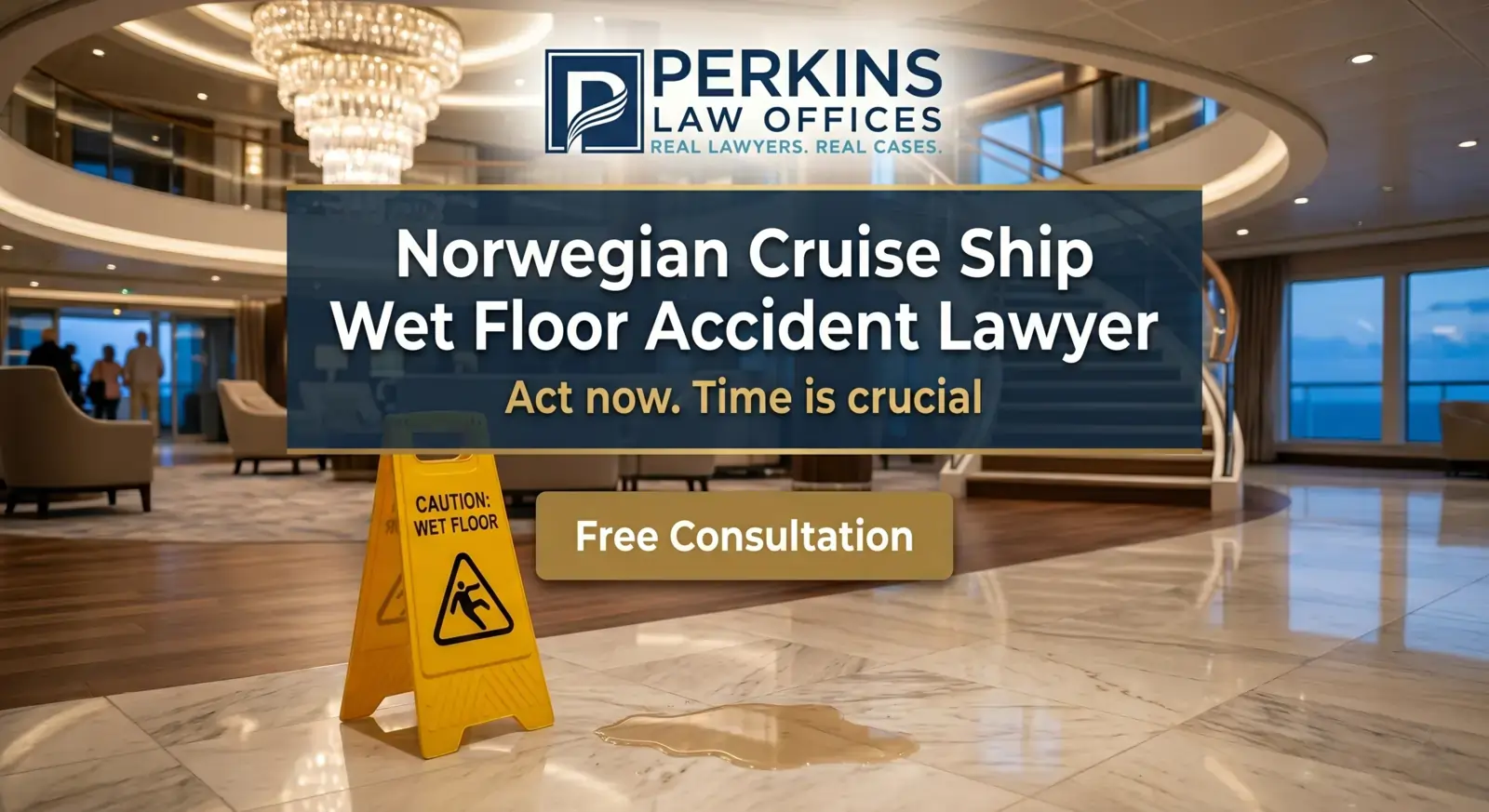
Norwegian Cruise Ship Wet Floor Accident Lawyer
Norwegian Cruise Ship Wet Floor Accident Lawyer: Nationwide Representation for NCL Slip and Fall Claims
A wet floor aboard a Norwegian Cruise Line vessel is a very common way cruise passengers get injured. Under federal maritime law, A wet floor can be a condition the cruise line has a legal duty to identify, address, and warn passengers about — and when that duty is breached, the resulting fall can give rise to a claim for substantial compensation. Norwegian, as a common carrier of passengers, is subject to federal law, even if an injury from a wet floor happens in international waters or import at a foreign country. NCL has a duty to exercise reasonable care under the circumstances. That being said, they are not automatically liable for an injury just because a passenger happens to slip on a floor that is wet. There must be negligence on the part of the cruise line in creating the danger or failing to correct it or worn about it adequately.
If you or a family member slipped and fell because a pool deck, dining venue, hallway, or casino floor was left wet, slick, or otherwise hazardous without adequate warning, you may have legal options, and the law does not require you to live near the Miami courthouse to pursue them. At Perkins Law Offices, we represent injured passengers in claims against Norwegian Cruise Line (NCL) regardless of where in the United States they call home. Because nearly every NCL passenger ticket contract requires litigation to proceed in federal court in Miami, our law firm here gives clients from coast to coast direct access to attorneys who litigate against this cruise line on a regular basis.
This page explains how wet floor claims against Norwegian Cruise Line are evaluated, the legal standard NCL must meet, the defenses its legal team typically raises, what compensation may be available, and the strict deadlines that make early legal consultation essential.
Why Wet Floor Accidents Are Among the Most Frequently Litigated Claims Against Norwegian Cruise Line
Slip and fall incidents involving wet flooring are consistently identified, in federal court filings and maritime law websites, as one of the most common categories of passenger injury claims brought against major cruise lines, including Norwegian Cruise Line. But just because a floor is wet, and a passenger got hurt, does not mean the NCL is automatically negligent and the passenger hit the jackpot. The existence of a wet floor alone is not negligence, but it can be evidence of negligence. Often times it’s not the fact that the floor was wet. That is the primary driving factor behind the liability. On many of these cruise lines certain flooring materials are not properly maintained and when they get wet, they are unreasonably slippery, which is a condition that can arise due to ongoing negligence overtime rather than the immediateAnd sometimes temporary condition of the floor being wet.
A cruise ship generates wet flooring conditions constantly. Pool decks are damp due to atmospheric conditions, and wet swim trunks. Buffet stations accumulate spilled beverages, condensation, and melted ice. Housekeeping crews mop corridors on tight schedules, often during the hours when passenger traffic is still heavy. Outdoor decks collect rain, shower drainage and condensation that can turn painted steel or composite resin into a hazard.
Because these conditions recur predictably, they are also foreseeable, and foreseeability can be a foundation of a negligence claim. When a cruise line knows, or reasonably should know, that a particular area becomes wet under routine operating conditions, it has a duty to implement measures that prevent passengers from being injured as a result. A failure to do so is not bad luck. It is a breach of duty, and it is the starting point of every wet floor case our firm evaluates.
The Legal Duty Norwegian Cruise Line Owes Every Passenger Aboard
Norwegian Cruise Line operates as what maritime law calls a common carrier — an entity that transports passengers for hire. This status carries a specific legal obligation: the duty of reasonable care under the circumstances. This standard, articulated by the U.S. Supreme Court in Kermarec v. Compagnie Generale Transatlantique and applied consistently by federal courts in cruise ship litigation since, requires the cruise line to take precautions a reasonably prudent operator would take given the known risks of its own environment.
This concept is related to the premises liability principles that govern hazardous conditions on land, but maritime law does not use the landowner categories applied in many state courts. Instead, federal maritime law applies a single, unified standard of reasonable care that takes into account the unique conditions of a vessel at sea.
Applied to wet floor hazards, this duty translates into concrete obligations: routine inspection of high-traffic and high-moisture areas, a prompt response when spills or wet conditions are reported, visible warning signage placed before a passenger is injured rather than after, and the use of non-slip mats, runners, or floor treatments in areas known to become wet. When Norwegian Cruise Line falls short of these obligations and a passenger is injured as a result, the elements of a negligence claim begin to take shape: duty, breach, causation, and damages.
Where Wet Floor Accidents Most Often Occur Aboard Norwegian Cruise Line Ships
Certain areas of an NCL vessel present a substantially higher risk of wet floor injuries than others. Understanding where these accidents tend to occur matters not only for prevention, but because the location of a fall often determines what evidence will be most important to your claim. It also determines the type of flooring material that is being utilized, and some materials are known to be dangerous when wet.
Pool Decks and Outdoor Sun Decks
Pool decks are often saturated by their nature. Splashing swimmers, poolside beverage service, pool showers, suntan lotion and exposure to rain or sea spray combine to create surfaces that can remain wet for hours at a time. Tile and painted composite decking, when wet, can become extremely slick, particularly for passengers walking barefoot or in sandals, as most are in this setting. There is a particular floor material utilized by Norwegian cruise line on open decks, called Bolidt, that is known to be a problem. Crew members are typically tasked with monitoring these areas and deploying mats or signage, and a failure to do so is one of the most common breaches our firm investigates.
Buffet and Main Dining Venues
High-volume dining areas see a constant flow of trays, beverages, dirty mopping and ice. A dropped drink or a leaking ice bin can create a hazard within seconds, in an area where passengers are often distracted, carrying plates, or navigating tight aisles between tables. Greasy mops being reused time after time, just spreads the slickness and coat it with a film of oil. Because these venues are staffed continuously, the question of whether crew members knew, or should have known, about a spill becomes central to the case. CCTV footage and I witness testimony is critical to establish the nature of the slick condition and the proximity of crew members that failed to do anything about it.
Cabin Hallways, Stairwells, and Corridors
Housekeeping operations mop interior corridors on a rotating schedule throughout the day. When this is done without adequate signage, or when a freshly mopped section is left without barriers while still wet, passengers moving between cabins, elevators, and stairwells have no warning of the hazard underfoot. Dim lighting in some corridors can compound the risk by making a wet patch difficult to see until it is too late.
Gangways and Embarkation Areas
Boarding and disembarking a cruise ship often means crossing a gangway exposed to rain, sea spray, or condensation, frequently at steep angles while moving from the sea and possibly while carrying luggag. These transitional surfaces, where dry interior flooring meets exposed exterior conditions, are a recurring source of falls, particularly during inclement weather at port or when there’s no anti-skid measures or assistance.
Proving Negligence: Duty, Breach, Causation, and Damages
Every wet floor claim against Norwegian Cruise Line is built on the same four legal elements, and each must be supported by evidence.
Duty is established by NCL’s status as a common carrier, as discussed above. This element is rarely in serious dispute.
Breach is where most cases are won or lost. Did NCL’s crew know, or should they have known, that the area was wet? Was a warning sign present before the fall, or only placed afterward once crew members responded to the incident? Was a non-slip mat in place, or had one been removed for cleaning and never replaced? Had the spill been reported to staff minutes, or hours, before the fall occurred? Each of these questions speaks directly to whether NCL met its duty of reasonable care.
Causation requires a clear, documented connection between the hazardous condition and your injury. This is why the steps taken immediately after a fall, covered later on this page, matter so much. A medical record created shortly after the fall that accurately reflects the mechanism of injury — a slip on a wet surface, the direction of the fall, the body parts impacted — is often the single most important piece of evidence in the entire case.
Damages encompass the full scope of harm the injury has caused, and in many cases, will continue to cause.
Consider a passenger walking from the pool deck toward the buffet shortly after a brief afternoon rain. The interior transition area has not been mopped, but water tracked in from the deck above has pooled near the entrance. No mat has been placed, and no sign is visible. The passenger, carrying a plate from breakfast service, slips, falls backward, and fractures a hip. In a case like this, duty is established by NCL’s status as a common carrier; breach may be established through crew testimony, deck logs, or maintenance records showing how long the condition existed; causation is supported by onboard medical records documenting the fall mechanism and resulting fracture; and damages include the surgery, rehabilitation, and any permanent limitations that follow. Every element interlocks, and a weakness in any one of them can be exploited by the cruise line’s legal team.
Anticipating Norwegian Cruise Line’s Defense Strategy
Norwegian Cruise Line maintains experienced in-house and outside counsel whose role is to limit the company’s exposure in every claim brought against it. Understanding the arguments they are likely to raise is part of building a claim that withstands them.
The “open and obvious” argument is among the most common. NCL’s defense may argue that a wet floor near a pool, in rainy weather, or in a buffet line is an inherently obvious condition that a reasonable passenger should have anticipated and avoided. Courts do not automatically accept this argument, particularly where the hazard was not visually apparent. Clear water on light-colored tile, for instance, can be nearly invisible until it is too late.
Comparative negligence is another frequent defense. NCL may point to a passenger’s footwear, suggest the passenger was distracted, or imply alcohol consumption played a role. Under the comparative fault principles applied in most of these cases, a percentage of fault assigned to the passenger can reduce, though not necessarily eliminate, recoverable damages, which is why how these facts are documented and framed matters significantly.
A third argument centers on notice. NCL may claim it had no actual or constructive knowledge that the area was wet, and therefore could not have prevented the fall. This is precisely why evidence such as prior complaints, maintenance logs, deck attendant schedules, and witness statements about how long a condition existed before the fall can be decisive.
These defenses are not theoretical. They are raised in nearly every wet floor claim, which is why working with attorneys who litigate against Norwegian Cruise Line on a regular basis, and who know which records to request and how quickly to request them, makes a measurable difference in outcome.
Compensation Available for Wet Floor Injuries on a Norwegian Cruise Ship
The damages recoverable in a successful claim against Norwegian Cruise Line generally fall into several categories.
Medical expenses cover the cost of treatment received both onboard and after disembarkation, including emergency evacuation, surgery, hospitalization, physical therapy, and any anticipated future care related to the injury.
Lost income accounts for wages missed during recovery, and in cases involving permanent impairment, may extend to diminished future earning capacity.
Pain and suffering, under the legal framework typically applied to these claims, encompasses physical pain, mental anguish, scarring or disfigurement, and the loss of capacity to enjoy activities the injured passenger engaged in before the accident.
The value of any individual claim depends entirely on its specific facts: the severity and permanence of the injury, the strength of the evidence establishing breach and causation, and the medical documentation supporting the damages claimed. No two wet floor cases are valued the same way, and any attorney who offers a specific dollar figure before reviewing your medical records and the circumstances of your fall is not giving you an honest assessment.
Critical Deadlines: The Notice Requirement and One-Year Filing Window
Cruise ship injury claims operate under deadlines that are substantially shorter, and far less forgiving, than those most people associate with personal injury cases.
Nearly every Norwegian Cruise Line passenger ticket contract requires written notice of an injury claim to be delivered to the cruise line within six months of the incident. This notice must include specific details about the incident and is separate from any incident report filed onboard at the time of the fall.
Beyond that, lawsuits arising from injuries aboard NCL vessels must generally be filed within one year of the date of the accident. This one-year window stands in sharp contrast to the two-to-four-year statutes of limitations that apply to most land-based personal injury claims, and it is strictly enforced. A claim filed even one day late is typically dismissed outright, regardless of its underlying merit.
These shortened deadlines are written into the fine print of the ticket contract every passenger accepts when booking. They are easy to overlook in the aftermath of an injury, particularly when a passenger is focused on recovery, and cruise lines are under no obligation to remind a claimant that time is running out. For these reasons, the most important step any injured passenger can take is to consult with a maritime injury attorney as soon as possible after the incident, even before deciding whether to move forward with a claim.
You Don’t Have to Live in Florida to Hire a Norwegian Cruise Line Accident Attorney
One of the questions we hear most often from passengers across the country is whether they need to find a lawyer near home. For claims against Norwegian Cruise Line, the answer is almost always no, and the reason is built directly into the ticket contract itself.
NCL’s passenger ticket contract, like those of most major cruise lines, contains a forum selection clause specifying that any lawsuit arising from a passenger’s voyage must be filed in the United States District Court for the Southern District of Florida, based in Miami. These clauses have been upheld by federal courts as enforceable, provided the notice was adequate and the process was fundamentally fair, and they apply to every passenger traveling under that booking, regardless of who paid for the ticket or where they boarded.
The practical result is that a passenger from Ohio, Texas, California, or anywhere else in the country who is injured on an NCL ship will, in virtually all cases, have their claim litigated in the same Miami federal courthouse as a passenger who lives down the street from it. This makes the location of your attorney’s office far less important than that attorney’s familiarity with this specific court, the judges who preside over maritime cases there, and Norwegian Cruise Line’s recurring litigation tactics and defense counsel.
As Alex Perkins explains it to clients who call from outside Florida: the question is never whether you can find a lawyer near you. It’s whether your lawyer is already comfortable in the courtroom where your case is headed. Perkins Law Offices is based in Miami and represents passengers nationwide for exactly this reason. Our proximity to the court where your case will almost certainly be filed is an advantage we extend to every client, no matter where they live.
What to Do Immediately After a Wet Floor Accident on Your Norwegian Cruise
The steps taken in the hours and days following a fall can shape the entire trajectory of a claim. The following actions help preserve the evidence that matters most:
- Seek medical attention from the ship’s medical center right away, and make sure the mechanism of your fall, including the wet condition, is documented in the medical record.
- Report the incident to ship security or guest services and request a copy of the written incident report. Describe what happened factually, and avoid speculating about your own role in the fall, as this language can later be used against you.
- Photograph the area where you fell as soon as possible, including the floor surface, any signage or its absence, and the surrounding conditions. These details can change within minutes as crew members respond.
- Identify witnesses and obtain their names and contact information before they disembark or disperse for the day.
- Preserve the shoes and clothing you were wearing at the time of the fall without cleaning them.
- Avoid signing any statements, releases, or settlement offers presented by the cruise line before speaking with an attorney.
- Contact a maritime injury attorney as soon as possible, both to begin preserving evidence on your behalf and to ensure the six-month notice deadline is met.
Why Passengers Nationwide Choose Perkins Law Offices for Norwegian Cruise Line Claims
Perkins Law Offices has represented injured passengers in claims against Norwegian Cruise Line and other major cruise operators for years, and we bring several advantages to every case we accept.
Direct attorney access. When you call our office, you speak with the attorney handling your case, not a rotating staff of intake coordinators.
No fee unless we recover compensation for you. Consultations are free, and our representation is provided on a contingency basis, meaning there is no upfront cost to have your claim evaluated and pursued.
Familiarity with the venue that matters. Because nearly every NCL claim is litigated in the Southern District of Florida, our position in Miami means we are working in the courthouse where your case will be filed, day after day.
A direct, honest assessment. We will tell you plainly whether we believe your case has merit, what the likely challenges will be, and what to realistically expect, without the sugar-coating that wastes a claimant’s time.
Frequently Asked Questions About Norwegian Cruise Ship Wet Floor Accident Claims
How long do I have to file a claim after a slip and fall on a Norwegian Cruise Line ship?
In most cases, written notice of your claim must be sent to Norwegian Cruise Line within six months of the incident, and any lawsuit must be filed within one year of the date of the fall. Both deadlines are set by the terms of the passenger ticket contract and are strictly enforced by federal courts.
Do I still have a case if there was a “Caution: Wet Floor” sign nearby?
Not necessarily, and the presence of a sign does not automatically defeat a claim. What matters is whether the sign was present before your fall, whether it was placed where it could reasonably be seen, and whether the underlying condition was otherwise addressed. In some cases, signage is placed only after a fall has already occurred, as part of the crew’s response, which is a detail worth documenting immediately.
Can I sue Norwegian Cruise Line if I don’t live in Florida?
Yes. Nearly all NCL passenger ticket contracts require lawsuits to be filed in federal court in the Southern District of Florida, regardless of where the passenger lives or boarded the ship. This means your case will almost certainly be litigated in Miami no matter where you call home, and a Miami-based maritime injury firm is well positioned to represent you throughout the process.
What if a Norwegian Cruise Line representative contacts me about my fall? Cruise lines often reach out to injured passengers shortly after an incident, sometimes asking for a recorded statement or offering an early settlement. Any statement you provide can be used to establish comparative fault, and early settlement offers are frequently far below what a claim may ultimately be worth once the full extent of an injury is known. Speak with an attorney before responding to any contact from the cruise line’s claims department.
How much is my Norwegian Cruise Ship wet floor accident claim worth? There is no standard figure. Case value depends on the severity of the injury, the strength of the evidence regarding breach and causation, medical costs both incurred and anticipated, lost income, and the impact of the injury on daily life. An attorney can provide a realistic assessment only after reviewing your medical records and the specific facts of your fall.
What evidence is most important for proving a wet floor accident claim? Photographs of the hazardous area taken as close to the time of the fall as possible, the official incident report, contemporaneous medical records documenting how the injury occurred, witness contact information, and the footwear and clothing worn at the time of the fall are all critical. The sooner this evidence is gathered, the less likely it is to be lost or altered.
Will my case go to trial, or will Norwegian Cruise Line settle? Most claims against cruise lines are resolved through negotiated settlement rather than trial, but Norwegian Cruise Line and its counsel are known to litigate vigorously when liability is contested. Preparing every case as though it may proceed to trial, gathering complete evidence and documentation from the outset, typically produces stronger settlement positions as well.
Does Perkins Law Offices charge anything for a consultation or to take my case? No. Consultations are free, and our representation is provided on a contingency-fee basis, meaning there are no upfront legal fees. We are compensated only if we recover money on your behalf.
Speak With a Norwegian Cruise Ship Wet Floor Accident Lawyer Today
If you were injured because of a wet floor aboard a Norwegian Cruise Line ship, the deadlines described above are already running, and the evidence that could support your claim may be disappearing by the day. Perkins Law Offices provides free, confidential consultations to passengers nationwide and a direct, honest assessment of your situation from an attorney, not an intake form.
Contact Perkins Law Offices to discuss your Norwegian Cruise Ship wet floor accident claim and find out what your next step should be.
This article is provided for general informational purposes only and does not constitute legal advice. It does not create an attorney-client relationship. The outcome of any legal claim depends on its specific facts, and prior results do not guarantee a similar outcome in future cases.