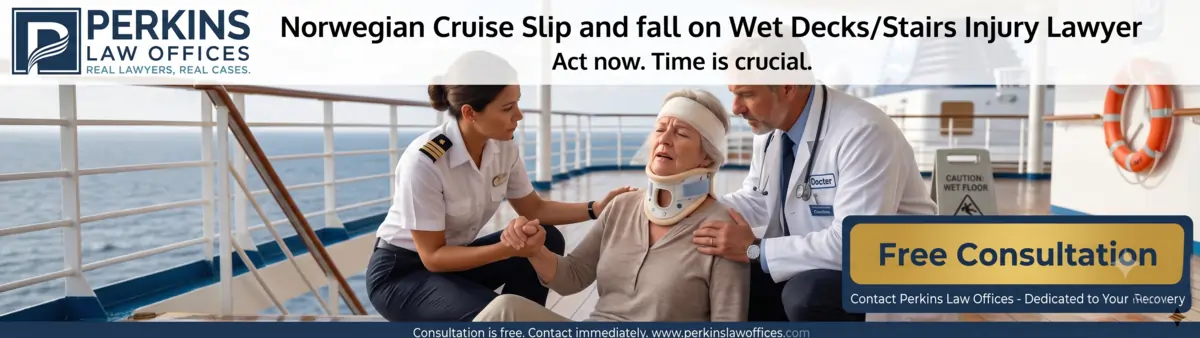
Norwegian Cruise Slip and Fall on Wet Decks & Stairs
A wet teakwood deck on the Norwegian Sky is the reason cruise passengers in this country still get their day in court. When a cruise customer slipped on that rain-soaked deck and fractured her wrist, Norwegian Cruise Line argued she had no case. The Eleventh Circuit disagreed, and Sorrels v. NCL (Bahamas) Ltd., 796 F.3d 1275 (11th Cir. 2015), reshaped how wet deck and wet stairs falls are litigated against the cruise lines. I am Alex Perkins, founding attorney at Perkins Law Offices. For more than 25 years I have represented injured people, and I handle Norwegian wet deck and staircase slip and fall claims for passengers across the United States. If you fell, you are not powerless, and you are not alone.
Call or text (305) 741-5297 | perkins@perkinslawoffices.com
No fee unless we win.
The Legal Standard That Decides Your Norwegian Wet Deck or Wet Stairs Claim
A slip and fall on a Norwegian cruise ship is not a Florida store-floor case dressed up in nautical language. It is a federal maritime claim, and it lives or dies on a different body of law. The foundation was set in Kermarec v. Compagnie Générale Transatlantique, 358 U.S. 625 (1959), where the Supreme Court held that a vessel owner owes those aboard a duty of reasonable care under the circumstances. The Eleventh Circuit, which governs cruise litigation in Miami, applies that standard to passengers and breaks every claim into four elements: duty, breach, causation, and damages. Chaparro v. Carnival Corp., 693 F.3d 1333 (11th Cir. 2012).
Duty
Norwegian must exercise reasonable care under the circumstances to keep its decks, stairways, and walkways reasonably safe for the passengers it invites aboard. That duty is not abstract. On a ship surrounded by water, with pools that splash, weather decks that take on rain and spray, and crew who hose down surfaces during the night, the foreseeable hazard is not exotic — it is wetness. The law expects Norwegian to plan for the conditions it knows will occur.
Breach
A breach is the failure to meet that duty. In wet deck and wet stairs cases, breach usually takes one of a few familiar shapes: a walking surface with too little slip resistance for an area the cruise line knows gets wet; a failure to apply, maintain, or replace anti-skid treatment on deck tile or stair nosing; a failure to dry, cordon, or warn an area after washing or after rain; or a drainage system that cannot keep up with the water the ship itself generates. Each of these is something a careful operator inspects for and fixes.
Causation
You must connect the breach to your fall. This is where preservation of evidence becomes decisive — the surveillance video, the incident report, the maintenance and cleaning logs, and the condition of the surface in the moments before you went down. The cruise line controls almost all of it, which is exactly why an early, lawyer-driven preservation demand matters.
Damages
Finally, the law compensates real harm. Recoverable damages in a maritime injury case can include past and future medical expenses, lost wages and lost earning capacity, and pain and suffering — which under the applicable law can include mental anguish, scarring or disfigurement, and the lost capacity to enjoy life. The figure is driven by the facts of your injury, never by a slogan.
Why “It Was Obviously Wet” Is Not the Defense Norwegian Thinks It Is
Expect Norwegian’s lawyers to say the deck was visibly wet, you saw it, and you walked anyway. It is the most predictable defense in cruise litigation. It is also weaker than it sounds. The Eleventh Circuit has drawn a careful line: even when the wetness of a deck is open and obvious, the unreasonably slippery state of the surface when wet may not be obvious to a reasonable person. Petersen v. NCL (Bahamas) Ltd., 748 F. App’x 246 (11th Cir. 2018). In plain terms — a passenger can see water and still have no way to know that this particular surface turns dangerously slick when it gets wet.
That distinction is the heart of a wet deck case, and it turns on the surface’s coefficient of friction, the engineering measure of slip resistance that Sorrels placed at the center of this litigation. Industry standards such as ASTM F1166 inform what slip resistance a passenger deck should provide, and the Eleventh Circuit in Sorrels rejected Norwegian’s attempt to argue that those standards somehow did not apply to areas passengers actually walk. Properly developed with a qualified expert, the friction evidence is often what defeats the “open and obvious” defense and gets a case to a jury.
The Notice Requirement — and How the Courts Reframed It
Maritime law adds a hurdle that ordinary premises cases do not: before Norwegian can be liable, it generally must have had actual or constructive notice of the risk-creating condition. Keefe v. Bahama Cruise Line, Inc., 867 F.2d 1318 (11th Cir. 1989). For years, cruise lines used that rule to argue that unless a crew member knew about the exact puddle you slipped in, there was no case.
The courts have since narrowed that escape hatch. In Carroll v. Carnival Corp., 955 F.3d 1260 (11th Cir. 2020), and again in Brady v. Carnival Corp. (11th Cir. 2022), the Eleventh Circuit clarified that the relevant condition is not the individual puddle but whether the cruise line knew the area had a reasonable tendency to become slippery and dangerous when wet. A pool deck that splashes, a weather-exposed staircase, a landing at the foot of a wet gangway — Norwegian cannot credibly claim surprise that these areas get wet. Evidence that the crew sometimes posted warning signs after rain, as in Sorrels and Brady, can itself establish that the cruise line knew the hazard existed. And where your injury was caused by the active negligence of a crew member rather than a passive condition, the notice requirement may not apply at all. Yusko v. NCL (Bahamas), Ltd., 4 F.4th 1164 (11th Cir. 2021).
Wet Stairs Are Their Own Category of Danger
A wet deck takes you down on a flat plane. A wet staircase takes you down a flight, and the injuries are predictably worse — wrist and elbow fractures from breaking the fall, ankle and tibia fractures, head strikes, and spinal injuries. Stairs also carry their own engineering duties that a competent maritime case must examine:
- Stair nosing and anti-skid strips. The leading edge of each tread is supposed to be marked and slip-resistant. Worn, peeling, or missing nosing tape is a recurring defect, and it is exactly the kind of transient condition a cruise line will quietly replace before you can document it.
- Handrails. Continuous, graspable handrails at the proper height are a basic safeguard. Missing, loose, interrupted, or wet metal rails that offer no real grip turn a stumble into a fall.
- Lighting and transitions. Dim stairwells, abrupt changes from dry interior carpet to wet exterior steel, and inconsistent riser heights all reduce a passenger’s ability to react.
- Surface slip resistance. As on decks, the coefficient of friction of the treads when wet is measurable, and a tread that fails industry slip-resistance standards is evidence of breach.
Where Wet Slip and Fall Injuries Happen on Norwegian Ships
Across Norwegian’s fleet, the same locations generate the same falls voyage after voyage: pool decks and the splash zones around hot tubs; weather decks and promenade areas after rain or sea spray; exterior and interior staircases and their landings; the steps and ramps of gangways during embarkation, tendering, and shore excursions; wet marble or tile in atriums and near buffets; and shower and bathroom thresholds in cabins. When Norwegian knows an area routinely gets wet and fails to make it reasonably safe or to warn, the resulting fall is not your fault — it is a foreseeable, preventable consequence of inadequate care.
The Deadlines That Can End Your Case Before It Begins
This is the part of the page I most need you to read. Norwegian’s passenger ticket contract sets deadlines far shorter than the statutes most people assume apply:
- Written notice within six (6) months. You must give Norwegian formal written notice of your claim within six months of the injury. The incident report you filled out on the ship is not enough on its own.
- Lawsuit within one (1) year. Suit must be filed within one year of the incident. This is shorter than the typical state personal injury limitation period, and the clock starts the day you fall.
- Venue in Miami. The forum selection clause requires most NCL lawsuits to be filed in the U.S. District Court for the Southern District of Florida, regardless of where you live or boarded.
Federal judges enforce these provisions strictly. A court will not extend the notice period simply because you were still treating your injuries or did not yet realize you had a claim. Cruise lines sometimes keep an injured passenger talking about a possible settlement until the one-year deadline quietly passes — and then the case is gone. Do not let conversation run out your clock.
Call or text (305) 741-5297 — available 24/7.
Evidence You Should Preserve Right Now
Wet deck and wet stairs hazards are transient by nature — the surface dries, the sign appears after the fact, the worn nosing gets replaced. Protect your case while the evidence still exists:
- Photograph and video the exact surface, from multiple angles, including the wet condition and any worn or missing anti-skid material.
- Note whether warning signs or cones were present before your fall, or only placed afterward.
- Identify CCTV cameras covering the area and report the incident to ship security in writing — but do not blame yourself in any statement.
- Preserve the shoes and clothing you were wearing; Norwegian will try to fault your footwear.
- Collect the names and contact information of any witnesses and save your own photos to a second device or email.
National Representation From a Miami Maritime Firm
Because Norwegian channels its lawsuits into the federal court in Miami, this is a Miami fight no matter where you call home. That is an advantage when your lawyer is already in that courtroom. Perkins Law Offices is based in Miami — the maritime litigation hub of the country — with a second office in Boca Raton, and we represent injured cruise passengers from coast to coast. You will work directly with your attorney, not a case-file number. We advance the costs, we handle the federal procedure and the carrier’s defense team, and we do not charge a fee unless we recover money for you.
Norwegian Cruise Line Fleet — Vessel-Specific Representation
We pursue wet deck and wet stairs claims across the entire Norwegian Cruise Line fleet. Each vessel has its own deck materials, stair configurations, and maintenance history:
- Norwegian Aqua
- Norwegian Viva
- Norwegian Prima
- Norwegian Encore
- Norwegian Bliss
- Norwegian Joy
- Norwegian Escape
- Norwegian Getaway
- Norwegian Breakaway
- Norwegian Epic
- Norwegian Jade
- Norwegian Pearl
- Norwegian Gem
- Norwegian Jewel
- Norwegian Dawn
- Norwegian Star
- Norwegian Sun
- Norwegian Sky
- Norwegian Spirit
- Pride of America
- Norwegian Luna (2026)
The Cruise Lines We Sue Nationwide
Our maritime practice is not limited to Norwegian. We represent passengers injured in wet deck and stairs falls aboard the major cruise lines, each of which uses similar ticket deadlines and forum clauses:
- Norwegian Cruise Line (NCL)
- Carnival Cruise Line
- Royal Caribbean International
- Celebrity Cruises
- MSC Cruises
- Princess Cruises
- Holland America Line
- Disney Cruise Line
- Costa Cruises
- Virgin Voyages
- Oceania Cruises
- Azamara
- Cunard Line
- Seabourn Cruise Line
- Silversea Cruises
- Viking Cruises
- Regent Seven Seas Cruises
- Margaritaville at Sea
Frequently Asked Questions
Can I sue Norwegian Cruise Line for a slip and fall on a wet deck or wet stairs?
Yes. A passenger who slips on a wet deck or wet staircase aboard a Norwegian ship can bring a negligence claim under United States general maritime law. You must prove duty, breach, causation, and damages, and that Norwegian had actual or constructive notice that the area had a tendency to become slippery and dangerous when wet. These cases are almost always filed in federal court in Miami under the ticket’s forum selection clause.
How long do I have to file a Norwegian Cruise Line slip and fall lawsuit?
Norwegian’s ticket contract typically requires written notice within six months of the injury and the filing of suit within one year. Both deadlines are shorter than ordinary state limitation periods and are strictly enforced. Missing either one can permanently bar your claim, which is why consulting a cruise injury lawyer quickly matters.
Norwegian says the wet deck was “open and obvious.” Does that defeat my claim?
Not necessarily. The Eleventh Circuit has held that even when the wetness of a deck is open and obvious, the unreasonably slippery condition of the surface when wet may not be obvious to a reasonable passenger. Whether a hazard was truly open and obvious is generally a fact question, and the surface’s slip resistance often must be evaluated by an engineering expert.
How much is a cruise ship wet deck or stairs slip and fall case worth?
There is no fixed value, and any lawyer who promises a number is not being straight with you. Recoverable damages can include medical expenses, lost wages and lost earning capacity, and pain and suffering. The value depends on the severity of your injury, the strength of the liability evidence, and the governing maritime law.
Do I need a lawyer to sue Norwegian, and what does it cost?
These cases are litigated in federal court under maritime law, against carriers with seasoned defense teams that control the evidence. You need an attorney admitted to that court. Perkins Law Offices handles cruise injury cases on a contingency fee — no upfront cost and no attorney fee unless we recover money for you. The consultation is free and confidential.
I live outside Florida. Can a Miami firm handle my Norwegian wet stairs case?
Yes. Because NCL’s contract requires most suits to be filed in the Southern District of Florida in Miami, where you live rarely changes where the case must be brought. We represent injured passengers from across the United States and litigate in that court.
What should I do first if I was injured on a wet Norwegian deck or staircase?
Seek medical care aboard the ship, report the incident in writing to ship security without admitting fault, photograph the surface and any hazards, identify witnesses and cameras, and contact a maritime attorney as soon as possible — ideally before the six-month notice deadline begins to close.
What Clients Say
I’m so thankful for Alex Perkins and Karla and everything they did for me throughout my case. From day one, they were professional, supportive, and always willing to help. They took the time to answer all my questions, kept me updated every step of the way, and genuinely cared about getting the best outcome for me. I really appreciated all their hard work, guidance, and kindness throughout. I highly recommend them to anyone looking for a team that truly cares about their clients.
— Ashley Soc
Mr. Perkins and Karla are absolutely the most professional and helpful team to have on your side. Unfortunately, my husband slipped and fell on our cruise causing injuries and were not treated very nicely by the cruise line. We reached out to Mr. Perkins and he immediately took over. Needless to say we came out of this lawsuit extremely happy with the results and very grateful for the time and commitment he and Karla put in! Excellent attorney!!!!!.
— Jon and Linda Costa
Testimonials reflect the experience of individual clients. Results depend on the specific facts of each case; prior results do not guarantee a similar outcome.
Speak directly with attorney Alex Perkins.
Call or text (305) 741-5297 | perkins@perkinslawoffices.com
Free consultation. No fee unless we win.
Perkins Law Offices — Miami Office: 1728 Coral Way, Suite 702, Miami, FL 33145 · (305) 741-5297. Boca Raton Office: 6560 W. Rogers Circle, Suite 15, Boca Raton, FL 33487 · (561) 621-1776. Licensed to practice law in Florida, Illinois, and Washington, D.C. Admitted to the U.S. District Court for the Southern District of Florida.
The information on this page is provided for general informational purposes only and is not legal advice for any individual case or situation. Reading this page does not create, and does not constitute, an attorney-client relationship. Submitting a contact form, sending a text message, making a phone call, or leaving a voicemail does not create an attorney-client relationship. The hiring of a lawyer is an important decision that should not be based solely upon advertising. Case citations are provided for general illustration of governing maritime law and do not constitute a prediction or guarantee regarding any particular claim.