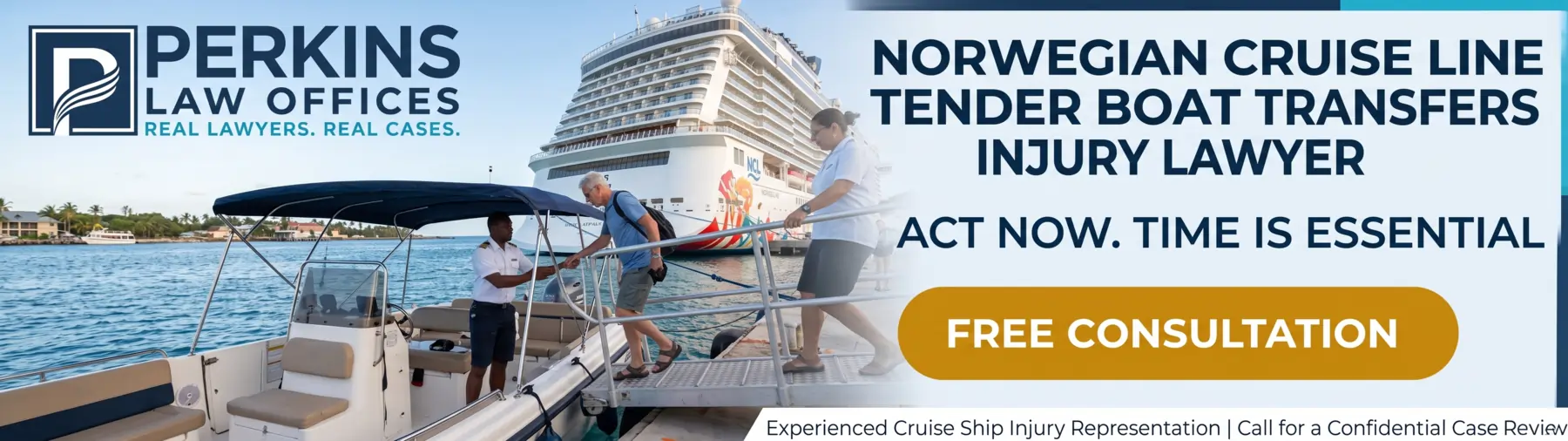
Norwegian Cruise Line Tender Boat Transfers Injury Lawyer
If you were injured during a Norwegian Cruise Line tender boat transfer, you have a right to compensation and you need a maritime attorney who knows how to hold NCL accountable.
Tender boat operations are among the most physically hazardous activities passengers encounter aboard a Norwegian Cruise Line voyage. Unlike docking at a modern pier, tender transfers require passengers to board and disembark small, open vessels often in moving water, with no gangway, in weather conditions that can change rapidly. When Norwegian Cruise Line fails to conduct these operations safely, passengers pay the price with fractured bones, spinal injuries, traumatic brain damage, and, in the most tragic cases, death. We have seen many people spilled out of personal mobility devices in wheelchairs because of the lack of assistance from crew members and the steep and moving nature of these gangways. Often times the anti-skid tape is worn out or missing, and we have even seen really makeshift looking tender boat gangways utilized by tender and fairy companies. Most people don’t realize this, but a lot of the tender boats are not owned bythe cruise lines themselves, but under federal maritime law, the cruise line is still responsible for getting passengers from ship to shore safely. Therefore lawsuits can be brought against the cruise line for injuries during tender boat operations, even if the cruise line was not the owner or operator of the tender.
Perkins Law Offices is a Miami-based maritime personal injury firm representing NCL tender boat injury victims across the United States. Attorney Alex Perkins has spent over two decades litigating cruise ship injury cases in federal court, including matters filed in the United States District Court for the Southern District of Florida — the mandatory venue under Norwegian Cruise Line’s ticket contract. If Norwegian Cruise Line’s negligence put you or a family member in a hospital, this firm will pursue every dollar of compensation the law entitles you to receive.
Call (305) 741-5297 — 24 hours a day, 7 days a week. No fee unless we win.
What Is a Tender Boat Transfer on Norwegian Cruise Line?
Norwegian Cruise Line operates large ocean vessels that cannot physically dock at certain ports. When a port lacks a pier capable of accommodating an NCL ship, or when port authority restrictions apply, the cruise line anchors offshore and ferries passengers to and from land using smaller vessels called tenders. These tenders are typically enclosed or semi-enclosed motorized boats operated by NCL crew members.
The tender transfer process itself introduces multiple points of failure:
- Passengers must step from a ship’s platform or gangway onto a tender bobbing in open water.
- Crew should assist passengers across gaps that shift constantly with wave action and vessel movement.
- Passengers must navigate entry and exit points that are inherently unstable, often wet, and frequently congested.
- Sea conditions, weather, and passenger mobility limitations can make each of these steps substantially more dangerous.
Norwegian Cruise Line bears the operational and legal responsibility to ensure that every aspect of the tender transfer process is executed safely, from crew training and equipment condition to the decision whether to suspend operations when conditions deteriorate. When the cruise line falls short of that obligation, the resulting injuries fall squarely within the scope of maritime personal injury law.
How Norwegian Cruise Line Tender Boat Accidents Happen
The causes of tender boat injuries are rarely unpredictable. Many follow patterns that experienced maritime litigators recognize. The following represent the most frequently documented negligence scenarios in NCL tender boat accident cases.
Unsafe Boarding and Disembarkation Procedures
The moment a passenger steps from the ship’s platform onto the tender — or from the tender onto a dock — is the highest-risk point of the entire transfer. If NCL crew fail to provide adequate physical assistance, fail to maintain a stable boarding point, or allow passengers to board without proper handrails or grab points, a fall becomes foreseeable. Courts have consistently found cruise lines liable when boarding procedures are inadequate and passengers sustain injuries at the transition point between vessels.
Operating Tenders in Unsafe Sea Conditions
Norwegian Cruise Line has both the authority and the obligation to suspend tender operations when sea conditions create unreasonable risk for passengers. When NCL continues to run tenders through rough swells, strong currents, or deteriorating weather — whether for commercial or scheduling reasons — and a passenger is injured as a result, the cruise line cannot deflect liability by characterizing conditions as “acts of nature.” The decision to operate is NCL’s decision. The consequences of that decision are NCL’s liability.
Crew Negligence and Inadequate Training
Tender operations require trained crew who understand maritime safety protocols, passenger handling, and emergency response. Undertrained crew, inattentive crew, or crew who fail to follow established procedures, whether boarding protocols or emergency stops, create conditions under which passenger injuries are predictable. Norwegian Cruise Line is vicariously liable for the negligent acts of its employees committed within the course of their employment.
Defective or Poorly Maintained Equipment
Tenders, boarding platforms, gangways, handrails, ladders, and dock equipment must be maintained in a safe condition. Worn or slippery non-skid surfaces, broken or missing handrails, malfunctioning boarding steps, and defective mechanical components have each been identified as causative factors in tender boat injury litigation. Norwegian Cruise Line’s maintenance obligations under maritime law are nondelegable.
Failure to Accommodate Passenger Disabilities and Mobility Limitations
Norwegian Cruise Line knows or should know the range of physical limitations among its passenger population, including elderly passengers, passengers using mobility aids, and passengers recovering from prior injuries or surgeries. A failure to provide appropriate accommodations, assign crew specifically to assist high-risk passengers, or advise passengers of particular risks they face during tender operations constitutes actionable negligence when injury results.
Tender Boat Collisions and Dock Impact Injuries
Tender vessels can strike docks, other vessels, or fixed structures when crew miscalculate approach speed or conditions exceed safe operating parameters. Passengers seated or standing inside the tender at the moment of impact sustain whiplash, blunt force trauma, fractures, and head injuries. Impact-based tender injuries are among the most serious in cruise maritime litigation.
Injuries Sustained in Norwegian Cruise Line Tender Boat Accidents
The marine environment amplifies injury severity. When a passenger falls on a tender boarding platform, there is no soft floor — there is vessel hull, dock edge, or open water. The injuries that result from Norwegian Cruise Line tender boat accidents range from serious to permanently disabling.
Fractures
Broken ankles, broken legs, pilon fractures, tibial and fibular fractures, broken elbows, and wrist fractures are among the most common injuries in tender boat boarding accidents. Falls at the point of vessel transfer generate significant impact force, and older passengers frequently sustain multiple fractures in a single incident. Surgical intervention, hardware implantation, and extended rehabilitation are common outcomes.
Traumatic Brain Injuries
A passenger who strikes their head on vessel structure during a fall or collision may sustain a traumatic brain injury ranging from concussion to severe closed-head trauma with long-term cognitive consequences. Cruise ship TBI cases require specialized expert testimony and life care planning to document the full scope of economic and non-economic damages.
Spinal Cord Injuries
Falls on tender vessels or during boarding can compress or sever spinal cord tissue, resulting in partial or complete paralysis. Spinal cord injuries sustained at sea often go improperly assessed and treated in the immediate aftermath, compounding long-term damage. These cases carry catastrophic damage values and demand experienced maritime litigation counsel.
Shoulder, Knee, and Soft Tissue Injuries
Passengers who brace themselves during a fall or stumble during boarding frequently sustain rotator cuff tears, labral tears, ACL and meniscal injuries, and extensive soft tissue damage requiring surgery and prolonged physical therapy. These injuries — often permanent in older passengers — dramatically affect quality of life and daily function.
Drowning and Wrongful Death
In the most catastrophic cases, passengers who fall from a tender during transfer — or who are thrown overboard during a collision — may drown or sustain fatal injuries. Norwegian Cruise Line wrongful death claims arising from tender boat accidents are governed by the Death on the High Seas Act (DOHSA) where applicable, and by general maritime law in territorial waters. The Perkins Law Offices has the capability to handle these most serious cases.
The Maritime Legal Framework Governing NCL Tender Boat Injury Claims
The Duty of Reasonable Care Under Federal Maritime Law
Norwegian Cruise Line’s legal obligations to its passengers are governed by federal maritime law, not state tort law. Under the standard established in Kermarec v. Compagnie Generale Transatlantique, 358 U.S. 625 (1959), cruise lines owe their passengers the duty of reasonable care under the circumstances. This standard applies throughout the cruise experience — including tender boat operations — and requires Norwegian Cruise Line to take affirmative steps to identify, address, and warn against dangers that it knew about or should have known about in the exercise of reasonable care.
Critically, NCL is held to the standard of a reasonably prudent maritime operator aware of the specific risks inherent in tender operations. The cruise line cannot claim ignorance of dangers that are inherent and well-documented in the operation of small vessels in open water conditions.
Notice of Prior Incidents as Evidence of Negligence
In NCL tender boat injury litigation, evidence that Norwegian Cruise Line had prior notice of the dangerous condition that caused the injury is central to establishing liability. Courts in the S.D. Florida have found that a cruise line’s awareness of prior similar incidents — whether through documented accident reports, maintenance records, or crew safety reports — is critical to whether NCL acted reasonably in failing to remediate the condition. Perkins Law Offices aggressively pursues vessel safety records, incident logs, and internal communications through the federal discovery process.
NCL’s Ticket Contract: Deadlines You Cannot Miss
Norwegian Cruise Line’s passenger ticket contract is a binding legal document that imposes time limits materially shorter than standard civil statutes of limitations. NCL’s current ticket contract requires:
- Written notice of the claim: Within six (6) months of the date of injury.
- Filing of a lawsuit: Within one (1) year of the date of injury.
- Mandatory venue: United States District Court for the Southern District of Florida, Miami Division.
These are not suggested timelines. They are contractual conditions enforceable by federal courts. Missing either deadline — the written notice requirement or the lawsuit filing deadline — can permanently extinguish your right to compensation, regardless of how severe your injuries are. If you were injured on a Norwegian Cruise Line tender boat, contact legal counsel immediately.
Jurisdiction and Venue: Why Miami Is the Battleground
Norwegian Cruise Line’s ticket contract compels all passenger injury litigation to be filed in the S.D. Florida. Perkins Law Offices maintains regular active practice in the Southern District of Florida and has direct experience navigating the specific procedural landscape — including the court’s local rules, discovery protocols, and judicial assignments — that governs NCL maritime litigation. Clients located anywhere in the United States can retain this firm; the litigation occurs in Miami federal court on your behalf.
What Damages Are Available in a Norwegian Cruise Line Tender Boat Injury Lawsuit?
Injured cruise passengers are entitled to pursue the full spectrum of compensatory damages permitted under federal maritime law. The following categories apply to Norwegian Cruise Line tender boat injury claims:
Economic Damages
- All past and future medical expenses, including emergency treatment, surgery, hospitalization, physical therapy, and long-term care.
- Lost wages from time missed at work during recovery.
- Loss of future earning capacity where the injury creates a permanent limitation on the ability to work.
- Cost of medical equipment, in-home assistance, and adaptive modifications.
Non-Economic Damages
- Physical pain and suffering — both past and future.
- Emotional distress and psychological trauma resulting from the accident and injury.
- Permanent physical impairment and disfigurement.
- Loss of enjoyment of life and inability to engage in activities the injured person previously enjoyed.
Wrongful Death Damages
In fatal tender boat accident cases, surviving family members may pursue damages for loss of financial support, loss of services, funeral and burial expenses, and — where applicable under general maritime law rather than DOHSA — loss of society and companionship.
What to Do After a Norwegian Cruise Line Tender Boat Accident
The actions you take in the immediate aftermath of a tender boat injury directly affect the strength of your legal claim. Norwegian Cruise Line’s claims and risk management teams begin assembling a defensive record from the moment an incident occurs. Your attorney needs a parallel evidentiary record built from the same moment. The following steps are essential:
1. Report the Incident to NCL Crew and Ship’s Medical Staff Immediately
Demand that Norwegian Cruise Line crew document the incident on the ship’s official log. Seek treatment at the ship’s medical facility and preserve all documentation of your evaluation and treatment. If necessary, request medical evacuation to a shoreside facility. An official record of the incident — created contemporaneously — is foundational to your case.
2. Document the Scene
Photograph or video the boarding platform, the tender vessel, the sea conditions, the condition of flooring surfaces, the absence or presence of handrails, and any visible defects or hazards. Gather contact information for any witnesses to the accident, including other passengers and, if possible, crew members who were present.
3. Preserve Your Medical Records
Request and retain copies of all shipboard medical records, emergency room records at your disembarkation port, and all subsequent treating physician documentation. Continuity of medical care and documentation is essential to demonstrating the nature, severity, and causal relationship of your injuries to the tender boat accident.
4. Do Not Sign Any Documents from Norwegian Cruise Line
NCL’s claims department may contact you following an incident and present documents for signature. Do not sign any release, settlement agreement, or acknowledgment without first consulting a maritime injury attorney. A premature settlement or release can permanently terminate your right to full compensation.
5. Contact Perkins Law Offices Immediately
Because NCL’s ticket contract imposes a six-month written notice requirement and a one-year filing deadline, every day of delay is legally consequential. Contact Perkins Law Offices as soon as possible after your injury to protect your legal rights before those deadlines run.
Why Retain Perkins Law Offices as Your NCL Tender Boat Injury Attorney
Maritime personal injury litigation against Norwegian Cruise Line is not a matter for a general practice attorney. NCL employs experienced defense firms whose singular focus is minimizing the company’s exposure in federal court. You need counsel with equivalent depth of knowledge, courtroom experience in the Southern District of Florida, and a demonstrated willingness to litigate aggressively.
Perkins Law Offices brings the following to every Norwegian Cruise Line tender boat injury case:
- Over 20 years of maritime and cruise ship injury litigation experience. Attorney Alex Perkins has handled claims against every major cruise line, including Norwegian Cruise Line, Carnival, Royal Caribbean, Celebrity, MSC, and others, in federal maritime court.
- S.D. Florida admission and active federal court practice. NCL’s ticket contract requires your case to be in Miami. This is where Perkins Law Offices operates every day.
- Comprehensive case investigation. We demand NCL’s incident reports, surveillance footage, vessel maintenance logs, crew training records, and communications through the discovery process — evidence the cruise line will not produce voluntarily.
- Medical and expert network. We work with orthopedic surgeons, neurologists, life care planners, maritime safety experts, and economic damage analysts to build a complete damages picture for each case.
- National client representation. Perkins Law Offices represents NCL tender boat injury victims from every state in the nation. Your location does not limit your ability to retain this firm or pursue a claim in federal court.
- Strict contingency fee representation. You pay no attorney’s fees unless and until we recover compensation for you. There are no upfront costs and no billing by the hour.
Norwegian Cruise Line Fleet: Tender Boat Operations by Vessel
Tender boat operations are used across the Norwegian Cruise Line fleet at ports worldwide that cannot accommodate large ocean vessels at pier. If you were injured in a tender transfer aboard any Norwegian Cruise Line vessel, Perkins Law Offices can evaluate your claim regardless of which ship was involved. The following NCL vessels commonly operate tender transfers at various ports of call:
- Norwegian Escape — Tender operations at select Caribbean and Mediterranean ports.
- Norwegian Breakaway — Tender operations in the Caribbean, Bermuda approach anchorages, and Pacific itineraries.
- Norwegian Getaway — Tender operations in Caribbean, Adriatic, and Northern European itineraries.
- Norwegian Epic — Tender operations at ports in the Mediterranean and Caribbean.
- Norwegian Prima — Tender operations at select Caribbean and European ports.
- Norwegian Viva — Tender operations at Mediterranean and Caribbean anchorage ports.
- Norwegian Joy — Tender operations on Alaska, Caribbean, and Pacific Coast itineraries.
- Norwegian Bliss — Tender operations on Alaska and Caribbean itineraries.
- Norwegian Encore — Tender operations at Alaska and Caribbean ports without piers.
- Norwegian Pearl — Tender operations in Mediterranean, Caribbean, and South Pacific itineraries.
- Norwegian Gem — Tender operations in the Caribbean and Atlantic itineraries.
- Norwegian Jade — Tender operations in Mediterranean, Caribbean, and transatlantic itineraries.
- Norwegian Sky — Tender operations at Caribbean ports, including Cuba and Bahamas anchorages.
- Norwegian Sun — Tender operations on Alaska, Caribbean, and Panama Canal itineraries.
- Norwegian Star — Tender operations at Pacific, South American, and Mediterranean ports.
- Norwegian Dawn — Tender operations in New England, Caribbean, and European itineraries.
- Norwegian Spirit — Tender operations in Asia-Pacific, Middle East, and Mediterranean itineraries.
- Pride of America — Tender operations at Hawaii anchorage ports including Kona.
If your injury occurred aboard a vessel not listed above, contact Perkins Law Offices directly. NCL’s fleet evolves through new builds and acquisitions, and this firm stays current with the entire Norwegian Cruise Line operating fleet.
Tender Boat Injury Claims Against Other Cruise Lines
Norwegian Cruise Line is not the only major operator conducting tender boat transfers. Passengers injured during tender operations on any of the following cruise lines may have comparable maritime personal injury claims, subject to each carrier’s ticket contract terms and federal maritime law. Perkins Law Offices evaluates and accepts tender boat injury cases against all major cruise operators:
- Carnival Cruise Line Tender Boat Injury Claims
- Royal Caribbean International Tender Boat Injury Claims
- Celebrity Cruises Tender Boat Injury Claims
- MSC Cruises Tender Boat Injury Claims
- Disney Cruise Line Tender Boat Injury Claims
- Princess Cruises Tender Boat Injury Claims
- Holland America Line Tender Boat Injury Claims
- Regent Seven Seas Cruises Tender Boat Injury Claims
- Oceania Cruises Tender Boat Injury Claims
- Seabourn Cruise Line Tender Boat Injury Claims
- Viking Ocean Cruises Tender Boat Injury Claims
- Azamara Cruises Tender Boat Injury Claims
Each cruise line’s ticket contract contains specific venue, notice, and filing deadline provisions that differ from NCL’s. If you were injured on a tender operated by any carrier above, contact Perkins Law Offices to discuss the specific legal requirements that govern your case.
We Represent NCL Tender Boat Injury Victims Across the United States
The geographic scope of Perkins Law Offices’ representation is national. Norwegian Cruise Line’s passengers come from every state in the country, and the injuries they sustain on NCL tender boats do not become legally inferior because the victim lives in Texas, California, New York, or any other state outside Florida. The S.D. Florida is the designated federal court for NCL litigation, and Perkins Law Offices is present and active in that court on behalf of clients from coast to coast.
Clients in the following states, among others, have contacted Perkins Law Offices following Norwegian Cruise Line tender boat injuries and have had their cases evaluated without any requirement to travel to Miami for an initial consultation:
- New York — New Jersey — California — Texas — Georgia — Illinois — Pennsylvania — Ohio — Michigan — Arizona — Washington — Colorado — Virginia — North Carolina — Massachusetts — Tennessee — Minnesota — Missouri — Nevada — Oregon — Indiana — Wisconsin — Maryland — Connecticut — Utah — Alabama — South Carolina — Louisiana — Kentucky — Oklahoma — and all other U.S. states and territories.
If Norwegian Cruise Line caused your injury during a tender boat transfer, the state where you live does not determine whether you have a claim. Federal maritime law and NCL’s ticket contract do. Call Perkins Law Offices from wherever you are located.
Frequently Asked Questions: Norwegian Cruise Line Tender Boat Injury Lawsuits
Can I sue Norwegian Cruise Line for an injury sustained during a tender boat transfer?
Yes. Norwegian Cruise Line owes its passengers a duty of reasonable care under federal maritime law throughout the entire voyage, including tender boat transfer operations. Where NCL’s negligence — through unsafe boarding conditions, inadequate crew training, defective equipment, or operation in dangerous sea conditions — caused your injury, you have a legal basis to pursue a maritime personal injury claim. Perkins Law Offices evaluates NCL tender boat claims at no cost and on a contingency fee basis.
How much time do I have to file a lawsuit against Norwegian Cruise Line for a tender boat accident?
NCL’s passenger ticket contract imposes two critical deadlines. First, you must provide written notice of your claim to Norwegian Cruise Line within six months of the incident. Second, you must file a lawsuit within one year of the date of injury. Both deadlines are substantially shorter than standard civil statutes of limitations and are routinely enforced by federal courts. Contact a maritime attorney immediately after any tender boat injury — delay is legally dangerous.
I live outside of Florida. Can I still hire Perkins Law Offices and sue Norwegian Cruise Line?
Yes. Norwegian Cruise Line’s ticket contract requires all passenger injury cases to be filed in the United States District Court for the Southern District of Florida in Miami — regardless of where the passenger resides. Perkins Law Offices is admitted to the S.D. Florida and represents NCL tender boat injury victims from all 50 states. Your location does not limit your ability to retain this firm or file suit against NCL.
What types of damages can I recover in an NCL tender boat injury lawsuit?
Under federal maritime law, injured passengers may recover past and future medical expenses, lost wages, reduced earning capacity, physical pain and suffering, emotional distress, permanent disability or disfigurement, and loss of enjoyment of life. In fatal tender boat cases, surviving family members may pursue wrongful death damages. Perkins Law Offices works with medical specialists and economic experts to document the full value of each client’s damages.
What if the tender boat accident happened in rough seas? Does that eliminate Norwegian Cruise Line’s liability?
Not necessarily. NCL has both the authority and the affirmative duty to assess sea conditions and suspend tender operations when conditions create unreasonable risk for passengers. A decision by Norwegian Cruise Line to continue tender operations in unsafe sea conditions — whether motivated by scheduling, commercial pressure, or operational convenience — can itself constitute actionable negligence. Rough conditions do not automatically shield NCL from liability when the cruise line knew or should have known that passenger transfers were dangerous.
What should I do right after a tender boat accident on Norwegian Cruise Line?
Report the incident immediately to NCL crew and ensure an official incident report is generated. Seek evaluation and treatment at the ship’s medical center and preserve all documentation. Photograph the scene — the boarding platform, the vessel, the sea state, any visible hazards or deficiencies. Collect witness contact information. Do not sign any documents presented by Norwegian Cruise Line’s crew or claims representatives without first consulting an attorney. Then contact Perkins Law Offices at (305) 741-5297.
Will Norwegian Cruise Line offer a settlement without a lawsuit?
Some NCL tender boat claims are resolved through pre-litigation negotiation, but Norwegian Cruise Line is a sophisticated maritime defendant represented by experienced defense counsel whose primary objective is to minimize the company’s financial exposure. An early settlement offer from NCL is almost never equal to the full value of your claim. Without counsel, injured passengers routinely accept far less than they are entitled to receive. Perkins Law Offices manages all communication with NCL and its insurers on behalf of clients and will not recommend settlement unless the offer represents full and fair compensation for your documented damages.
What if I was already given a settlement form to sign by Norwegian Cruise Line?
Do not sign it. Contact Perkins Law Offices immediately. A signed release extinguishes your legal claims permanently, regardless of whether you were treated fairly or informed of the full value of your injuries at the time. An attorney can review any document NCL has presented before you decide whether to sign — at no cost to you under our contingency fee arrangement.
Does Perkins Law Offices handle tender boat wrongful death cases?
Yes. Perkins Law Offices represents surviving family members in wrongful death cases arising from fatal Norwegian Cruise Line tender boat accidents. These cases may be governed by the Death on the High Seas Act where applicable, or by general maritime law in territorial waters, with different damages frameworks applying in each context. We evaluate every wrongful death matter individually to determine the applicable legal framework and maximum recoverable damages.
How much does it cost to hire Perkins Law Offices for an NCL tender boat injury case?
There is no upfront cost. Perkins Law Offices represents all cruise ship injury clients, including Norwegian Cruise Line tender boat injury victims, on a strict contingency fee basis. Attorney’s fees are only charged as a percentage of the recovery obtained on your behalf. If there is no recovery, you owe no attorney’s fees. Initial case evaluations are free and available 24 hours a day by calling (305) 741-5297.
Contact a Norwegian Cruise Line Tender Boat Transfers Injury Lawyer Today
A tender boat accident on a Norwegian Cruise Line vessel is not a routine travel misfortune. It is a serious maritime incident with legal consequences, contractual deadlines, and complex evidentiary requirements that demand experienced counsel. Perkins Law Offices has spent over two decades holding cruise lines accountable in federal maritime court — and this firm is prepared to fight for you, wherever in the United States you are located.
The clock on your legal rights starts the day you were injured. Norwegian Cruise Line’s six-month notice requirement and one-year filing deadline do not pause while you recover, consult physicians, or consider your options. Take one step now that costs you nothing: call Perkins Law Offices.
Call (305) 741-5297 — Available 24/7, nationwide.
No fee unless we win. Free case evaluation. Hablamos Español.
1728 Coral Way, Suite 702
Miami, FL 33145
Phone: (305) 741-5297
Website: www.perkinslawoffices.com
Perkins Law Offices is licensed in Florida, Illinois, and Washington D.C., and is admitted to practice before the United States District Court for the Southern District of Florida. This page is intended for general informational purposes and does not constitute legal advice. The facts of each case are unique. No attorney-client relationship is formed until a written retainer agreement has been signed.