Norwegian Cruise Line Trimalleolar Ankle Fracture Injury Lawyer | National Maritime Injury Attorney
Representing Passengers Nationwide Who Suffered a Trimalleolar Ankle Fracture Aboard a Norwegian Cruise Line Vessel
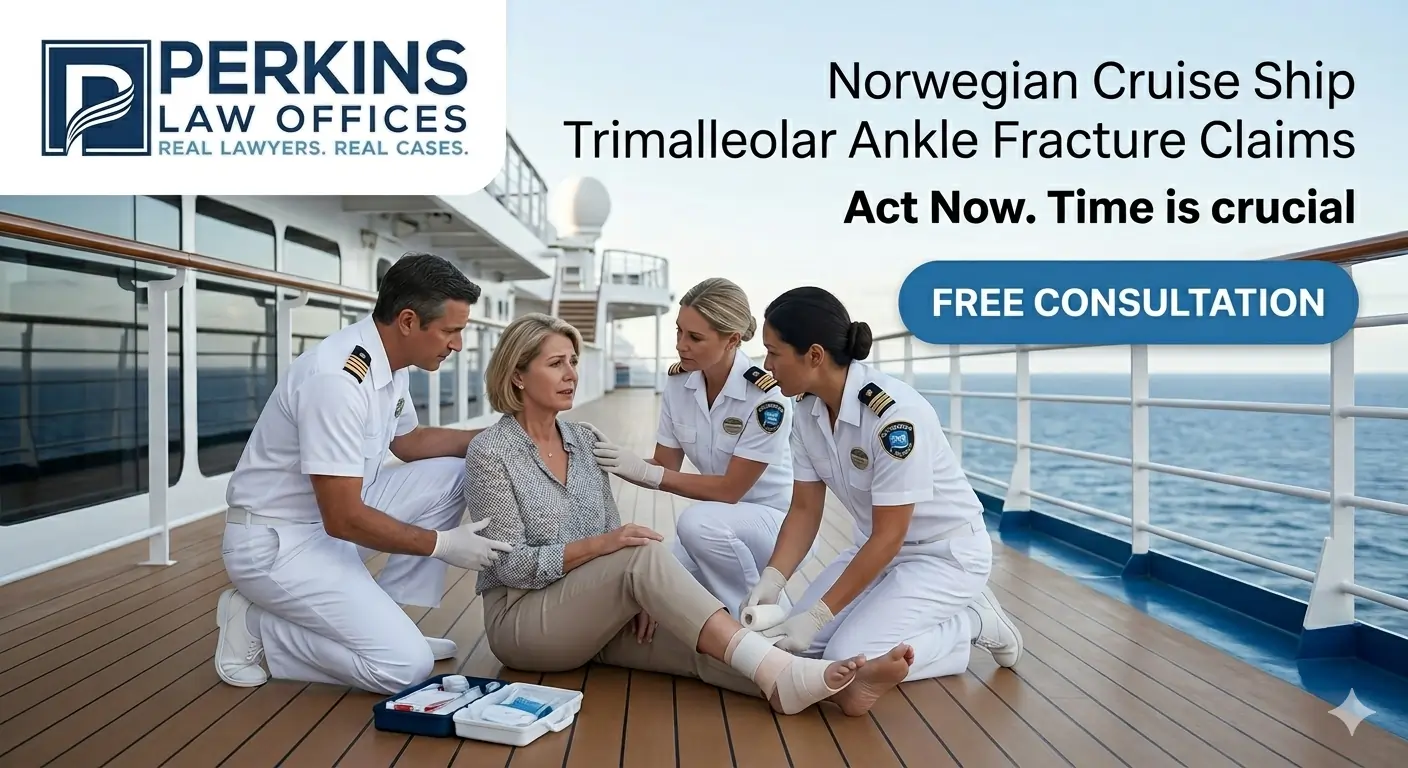
A trimalleolar ankle fracture is not a sprain, and it is not a “minor” cruise injury. It is a break in three distinct parts of the ankle joint — the medial malleolus, the lateral malleolus, and the posterior malleolus — and in nearly every case it requires open reduction and internal fixation surgery, hardware, and months of non-weight-bearing recovery. When this injury happens on a Norwegian Cruise Line vessel because of a wet deck, an unmarked step, a defective gangway, or a poorly maintained pool area, the passenger is not just dealing with a fracture. They are dealing with a federal maritime claim against a sophisticated corporate defendant with in-house counsel, insurance adjusters, and a ticket contract written to limit what the passenger can recover.
I am Alex Perkins. My firm represents injured cruise passengers nationwide, regardless of where they live, in claims against Norwegian Cruise Line and every major cruise operator. If you or a family member suffered a trimalleolar ankle fracture aboard an NCL ship, my firm will help you get just compensation. Hopefully my website will help explains your legal options and how cruise ship injury cases work. Since a cruise accident case has different legal standards that apply compared to a typical personal injury case in state court.
What Is a Trimalleolar Ankle Fracture, and Why Does It Matter Legally?
The ankle joint is stabilized by three bony prominences, or malleoli. A trimalleolar fracture means all three are broken simultaneously, almost always from a high-energy mechanism such as a fall on a hard or wet surface, a trip on an uneven threshold, or a slip down a slick stairwell. This is materially different from a simple ankle sprain or a single-malleolus fracture, and the law treats it differently because the damages are categorically more severe.
From a medical standpoint, a trimalleolar fracture typically requires:
Surgical fixation with plates and screws to stabilize the joint, a recovery period of six to twelve weeks of non-weight-bearing immobilization, extended physical therapy to restore range of motion and strength, and in a meaningful percentage of cases, post-traumatic arthritis that develops years later because the joint surface was disrupted.
This matters in your claim because Norwegian Cruise Line’s insurers will look at the severity of a trimalleolar fracture and immediately understand that the exposure is significant. That is precisely why these claims are aggressively investigated and frequently disputed on liability, even when the facts plainly point to a hazard the cruise line should have corrected.
The Legal Standard: Duty, Breach, Causation, and Damages
Every cruise ship injury claim, regardless of which deck the fall occurred on or which ship was involved, rises or falls on four legal elements. I evaluate every trimalleolar ankle fracture case against this framework before I ever file a notice of claim.
Duty of Care
Norwegian Cruise Line, as a common carrier transporting passengers for hire, owes its passengers a duty of reasonable care under the circumstances. This is the federal maritime negligence standard established in Kermarec v. Compagnie Generale Transatlantique, and it requires the cruise line to maintain decks, stairwells, pool areas, gangways, and public spaces in a reasonably safe condition, and to warn passengers of hazards the cruise line knew or should have known about.
Breach
Breach means the cruise line failed to meet that standard. In trimalleolar ankle fracture cases, breach commonly arises from conditions such as wet or slippery deck surfaces without adequate warning signage, defective or unsecured gangways between ship and shore, broken or uneven flooring, stairs with degraded anti-slip nosing, inadequate lighting in walkways, or known recurring hazards the crew failed to remediate despite prior incident reports.
Causation
You must be able to connect the specific hazardous condition directly to the fall and the resulting fracture. While you may think a broken ankle from a slip and fall on a cruise is obviously caused by that fall, you would be surprised as to lengths the cruise lines would go to fight that injury actually happened on the ship. The cruise line has defenses to causation, such as pre-existing injury, intermittent injury, and failure to mitigate your injury.
Damages
Damages cover medical expenses, including surgery and hardware, lost income during the recovery period, pain and suffering, and any permanent impairment or future arthritic complications tied to the joint trauma.
If any one of these four elements is missing or cannot be proven, the claim is vulnerable. This is precisely where cruise lines focus their defense, and why a maritime attorney with experience specifically in cruise ship litigation is necessary to build a case that withstands that scrutiny.
Common Causes of Trimalleolar Ankle Fractures on Norwegian Cruise Ships
Based on the patterns I see in cruise ship injury litigation, trimalleolar ankle fractures most frequently occur in these settings aboard Norwegian vessels:
Pool deck areas where water accumulates on tile or composite decking without sufficient slip resistance or posted warnings. Gangway and embarkation areas where uneven transitions, loose matting, or wet conditions create a fall hazard as passengers board or disembark. Interior and exterior stairwells where worn anti-slip strips on stair nosing no longer provide adequate traction. Cabin hallways and thresholds with raised lips or carpet seams that catch a foot. Buffet and dining areas where spills are not promptly cleaned or marked.
Each of these scenarios supports a distinct theory of negligence, and the evidence needed to prove the case differs depending on where and how the fall occurred.
National Representation: You Do Not Need to Live in Florida to Bring This Claim
A trimalleolar ankle fracture sustained on a Norwegian Cruise Line ship almost always must be litigated in the United States District Court for the Southern District of Florida in Miami, because Norwegian’s passenger ticket contract contains a forum selection clause requiring it. That is true whether you boarded in Miami, New York, Los Angeles, Seattle, or anywhere else in the country, and whether you currently live in Florida, Texas, Ohio, California, or any other state.
This is precisely why my firm represents injured passengers nationwide. You do not need a lawyer in your home state. You need a maritime lawyer admitted to practice in the Southern District of Florida who handles cruise ship litigation specifically, because that is where Norwegian Cruise Line’s claims will be decided regardless of where you live. I have represented clients from across the country in claims against Norwegian, and I structure every engagement to minimize how much travel and disruption the client experiences during the case.
Deadlines That Will Bar Your Claim if Missed
Norwegian’s passenger ticket contract imposes two deadlines that are far shorter than most injury victims expect, and missing either one can permanently end your right to compensation.
A written notice of claim must typically be submitted to Norwegian within six months of the date of the injury, detailing the incident and the nature of the harm. A lawsuit must generally be filed within one year of the date of the injury, regardless of whether Norwegian has acknowledged the claim or appeared willing to negotiate.
I have seen cruise lines engage in months of informal claims correspondence, only for the one-year deadline to pass while the passenger believed the matter was still being resolved. Once that year expires, the claim is barred by the court regardless of how strong the underlying facts were. If you are reading this and you are unsure how much time has passed since your fall, do not wait to find out. Call my office today.
What to Do If You Suffered a Trimalleolar Ankle Fracture on a Norwegian Cruise
The steps you take in the days immediately following the injury directly affect the strength of the claim. I advise every client to do the following as soon as possible.
Request and obtain a copy of the official incident report filed with ship security, and do not sign any statement suggesting you were at fault for the fall. Photograph the exact location of the fall before conditions change, including any wet floor, broken tile, worn stair nosing, or missing warning signage. Photograph your injury, and continue photographing the cast, surgical site, and recovery progression throughout treatment. Collect names and contact information from any passengers who witnessed the fall, since crew testimony alone is rarely sufficient and witnesses are difficult to locate months later. Seek onboard medical evaluation immediately, and obtain copies of all medical records generated on the ship before disembarking if possible. Preserve the footwear you were wearing, since cruise lines routinely attempt to argue comparative negligence based on footwear choice. Contact a maritime attorney before the six-month notice deadline, ideally within days of the incident, not months later.
Compensation Available in a Trimalleolar Ankle Fracture Claim
A properly developed claim accounts for the full scope of harm caused by this injury, not merely the immediate hospital bill. This includes past and future medical expenses related to surgical fixation, hardware removal if required, and ongoing physical therapy; lost wages during the recovery period, which for a trimalleolar fracture frequently extends well beyond the initial hospitalization; pain and suffering, including the physical pain of the injury and surgery itself; and permanent impairment damages where the joint trauma results in long-term mobility limitations or early-onset arthritis in the ankle.
Florida maritime law, which generally governs these claims given Norwegian’s choice-of-law provisions, allows for compensation tied to mental anguish, lost capacity for enjoyment of life, and disfigurement, in addition to the economic losses tied to medical bills and lost income.
Why Norwegian Cruise Line Will Dispute Your Claim
Norwegian Cruise Line, like every major cruise operator, maintains experienced in-house and outside counsel whose function is to limit the company’s financial exposure. In a trimalleolar fracture case specifically, expect the claims adjuster or defense counsel to argue that warning signage was posted and simply not seen, that the passenger’s own footwear or inattention caused the fall, that the hazard was open and obvious and therefore the passenger should have avoided it, or that the injury was pre-existing or unrelated to the alleged incident.
These defenses are predictable, and they are why the evidence collected in the first hours and days after the fall is so important. A maritime attorney who has litigated against Norwegian before knows which of these arguments the company tends to raise and how to build the record in advance to defeat them.
Other Cruise Lines We Handle Trimalleolar Ankle Fracture Claims Against
While this page addresses Norwegian Cruise Line specifically, trimalleolar ankle fracture claims arise on every major cruise line operating out of U.S. ports, and my firm represents injured passengers nationwide against each of the following carriers:
Royal Caribbean International, Carnival Cruise Line, Celebrity Cruises, Princess Cruises, Holland America Line, MSC Cruises, Disney Cruise Line, Costa Cruises, Virgin Voyages, Oceania Cruises, Azamara, Cunard Line, Seabourn Cruise Line, and Silversea Cruises.
If your fall occurred on a different cruise line, the same legal framework of duty, breach, causation, and damages applies, though the specific forum and notice provisions in the ticket contract will differ by carrier.
Frequently Asked Questions About Norwegian Cruise Line Ankle Fracture Claims
Can I sue Norwegian Cruise Line for a broken ankle even if I live outside Florida?
Yes. Norwegian’s ticket contract requires claims to be filed in federal court in Miami regardless of where the passenger resides or boarded the ship. My firm represents clients from all over the country in these claims, and residency in Florida is never a requirement to pursue a case.
How much is my trimalleolar ankle fracture claim against Norwegian Cruise Line worth?
There is no fixed value, because compensation depends on the severity of the fracture, the surgical treatment required, lost income, and the strength of the liability evidence. A trimalleolar fracture requiring surgical fixation generally carries higher damages than a single-malleolus fracture because of the increased likelihood of permanent impairment and post-traumatic arthritis. An attorney needs to review your medical records and the facts of the fall to provide a meaningful evaluation.
How long do I have to file a claim against Norwegian Cruise Line for my ankle injury?
Norwegian’s ticket contract requires written notice of the claim within six months of the incident and generally requires the lawsuit itself to be filed within one year of the incident. Both deadlines are strictly enforced, and missing either one can permanently bar the claim.
Do I need a lawyer to pursue a cruise ship ankle fracture claim, or can I negotiate with Norwegian myself?
Norwegian’s claims department and insurers are positioned to minimize payouts and frequently dispute liability even in cases with strong facts. An attorney experienced specifically in maritime injury litigation understands the forum requirements, notice deadlines, and evidentiary standards unique to cruise ship cases, all of which differ substantially from a standard land-based slip and fall claim.
What does it cost to hire a lawyer for a Norwegian Cruise Line injury claim?
My firm handles cruise ship injury cases on a contingency fee basis. There is no upfront cost, and you owe no attorney fee unless we recover compensation on your behalf.
What if Norwegian Cruise Line says the wet floor sign was posted and I just didn’t see it?
This is one of the most common defenses raised in slip and fall claims aboard cruise ships, and it is precisely why photographic documentation of the scene immediately after the fall, along with witness statements, matters so much. If no sign was visible at the time of the fall, evidence proving that absence is central to overcoming this argument.
Can I still bring a claim if I signed something on the ship admitting I might have been careless?
A statement made to ship security or medical staff shortly after a traumatic injury is not the same as a binding admission of fault, and maritime negligence law in most cases still allows for comparative fault analysis rather than an outright bar to recovery. Speak with an attorney before assuming any statement made onboard has ended your claim.
How long does a trimalleolar ankle fracture lawsuit against a cruise line typically take to resolve?
Maritime injury cases involving surgical fractures often take a year or more to resolve, particularly if liability is contested or if the full extent of permanent impairment is not yet known at the time the claim is filed. Cases frequently settle once treatment has concluded and the long-term prognosis is clear, though some proceed to trial in the Southern District of Florida if a fair settlement cannot be reached.
Contact a National Maritime Injury Attorney Today
If you or someone in your family suffered a trimalleolar ankle fracture aboard a Norwegian Cruise Line ship, the clock on your notice deadline is already running. Evidence at the scene will not wait, witnesses become harder to locate, and the cruise line’s investigation is already underway from the moment the incident report was filed.
I represent injured passengers nationwide in claims against Norwegian Cruise Line and every major cruise operator, and consultations are free. There is no fee unless we recover compensation for you. Call my office today at (305) 741-5297 or email perkins@perkinslawoffices.com to discuss the facts of your case confidentially.
This information is for general educational purposes only and does not constitute legal advice for any individual case. Viewing this page does not create an attorney-client relationship. Every claim depends on its specific facts, medical records, and the terms of the applicable passenger ticket contract.