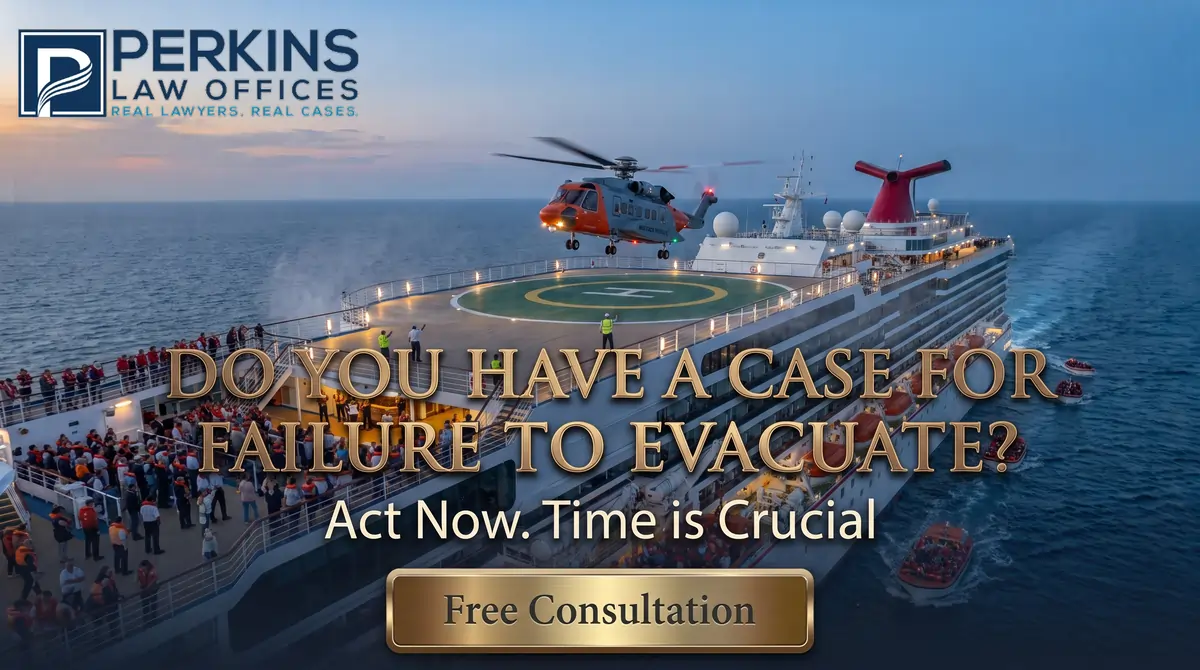
Can You Sue a Cruise Line for Failing to Arrange a Medical Evacuation?
When a passenger suffers a stroke, a cardiac event, a severe fall, or internal bleeding at sea, the single most important medical decision made on that voyage is often not a diagnosis. It is whether the ship’s medical staff and command staff act fast enough to get that passenger off the vessel and into a real hospital. When they don’t, a survivable emergency can become a permanent disability or a wrongful death. This is the legal theory behind a failure-to-evacuate claim, and it is one of the most serious and most frequently misunderstood categories of cruise ship litigation in the United States today.
Perkins Law Offices represents injured passengers and grieving families nationwide, not just in Florida. Because cruise line ticket contracts route virtually every claim into federal court under maritime law regardless of where the passenger boarded or resides, a passenger from Ohio, Texas, or California has the same legal footing as a passenger from Miami. What matters is the strength of the evidence and the lawyer’s familiarity with maritime medical negligence law, not the passenger’s home zip code.
What Is a Failure-to-Evacuate Claim?
A failure-to-evacuate claim arises when a cruise line’s onboard medical staff, captain, or corporate shoreside medical operations center becomes aware, or should have become aware, that a passenger’s condition requires a higher level of care than the ship can provide, and then fails to act on that knowledge with reasonable speed. This can take several forms:
- Delaying a request for a Coast Guard, military, or private helicopter evacuation after a stroke or cardiac event has been diagnosed or reasonably suspected
- Continuing on to the next scheduled port of call instead of diverting to the nearest port with adequate hospital facilities
- Downplaying the severity of symptoms to avoid the cost and disruption of an evacuation
- Failing to arrange ground or air transport once the ship reaches port
- Placing a critically injured or ill passenger in a vehicle for a lengthy overland transfer instead of coordinating an airlift
- Failing to communicate the passenger’s true condition to shoreside receiving physicians
Each of these scenarios shares a common thread: time is the variable that determines the medical outcome, and the cruise line controlled that variable.
The Legal Duty a Cruise Line Owes Its Passengers
Cruise lines operating out of United States ports are common carriers and owe their passengers a duty of reasonable care under the circumstances. This is a well-settled standard in federal maritime law, and it applies with particular force to shipboard medical decisions because the passenger has no ability to choose an alternate provider once at sea. The passenger is, in every practical sense, a captive patient.
For decades, cruise lines argued they could never be held responsible for the negligence of their own ship’s doctors and nurses under an old rule known as the Barbetta rule, drawn from Barbetta v. S/S Bermuda Star, 848 F.2d 1364 (5th Cir. 1988). That immunity no longer holds in the circuit that governs almost every major cruise line’s ticket contract. In Franza v. Royal Caribbean Cruises, Ltd., 772 F.3d 1225 (11th Cir. 2014), the Eleventh Circuit reversed a district court’s dismissal of a claim brought after an elderly passenger fell and struck his head aboard the Explorer of the Seas, after the ship’s nurse and doctor allegedly failed to assess his cranial trauma, failed to order diagnostic imaging, and did not see him for nearly four hours before he later died. The Eleventh Circuit expressly rejected the Barbetta rule and held that a passenger may pursue a cruise line for the medical negligence of its onboard doctor and nurse under theories of actual agency, apparent agency, or both.
The court’s reasoning matters for every failure-to-evacuate case that has followed. The Eleventh Circuit reasoned that the evolution of legal norms, the growth of the modern cruise industry, and advances in communication technology had erased whatever justification the old immunity rule once had. Courts applying Franza since 2014 have looked closely at the degree of control a cruise line exercises over its medical department, including whether the line advertised the existence of the medical center to passengers, retained the right to hire and fire medical staff, required medical staff to wear the ship’s uniform and report to the ship’s officers, and billed passengers for medical services through the ship’s onboard charge account. These same control factors apply directly to an evacuation decision, because the decision to call for a medevac, divert the vessel, or continue the itinerary is made by ship’s officers and medical staff acting under the cruise line’s chain of command.
Proving Duty, Breach, Causation, and Damages
Every cruise ship medical negligence and failure-to-evacuate case is built on the same four elements required in any negligence claim, and each one requires specific proof unique to the maritime setting.
Duty
The cruise line owed the passenger a duty of reasonable care under the circumstances, including reasonable care in staffing, equipping, and operating its medical facility and in making evacuation decisions once a serious condition was identified or reasonably suspected.
Breach
The medical staff or ship’s command breached that duty by failing to timely diagnose the condition, failing to request evacuation resources, or delaying the evacuation once it was requested. Breach is typically proven through the ship’s medical records, the deck log, radio and satellite communication logs with the Coast Guard or shoreside operations, and the testimony of the treating shoreside physicians who received the passenger after the delay.
Causation
This is frequently the most contested element. The cruise line’s defense will argue the outcome would have been the same regardless of when evacuation occurred. Overcoming this defense requires a qualified medical expert who can establish, to a reasonable degree of medical probability, that earlier evacuation and treatment would have prevented or materially reduced the injury, disability, or death. Time-sensitive conditions such as stroke, myocardial infarction, sepsis, and internal hemorrhage are especially well suited to this kind of causation analysis because medicine already recognizes narrow windows in which intervention changes outcomes.
Damages
Recoverable damages typically include past and future medical expenses, lost earnings and loss of earning capacity, and pain and suffering, which under general maritime law can include mental anguish, disfigurement, and loss of enjoyment of life. If the delay resulted in death and occurred within United States territorial waters or during voyages governed by state wrongful death law incorporated into maritime claims, survivors may recover more broadly. If death occurred more than three nautical miles from shore, the claim may instead be governed by the Death on the High Seas Act, which limits recovery to pecuniary losses and does not permit recovery for the survivors’ grief or loss of companionship. Determining which framework applies is one of the first things an experienced maritime attorney must resolve, because it materially affects the value of the case.
Why These Cases Require a Maritime Attorney, Not a General Injury Lawyer
Failure-to-evacuate claims sit at the intersection of medical malpractice and maritime law, two of the most technical areas of civil litigation. A lawyer must be able to read a ship’s medical chart the way a malpractice attorney would, while also understanding forum-selection clauses, notice deadlines, agency theory under Franza, and the jurisdictional quirks that differ by cruise line. Cruise lines defend these cases aggressively because a finding of liability threatens the very immunity structure the industry relied on for over a century before Franza was decided. Expect the defense to argue the passenger’s condition was unforeseeable, that shipboard staff acted within the applicable standard of care, or that the passenger’s own delay in reporting symptoms caused the outcome.
National Representation: Cruise Lines We Litigate Against
Perkins Law Offices represents passengers and families nationwide against the major cruise lines operating out of United States ports. Each line has its own forum-selection clause, notice requirements, and litigation history, and our firm tracks the differences across all of them:
- Carnival Cruise Line
- Royal Caribbean International
- Norwegian Cruise Line
- Celebrity Cruises
- Princess Cruises
- MSC Cruises
- Holland America Line
- Disney Cruise Line
Most of these lines require litigation in the United States District Court for the Southern District of Florida in Miami. Disney Cruise Line’s ticket contract requires suit in the Middle District of Florida in Orlando, and Holland America’s ticket contract requires suit in the Western District of Washington in Seattle. A passenger who lives nowhere near Florida or Washington can still bring a claim; the case is simply filed in the venue the ticket contract requires, and the passenger’s attorney appears there on the passenger’s behalf.
Deadlines That Can Destroy a Valid Claim
Cruise ticket contracts impose two deadlines that do not exist in typical land-based malpractice cases. Passengers generally must provide written notice of the claim to the cruise line within six months of the incident, and any lawsuit generally must be filed within one year of the incident. These deadlines apply even in death cases and even while a family is still absorbing the loss of a loved one. Missing either deadline can permanently bar an otherwise valid claim, regardless of how clear the medical negligence was.
What to Do If You Believe a Cruise Line Delayed Your Evacuation
- Request complete copies of your onboard medical records, including physician and nursing notes, vital sign logs, and any documentation of evacuation requests or denials, before you disembark if possible.
- Obtain the names and contact information of the shoreside physicians who treated you after the delay, along with their initial assessment of your condition on arrival.
- Preserve all communications with the cruise line, including any statements made by ship’s officers or medical staff about why evacuation was delayed.
- Do not sign any release, settlement offer, or statement provided by the cruise line without independent legal review.
- Contact a maritime attorney immediately given the six-month notice deadline and one-year filing deadline described above.
Frequently Asked Questions About Cruise Ship Medical Malpractice and Failure to Evacuate
Can I sue a cruise line for failing to evacuate a passenger for medical treatment?
Yes, in the right circumstances. Under Franza v. Royal Caribbean Cruises, Ltd., a cruise line can be held vicariously liable for the negligence of its onboard medical staff under theories of actual or apparent agency. If the medical staff or ship’s officers recognized a serious condition and unreasonably delayed calling for evacuation, refused to divert the vessel, or continued the voyage instead of getting the patient to a shoreside hospital, that delay can support a negligence claim.
What counts as a wrongful failure to evacuate on a cruise ship?
Generally, it involves shipboard medical staff or command being on notice of a serious, time-sensitive condition and failing to timely coordinate a helicopter or vessel evacuation, failing to divert to the nearest capable port, or continuing to the next scheduled port despite closer medical facilities being available.
How do I know if I have a case against a cruise line for medical negligence?
You may have a case if a family member’s condition worsened, resulted in permanent disability, or resulted in death because of delayed diagnosis, delayed treatment, or a delayed or refused evacuation. Strength of claim depends on the medical records, ship’s logs, and expert medical review establishing that earlier evacuation would have changed the outcome. A free case evaluation is the fastest way to find out.
How long do I have to file a cruise ship medical malpractice claim?
Most ticket contracts require written notice within six months of the incident and require any lawsuit to be filed within one year, both of which are shorter and more strictly enforced than typical land-based deadlines.
Where do I file a lawsuit against a cruise line for failure to evacuate?
Venue is dictated by the ticket contract, not by where the passenger lives. Most major lines require Southern District of Florida in Miami; Disney requires Middle District of Florida in Orlando; Holland America requires Western District of Washington in Seattle.
Does it matter which state I live in if I was hurt on a cruise?
No. These claims are governed by federal maritime law and the forum-selection clause in the ticket contract, not the passenger’s home state law. Perkins Law Offices represents passengers from anywhere in the United States.
Speak With a Maritime Attorney Today
If you or a loved one experienced a delayed diagnosis, a delayed evacuation, or a refused medevac aboard a cruise ship, the clock on your claim is already running. Perkins Law Offices evaluates cruise ship medical malpractice and failure-to-evacuate cases for passengers nationwide at no cost, and there are no attorney’s fees unless we recover compensation for you. Call (305) 741-5297, email perkins@perkinslawoffices.com, or visit perkinslawoffices.com to speak confidentially with our team.
This article is for general informational purposes only and does not constitute legal advice for any individual case. Viewing or submitting information through this page does not create an attorney-client relationship with Perkins Law Offices.