Yes. If your child suffered a brain injury on a cruise ship due to an unsafe sports facility, hazardous recreational area, or negligent maintenance, you may have a claim against the cruise line. Cruise companies have a duty to provide reasonably safe environments for passengers, including children, and may be held responsible when unsafe conditions cause serious injuries.
If your child suffered a brain injury on a cruise ship sports court, playground, or recreation deck — or on any unsafe property on land — you need answers, not sympathy. You need to know who is responsible, what the law requires them to prove, and how to move quickly before deadlines close the door on your case.
At Perkins Law Offices, we represent families across the United States as a child brain injury lawyer for unsafe sports facilities and premises liability cases on cruise ships. This is not a general practice we dabble in. It is a focused area of our firm built around one question: did the party responsible for that property owe your child a duty of care, and did they fail to meet it?
We handle these cases nationally, not just in Miami. Cruise lines board passengers from Florida, Texas, California, New York, and every port in between, and children are injured on land-based sports facilities in every state. Wherever your family lives, and wherever the injury occurred, our firm is built to take on that case.
Why Sports Facilities and Recreation Decks Put Children at Risk
Modern cruise ships and many commercial properties market themselves on their recreation amenities — basketball courts, ropes courses, climbing walls, waterslides, mini-golf courses, and open-air sports decks. These features sell tickets and memberships. They do not always come with the supervision, railing height, surfacing, and equipment maintenance that child safety requires.
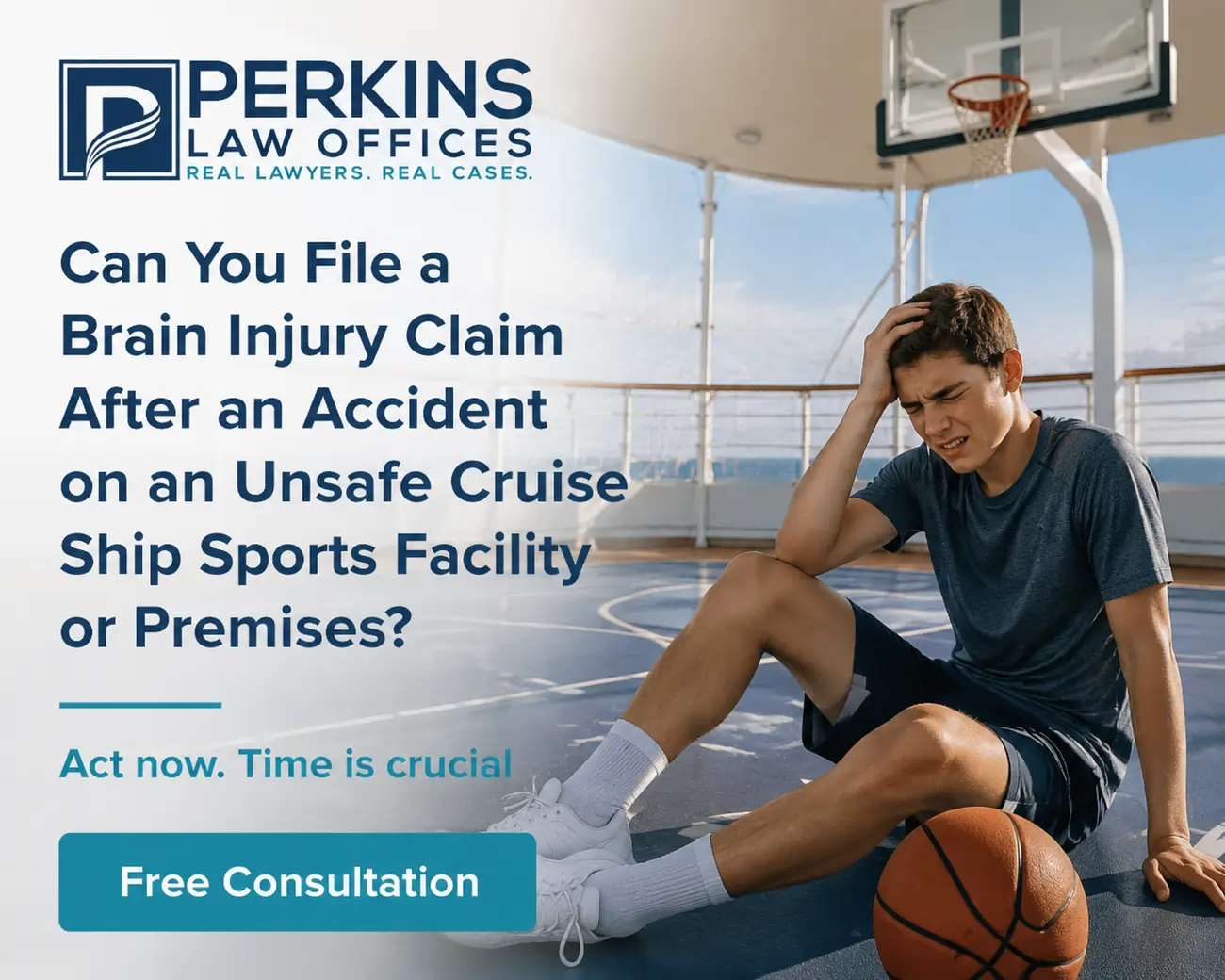
A basketball court built along the edge of an upper deck, a climbing wall without proper harness inspection, a sports court with a low or damaged railing, or a playground with hard surfacing instead of impact-absorbing material — each of these is a foreseeable hazard to a child’s head and brain. Brain injury is consistently one of the leading causes of disability and death among children in the United States, and unsupervised falls and blunt-force impacts are a major driver of that toll in young children, according to public health data compiled by federal injury-surveillance agencies. That is not an abstract statistic to a parent standing in a hospital hallway. It is the reason these cases exist.
Common Hazards We Investigate
- Sports courts or basketball hoops positioned near unguarded railings or drop-offs
- Missing, low, or damaged guardrails on elevated recreation areas
- Inadequate or absent staff supervision at child-designated play zones
- Worn, wet, or non-slip-rated flooring on courts and play decks
- Defective or poorly maintained sports and playground equipment
- Failure to enforce posted age or height restrictions on recreational features
- Absence of soft-fall surfacing beneath climbing or play structures
The Legal Framework: Duty, Breach, Causation, Damages
Every child brain injury claim, whether it arises on a cruise ship or on land, is built on four elements. We do not skip any of them, and neither will the defense.
Duty of Care
A property owner, cruise line, or facility operator owes a duty to keep the premises reasonably safe for the people it invites onto that property — and courts apply a heightened standard when children are foreseeably present. Cruise lines specifically owe passengers a duty of “reasonable care under the circumstances,” a standard the U.S. Supreme Court established for maritime passenger claims and that federal courts continue to apply today. On land, most states apply ordinary premises liability principles, and many recognize an elevated duty toward children through doctrines such as attractive nuisance, which anticipates that kids will be drawn to interesting but dangerous features on a property.
Breach
Breach means the operator failed to meet that duty — by ignoring a known hazard, skipping required inspections, failing to train or station staff, or disregarding manufacturer safety guidance for equipment. In maritime cases, we typically must show the cruise line had actual notice of the hazard or constructive notice, meaning it should have discovered the danger through reasonable inspection.
Causation
We must connect the breach directly to your child’s injury. This is where cruise ship surveillance footage, maintenance logs, incident reports, and witness statements matter most — and why time-sensitive evidence preservation is one of the first things our firm addresses in every new case.
Damages
Damages cover what your family has lost and what your child will need going forward: emergency and hospital care, neuroimaging and neuropsychological evaluation, inpatient or outpatient rehabilitation, special education support, future medical monitoring, and the non-economic toll of a child living with a cognitive or neurological impairment. Parents may also have independent claims for the costs of care and the disruption to the family unit.
Cruise Ship Cases Follow a Different Rulebook
Parents are often stunned to learn that a cruise ship injury is not treated like a typical personal injury claim. Cruise ship claims are governed by federal maritime law, not the law of the state where you live or even where the ship departed. That distinction changes almost everything about how the case proceeds.
The Ticket Contract Controls More Than You Think
The cruise ticket your family accepted when boarding functions as a binding legal contract. Buried in the fine print are provisions that can:
- Require written notice of your claim within a matter of months
- Shorten the standard three-year maritime filing deadline to as little as one year
- Dictate the specific federal court where any lawsuit must be filed, regardless of where you live
Missing any one of these deadlines can end a valid claim before it is ever heard. This is precisely why families should not wait to speak with a lawyer who works in maritime and cruise ship cases regularly.
Notice Requirements Are Strict
Because cruise lines argue they cannot be expected to fix every hazard instantly, courts generally require proof that the cruise line had actual or constructive notice of the dangerous condition. Prior incident reports, maintenance records, and internal safety communications are often the deciding evidence in these cases — and cruise lines do not volunteer them. Preserving that evidence early is a priority in every case our firm accepts.
Signs of a Child Brain Injury After a Fall or Impact
Not every brain injury announces itself immediately. Some symptoms surface hours or even days after a fall, blow to the head, or collision on a sports court. Parents should seek medical evaluation promptly if a child shows:
- Headache that worsens or persists
- Vomiting, nausea, or dizziness following the incident
- Confusion, disorientation, or difficulty concentrating
- Unusual drowsiness, or trouble staying awake
- Slurred speech or blurred vision
- Behavioral changes, irritability, or mood swings
- Loss of consciousness, even briefly
- Sensitivity to light or noise
A documented medical evaluation shortly after the incident does two things: it protects your child’s health, and it creates a medical record that becomes essential evidence if you later pursue a claim.
A National Practice, Built to Handle These Cases Anywhere
Families do not choose where a hazard is located, and they should not be limited to whichever attorney happens to have an office nearby. Perkins Law Offices represents child brain injury clients across the country, coordinating with local and admiralty counsel where needed, arranging virtual consultations, and managing the logistics of multi-jurisdictional cruise line litigation from a single point of contact. Whether the injury happened on a ship that departed from a port thousands of miles from home, or on a sports facility in another state entirely, our firm is structured to take that case on and see it through.
What Compensation May Be Available
Every case is different, and no attorney can promise a specific result before reviewing the facts. Depending on the severity of the injury and the strength of the liability evidence, compensation in a child brain injury case may address:
- Past and future medical expenses, including neurological specialists and rehabilitation
- Cognitive and educational support, tutoring, or special education services
- Pain, suffering, and loss of enjoyment of life
- Parents’ out-of-pocket costs and lost income from providing care
- Long-term or permanent disability and diminished future earning capacity, where applicable
A Realistic Scenario
Consider a family on a multi-day cruise whose eight-year-old was playing on an onboard sports court positioned near an unguarded ledge on an upper deck. No staff member was stationed nearby, the court had no barrier separating play space from the drop-off, and the child fell, striking his head. The family later learned, through documents obtained in litigation, that similar close calls had been reported on that same deck months earlier. That prior notice — combined with the absence of any barrier or supervision — is the kind of evidence that turns a tragic accident into a provable claim. This scenario reflects the type of facts our firm investigates in cruise ship sports facility cases; it is not a description of any specific client or case.
Frequently Asked Questions
How much does it cost to hire a child brain injury lawyer?
Perkins Law Offices handles these cases on a contingency fee basis. There is no upfront cost, and you owe attorney’s fees only if we recover compensation on your child’s behalf.
How long do I have to file a claim if my child was injured on a cruise ship?
This is one of the most important questions a parent can ask, and the answer is often shorter than people expect. While the general federal maritime statute of limitations for personal injury is three years under 46 U.S.C. § 30106, most cruise ticket contracts shorten that window — frequently to one year — and may also require written notice of the claim within just a few months of the incident. Missing these deadlines can bar the claim entirely, so early legal review matters.
Does it matter that my child is a minor?
Yes, the fact that your child is a minor is legally significant, but it does not eliminate the contractual and maritime deadlines discussed above, and parents should never assume they have extra time by default. The safest course is to have a claim evaluated immediately rather than relying on assumptions about tolling rules.
Can I sue if the cruise ship is registered outside the United States?
In most cases, yes. Major cruise lines that sell tickets to U.S. residents and depart from U.S. ports are still subject to U.S. federal maritime law and to the forum clauses written into their own ticket contracts, regardless of where the vessel is flagged.
What if my child’s symptoms didn’t appear until days after the incident?
Delayed-onset symptoms are common with traumatic brain injuries, including concussions. A delay in symptoms does not disqualify a claim, but it does make prompt medical documentation and a clear timeline connecting the injury to the incident especially important.
Do you only handle cases in Florida?
No. While Perkins Law Offices is based in Miami, we represent families nationwide in child brain injury, unsafe sports facility, and cruise ship premises liability cases, coordinating admiralty and local counsel as needed wherever the case requires it.
What evidence should I gather right away?
Photographs of the hazard and the surrounding area, the names of any witnesses, incident or medical reports generated on board or at the facility, and the ticket contract or facility waiver your family received. Cruise lines and property owners are not obligated to preserve everything indefinitely, so early documentation matters.
Will the cruise line or property owner claim my child was unsupervised or at fault?
It is common for defendants to raise comparative negligence, including suggestions that a child was unsupervised. These arguments do not automatically defeat a claim, but they do underscore the importance of a lawyer who can respond to that defense with facts, not assumptions.
Speak With a Child Brain Injury Lawyer Before Deadlines Close
If your child was hurt on an unsafe sports facility, playground, or cruise ship recreation area, the facts of your case and the applicable deadlines need to be reviewed now, not after the ticket contract’s notice period has already passed. Perkins Law Offices evaluates child brain injury, premises liability, and cruise ship negligence claims for families throughout the United States.
This article is provided for general informational purposes and does not constitute legal advice. Every case depends on its own facts, and past results do not guarantee a similar outcome in any future matter. Contact Perkins Law Offices for a case-specific evaluation.