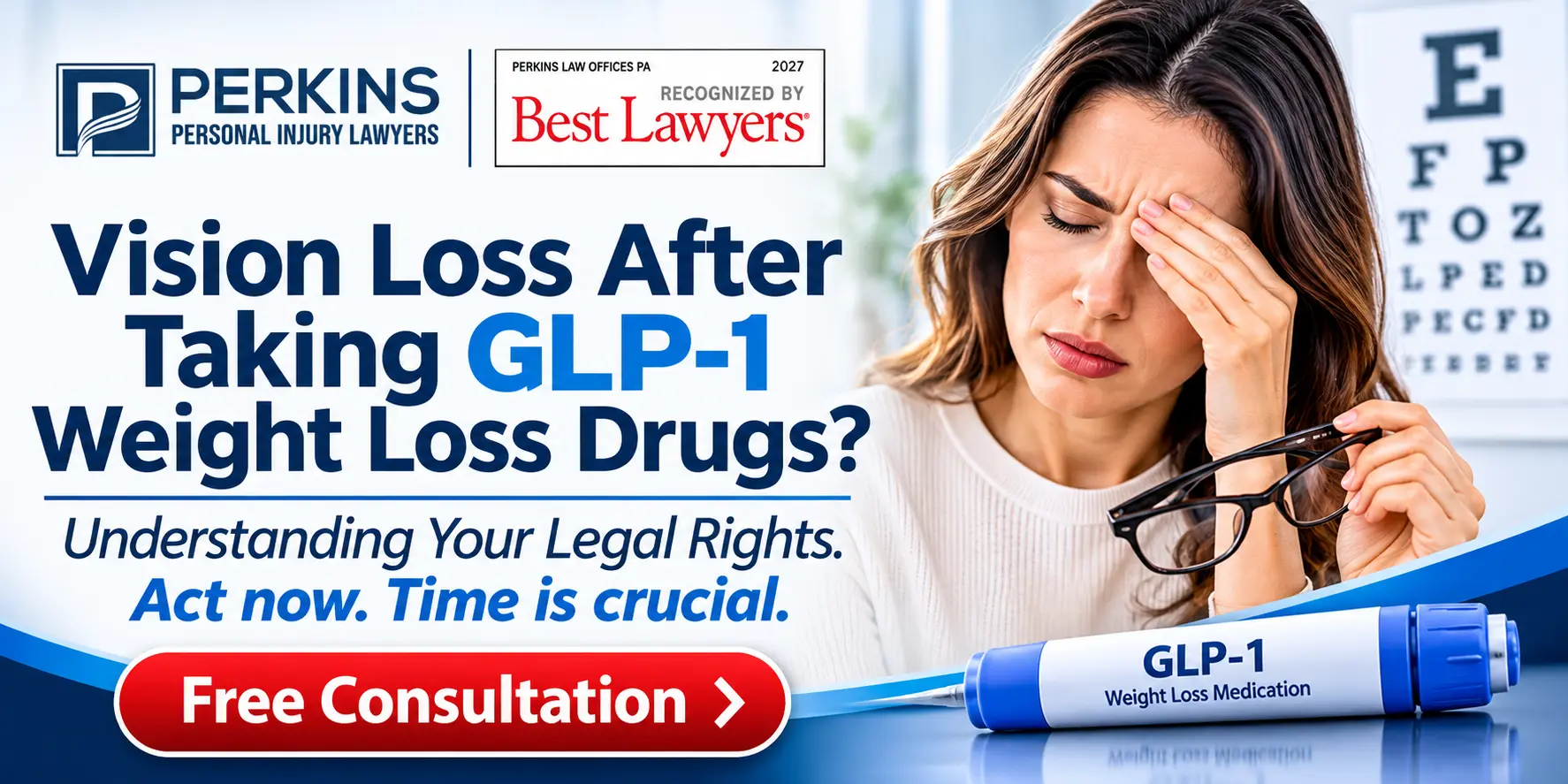
Vision Loss After Taking GLP-1 Weight Loss Drugs? Understanding Your Legal Rights
Vision Loss After Taking GLP-1 Weight Loss Drugs? Understanding Your Legal Rights
By Alex Perkins, Founding Attorney, Perkins Law Offices | Updated November 12, 2026
Perkins Personal Injury Lawyers help clients with defective drug and pharmaceutical injury claims for clients across the United States. Reports are increasing of people losing their sight almost instantly from one day to the next after using weight loss drugs. Victims can wake up with a gray shadow over part of their vision after taking Ozempic, Wegovy, Mounjaro, Zepbound or another GLP-1 medications. Many are searching the internet to find the cause and cure only to learn it’s a irreversible. The next line of questions are, can I sue, and do I have a real case?
The answer changed this week. On November 9, 2026, the U.S. Food and Drug Administration required the manufacturers of every GLP-1 receptor agonist sold in this country to add a warning about a potential increased risk of non-arteritic anterior ischemic optic neuropathy, known as NAION. That is the condition at the center of the GLP-1 vision loss lawsuit now pending in federal court.
Below I explain what NAION is, what the science does and does not show, how a pharmaceutical injury lawyer evaluates duty, breach, causation and damages in these cases, where the national litigation stands, and what you should do now to protect your claim.
Where GLP-1 Vision Loss Claims Stand in November 2026
Here are the facts as they exist today, without spin:
- The FDA has acted. On November 9, 2026, the agency announced it is requiring all GLP-1 manufacturers to add information about a potential increased risk of NAION to the Warnings and Precautions section of their labeling. The FDA described NAION as a rare condition that can cause sudden, painless vision loss in one eye, including permanent vision loss.
- The FDA did not find direct causation. The agency identified a potential increased risk. It did not establish that GLP-1 drugs cause NAION. That distinction will matter in court.
- Federal cases are consolidated. Vision loss claims against Novo Nordisk and Eli Lilly are grouped in MDL 3163, In re: GLP-1 RAs NAION Products Liability Litigation, before Judge Marston in the U.S. District Court for the Eastern District of Pennsylvania. According to Judicial Panel on Multidistrict Litigation figures, 247 cases were pending as of October 1, 2026, up from 29 in early January 2026.
- State court cases are also moving. A parallel New Jersey Multicounty Litigation handles GLP-1 NAION cases filed in New Jersey state court.
- Nothing has settled. No GLP-1 vision loss case has settled, and no judge or jury has found that these drugs caused anyone’s blindness. Anyone quoting you a settlement figure is guessing.
That is the landscape. It’s very early and it will be years before we see meaningful progress toward whether these will be viable drug defect claims.
What Is NAION, and Why Do Doctors Call It an “Eye Stroke”?
Non-arteritic anterior ischemic optic neuropathy is damage to the optic nerve caused by a sudden loss of blood flow to the front of the nerve, where it enters the eye. Think of the optic nerve as a thick fiber-optic cable carrying every image from your eye to your brain. NAION is a blackout at the junction box. When blood flow drops, part of that cable dies, and the signals it carried stop arriving.
How NAION Typically Presents
The pattern is remarkably consistent, and it matches the medical literature:
- Vision loss in one eye, often noticed on waking.
- No pain. Many people assume something minor is wrong because it does not hurt.
- A blurred, dimmed or missing section of the visual field, frequently the upper or lower half.
- Colors that look washed out in the affected eye.
Why NAION Vision Loss Is Usually Permanent
Nerve tissue that dies from lack of blood flow does not grow back. There is no established treatment that reliably restores vision lost to NAION. Some patients see limited improvement over the following months. Most live with a permanent deficit. That permanence is why these cases are serious, and why the damages analysis, which I cover below, looks so different from a typical injury claim.
NAION is also rare in the general population. Medscape, summarizing the FDA’s review, reported a background rate of roughly 2.3 to 10.2 cases per 100,000 adults over age 50. Rare conditions are hard to study, which is one reason the science on GLP-1 drugs took time to develop.
What the Research Shows About Ozempic, Wegovy and Semaglutide Vision Loss
Every pharmaceutical injury claim rises or falls on the science. Here is how the evidence on GLP-1 drugs and blindness developed, in order.
2024: The Harvard / Mass Eye and Ear Study
In July 2024, researchers at Massachusetts Eye and Ear and Harvard Medical School published a study in JAMA Ophthalmology (Hathaway et al., 2024) reviewing records of 16,827 patients seen in a neuro-ophthalmology service. Among patients with type 2 diabetes, those prescribed semaglutide had a hazard ratio of 4.28 for NAION compared with patients on other diabetes medications. Among patients with overweight or obesity, the hazard ratio was 7.64.
In plain terms, semaglutide patients in that study developed NAION at several times the rate of comparable patients who were not taking it. The researchers also observed that the risk appeared highest in the first year after the prescription.
The study’s senior author, Dr. Joseph Rizzo of Mass Eye and Ear, said that while semaglutide offers significant benefits, conversations between patients and their doctors going forward should include NAION as a potential risk. That is a respected neuro-ophthalmologist saying, in effect, that patients deserved to be told.
The Limits of That Study
One study does not mean the cases are open and shut. The Harvard study was observational and drawn from a single specialty eye hospital, whose patients are not representative of the general public. The absolute number of NAION cases was small. The authors themselves stated that further study was needed to assess causality. In an invited commentary published alongside it, Professor Susan Mollan, a neuro-ophthalmologist at the University of Birmingham, challenged the conclusion that the drug itself caused the increased risk. Defense lawyers will lean hard on every one of these points. As of now, much more study is needed for claims to survive.
2025: Europe Reaches a Conclusion First
In June 2025, the European Medicines Agency’s safety committee (PRAC) completed its review of semaglutide and concluded that NAION is a very rare side effect of Ozempic, Rybelsus and Wegovy, meaning it may affect up to 1 in 10,000 people taking the drug. The EMA reported that several large epidemiological studies suggested roughly a two-fold increase in NAION risk for adults with type 2 diabetes taking semaglutide, corresponding to about one additional case per 10,000 person-years of treatment. European product information was updated, with instructions that semaglutide should be stopped if NAION is confirmed.
That date matters legally. For more than a year after European regulators added NAION to semaglutide labeling, U.S. labeling did not carry a comparable NAION warning. Plaintiffs in the U.S. litigation point to that gap as the core of their failure-to-warn theory.
Other data points have accumulated. A large 2025 study of roughly 175,000 diabetic patients on semaglutide, compared against an equal number on non-GLP-1 medications, reported that NAION risk more than doubled after two years of treatment. And in Denmark, the national patient compensation authority granted compensation to four patients who lost vision after using Novo Nordisk GLP-1 drugs.
November 2026: The FDA’s Class-Wide Warning
The FDA’s November 9, 2026 action went further than Europe in one respect. The EMA review addressed semaglutide. The FDA requirement covers the entire GLP-1 class. The agency noted that NAION cases had been reported in postmarketing surveillance for every currently marketed GLP-1 drug.
The FDA was also candid about the uncertainty. Its meta-analysis of 126 clinical trials, covering 134,253 participants of whom 78,217 received a GLP-1 drug, identified only 15 probable NAION events. Its animal data review did not identify a mechanism. In its real-world analysis, GLP-1 drugs showed a statistically increased NAION risk compared with DPP-4 inhibitors (hazard ratio 1.43) but not compared with SGLT2 inhibitors (hazard ratio 1.19). The FDA weighed all of it and required the warning anyway.
The FDA’s new guidance to physicians is direct: if NAION is suspected, promptly refer the patient to an ophthalmologist, and consider discontinuing the GLP-1 drug in patients who develop NAION unless the benefits of treatment clearly outweigh the risk.
Which Drugs Are Covered by the New Warning
Per the FDA’s list, the labeling requirement applies to:
- Semaglutide: Ozempic, Wegovy, Rybelsus (Novo Nordisk)
- Tirzepatide: Mounjaro, Zepbound (Eli Lilly)
- Dulaglutide: Trulicity (Eli Lilly)
- Liraglutide: Victoza, Saxenda; and liraglutide with insulin degludec (Xultophy)
- Lixisenatide with insulin glargine: Soliqua
- Exenatide
- Orforglipron: Foundayo, approved in 2026
The products named in MDL 3163 include Ozempic, Wegovy, Rybelsus, Saxenda, Trulicity, Mounjaro and Zepbound.
A Typical Call to My Office
The following is a composite drawn from the kinds of calls law firms are receiving about GLP-1 vision loss. It does not describe any specific client.
A 58-year-old woman had been on a weekly GLP-1 injection for about seven months. She had lost 40 pounds and felt better than she had in years. One morning she noticed the bottom half of the world looked dim through her right eye. No pain, so she waited two days. Her optometrist sent her to a neuro-ophthalmologist, who diagnosed NAION. Seven months later, the vision has not returned. She can no longer drive at night. She asks me two questions: “Why didn’t anyone tell me this could happen?” and “Is it too late to do anything?”
A GLP-1 product liability lawsuit is not a lottery ticket. It is a claim that must be proven with science and experts.
A prescription drug manufacturer has a duty to warn of the known risks of its product. That duty also extends to foreseeable off-label uses. This matters for anyone prescribed Ozempic for weight loss rather than diabetes. Florida and other courts have recognized the duty to warn applies to foreseeable off-label use, and given how widely GLP-1 drugs have been prescribed for weight loss, foreseeability is not a difficult argument.
The central allegation in the Ozempic blindness lawsuit and the Wegovy blindness lawsuit is that the manufacturers knew, or should have known, of a NAION risk and failed to warn adequately. Plaintiffs point to the 2024 Harvard study, the European label change in 2025, and the postmarketing reports the FDA has now acknowledged across the class.
The legal question becomes one of timing. What did the manufacturer know, and when? Could it have updated the U.S. label sooner? Under Wyeth v. Levine, 555 U.S. 555 (2009), a brand-name manufacturer can generally strengthen its warning label on its own through the FDA’s “changes being effected” process, without waiting for agency approval. That decision is a cornerstone of failure-to-warn claims against brand manufacturers like Novo Nordisk and Eli Lilly.
Causation is where pharmaceutical cases are won and lost, and it has two layers:
- General causation: Can GLP-1 drugs cause NAION at all? This is decided once, for everyone in the MDL, through expert testimony tested under Federal Rule of Evidence 702. The court has entered scheduling orders contemplating early motion practice on general causation and preemption, with Rule 702 and summary judgment motions currently scheduled for mid-2027.
- Specific causation: Did the drug cause your NAION? This is individual. Your neuro-ophthalmologist’s findings, your other risk factors, and the timing between starting the drug and losing vision all matter.
The second warning layer also matters. Plaintiffs generally must show that a stronger warning would have changed the outcome, for example that the prescribing physician would not have prescribed the drug, would have monitored differently, or would have stopped it at the first sign of trouble.
When vision loss is permanent, damages are measured across a lifetime, not a recovery period. Depending on the facts and the governing state law, recoverable damages in a medication vision loss claim can include:
- Past and future medical expenses, including neuro-ophthalmology care, imaging and low-vision rehabilitation
- Lost wages and lost earning capacity, especially for anyone whose work depends on driving or fine visual tasks
- Costs of adaptive equipment, transportation and household help
- Pain and suffering, mental anguish and loss of the capacity for the enjoyment of life
- In some cases, a spouse’s claim for loss of consortium
Losing sight in one eye changes depth perception, night driving, reading, sports and independence. A properly documented damages case shows a jury, in concrete terms, what that loss means day to day.
The Counterarguments
Every GLP-1 eye injury claim will face a well-funded defense. These are the arguments Novo Nordisk and Eli Lilly can be expected to raise, and you should weigh them honestly:
- The absolute risk is small. Even accepting the EMA’s figures, the added risk is on the order of one case per 10,000 patient-years. Defendants will argue millions of patients have benefited and very few were harmed.
- NAION has other causes. Diabetes, high blood pressure, sleep apnea, a structurally “crowded” optic disc and certain medications are all associated with NAION. Many GLP-1 patients have one or more of these. The defense will argue your NAION would have happened anyway.
- The science is mixed. The FDA’s own trial analysis found only 15 probable events, and its real-world comparisons varied by comparator drug. Defense experts will cite every negative study.
- Federal preemption. Manufacturers argue that federal law blocks state failure-to-warn claims where there is clear evidence the FDA would have rejected a stronger warning. The Supreme Court addressed that standard in Merck Sharp & Dohme Corp. v. Albrecht, 587 U.S. 299 (2019). The FDA’s November 2026 requirement cuts against a preemption defense, but expect the issue to be litigated.
- Your doctor already knew. Under the learned intermediary doctrine, if your physician was independently aware of the NAION risk, the defense will argue the label’s content did not matter.
None of these arguments means you do not have a case. They mean your case needs to be evaluated and built carefully, from medical records forward.
How GLP-1 Vision Loss Lawsuits Are Handled Nationally
MDL 3163 in the Eastern District of Pennsylvania
When many people file similar lawsuits in federal courts around the country, the Judicial Panel on Multidistrict Litigation can send them to one judge for coordinated pretrial proceedings. That is what happened here. In December 2025, the Panel created MDL 3163 for NAION claims, separate from MDL 3094, which handles gastroparesis and other gastrointestinal injury claims against the same manufacturers. A vision loss case filed by a patient in Texas, Ohio or California follows the same path into MDL 3163 as one filed by a patient in Miami.
This Is Not a Class Action
People often search for a “GLP-1 class action lawsuit.” That is not how this litigation works. In an MDL, every plaintiff keeps an individual lawsuit. Discovery and expert rulings are shared, but your compensation, if any, turns on your own diagnosis, records and losses. That is generally better for a person with a serious, permanent injury, because your case is not averaged with everyone else’s.
The New Jersey Multicounty Litigation
Novo Nordisk’s U.S. operations are headquartered in New Jersey, and GLP-1 NAION cases filed in New Jersey state court are coordinated in a separate Multicounty Litigation. Whether a case belongs in federal or state court is a strategic decision that depends on the facts and should be made with counsel.
Representing Clients Across the United States From Miami
My office is in Miami, with a second office in Boca Raton, but the patients harmed by nationally marketed drugs live everywhere. Perkins Law Offices represents injured clients nationally. I am licensed in Florida, Illinois and Washington, D.C. Where a particular state or court requires it, we work alongside locally licensed co-counsel so that every case is filed and handled properly, wherever the client lives. Our product liability practice is built for exactly this kind of multi-state litigation against large corporate defendants.
Do You Have a GLP-1 Vision Loss Case? A Practical Screening Checklist
When I review a potential NAION vision loss lawsuit, these are the first questions I ask. If you can answer yes to most of them, you should speak with a lawyer:
- Were you prescribed a GLP-1 drug such as Ozempic, Wegovy, Rybelsus, Mounjaro, Zepbound, Trulicity or Saxenda?
- Did you experience sudden vision loss after starting the medication?
- Were you diagnosed with NAION or ischemic optic neuropathy by an ophthalmologist or neuro-ophthalmologist?
- Is the vision loss permanent or still present months later?
- Can you document when you started the drug, through pharmacy records or prescriptions?
- Did your vision loss occur before the November 9, 2026 FDA warning, or before your prescriber told you about the NAION risk?
One distinction I raise early: if you used a compounded semaglutide or tirzepatide product from a compounding pharmacy or telehealth company, rather than the brand-name drug, the defendants and legal theories may be different. That does not end the inquiry, but it changes it. Tell your lawyer exactly what you took and where it came from.
What to Do Right Now If You Lost Vision on a GLP-1 Drug
Medical care comes first. Legal protection comes immediately after.
- Treat sudden vision loss as an emergency. Get evaluated by an eye doctor the same day if you can. Other causes of sudden vision loss, including arteritic forms that threaten the other eye, require urgent treatment.
- Do not stop or change medication on your own. Discuss it with your prescribing physician. The decision is medical, not legal.
- Request your records. Ask for the ophthalmology and neuro-ophthalmology notes, visual field tests, OCT imaging and the written diagnosis.
- Preserve proof of use. Keep pens, cartons, pharmacy labels and receipts. Download your pharmacy history. If the product was compounded, keep the vial and paperwork.
- Write a timeline while it is fresh. When you started the drug, dose changes, when you first noticed the vision change, and every doctor you saw.
- Stay off social media about it. Defense lawyers read public posts.
- Calendar your deadline. Then call a lawyer before it approaches, not after.
Filing Deadlines: How Long Do You Have to File a GLP-1 Vision Loss Lawsuit?
Every state sets its own statute of limitations, and missing it ends the claim regardless of its merit.
In Florida, product liability claims are generally subject to a four-year statute of limitations under section 95.11(3), Florida Statutes, with a statutory discovery rule under section 95.031(2) and a 12-year statute of repose. However, Florida’s 2023 tort reform, HB 837, reduced the limitations period for negligence actions accruing on or after March 24, 2023 from four years to two. A GLP-1 claim often pleads both strict liability and negligence counts, so the safest practice is to treat two years as the outer limit for planning purposes until a lawyer reviews your dates.
Other states are shorter. Some allow as little as one year for personal injury claims. When the clock starts, whether at the date of vision loss, the diagnosis, or when you reasonably connected the injury to the drug, is itself a contested legal question. Defendants may argue that widespread publicity about the Harvard study, the EMA decision or the FDA warning started the clock. Do not assume you have time.
What It Costs to Hire a GLP-1 Injury Attorney at Perkins Law Offices
Your consultation is free and confidential. Perkins Law Offices handles injury cases on a contingency fee basis. You pay no attorney fee unless we recover money for you, and the written fee agreement explains exactly how fees and case costs are handled before you sign anything. You will speak with me directly, not a call center.
Frequently Asked Questions About GLP-1 Vision Loss Lawsuits
Can I sue if I lost vision after taking Ozempic or Wegovy?
Possibly. Patients diagnosed with NAION after taking a GLP-1 drug are filing product liability lawsuits alleging the manufacturers failed to adequately warn of the risk. Whether you have a viable claim depends on your diagnosis, medical records, timing and your state’s filing deadline.
Is there a GLP-1 class action lawsuit for vision loss?
Not in the usual sense. Federal cases are grouped in MDL 3163 for pretrial proceedings, but each person keeps an individual lawsuit, and any recovery depends on that person’s own injuries and evidence.
How many GLP-1 vision loss lawsuits have been filed?
According to Judicial Panel on Multidistrict Litigation data, 247 cases were pending in MDL 3163 as of October 1, 2026, up from 29 in early January 2026. The number has grown every month.
Does the FDA’s November 2026 warning prove my case?
No. It is significant evidence that a risk is recognized, but the FDA stated a potential increased risk and did not conclude that GLP-1 drugs directly cause NAION. Causation must still be proven with expert testimony. The warning does, however, strengthen the argument that patients should have been told sooner.
How much is a GLP-1 vision loss case worth?
No one can honestly answer that today. There have been no settlements or verdicts in this litigation. Value in any individual case depends on the severity and permanence of vision loss, age, work, medical costs and the strength of causation evidence. Be cautious of any firm advertising a specific number.
Do Mounjaro and Zepbound users have claims too?
The FDA’s warning applies to tirzepatide products, and MDL 3163 includes Eli Lilly’s Mounjaro, Zepbound and Trulicity alongside Novo Nordisk’s semaglutide products. Much of the published research focused on semaglutide, which a defense will emphasize, but tirzepatide users with a NAION diagnosis should have their cases reviewed.
What if I took a compounded or telehealth version of semaglutide?
Claims involving compounded drugs may target different defendants, such as the compounding pharmacy, and may rely on different legal theories than claims against the brand manufacturer. Bring every record of what you took and where it came from.
What if I have diabetes or sleep apnea, which also raise NAION risk?
Having other risk factors does not automatically defeat a claim, but it makes specific causation harder and makes expert analysis essential. Be candid with your lawyer about your full medical history. Hidden facts hurt cases far more than disclosed ones.
Do I need to live in Florida to hire Perkins Law Offices?
No. We represent clients nationally. Federal GLP-1 vision loss cases from across the country are consolidated in MDL 3163, and where a court or state requires it, we work with locally licensed co-counsel.
Should I stop my GLP-1 medication if I notice vision changes?
Get an eye examination immediately and talk to your prescribing doctor. The FDA advises physicians to consider discontinuing the drug in patients who develop NAION unless the benefits clearly outweigh the risk. That is a medical decision for you and your doctor.
Talk to Alex Perkins About Your GLP-1 Vision Loss
The GLP-1 drugs have helped many people. They have also, according to a growing body of evidence now recognized by regulators on two continents, been associated with a rare and permanent form of vision loss that patients in this country were not warned about until November 2026. If you were one of the people harmed, you have the right to have your case evaluated by a lawyer who will tell you the truth about its strengths and its weaknesses.
I will review your records, explain how your state’s deadlines apply, and tell you plainly whether I believe you have a viable claim. Call or text (305) 741-5297, email perkins@perkinslawoffices.com, or request a free, confidential case review. We represent clients throughout the United States.
Perkins Law Offices | Miami Office
1728 Coral Way, Suite 702, Miami, FL 33145
(305) 741-5297
Perkins Law Offices | Boca Raton Office
6560 W. Rogers Circle, Suite 15, Boca Raton, FL 33487
(561) 621-1776
Sources
- U.S. Food and Drug Administration, Drug Safety Communication: FDA Requires Safety Labeling Changes for GLP-1 Receptor Agonists Due to Potential Increased Risk of Rare But Serious Eye Condition (November 9, 2026).
- European Medicines Agency, PRAC concludes eye condition NAION is a very rare side effect of semaglutide medicines Ozempic, Rybelsus and Wegovy (June 2025).
- Hathaway JT, et al. Risk of Nonarteritic Anterior Ischemic Optic Neuropathy in Patients Prescribed Semaglutide. JAMA Ophthalmology. 2024;142(8):732-739.
- Mollan SP. Invited Commentary: Semaglutide and Nonarteritic Anterior Ischemic Optic Neuropathy. JAMA Ophthalmology. 2024.
- Judicial Panel on Multidistrict Litigation, pending case statistics, MDL No. 3163 (October 2026).
- Felix v. Hoffmann-LaRoche, Inc., 540 So. 2d 102 (Fla. 1989).
- Wyeth v. Levine, 555 U.S. 555 (2009).
- Merck Sharp & Dohme Corp. v. Albrecht, 587 U.S. 299 (2019).
- Sections 95.11 and 95.031, Florida Statutes.
Attorney Advertising. The information on this page is for general informational purposes only and is not legal or medical advice for any individual situation. Reading this page, submitting a contact form, calling, texting or emailing does not create an attorney-client relationship. Past results do not guarantee a similar outcome, and no outcome is promised. Do not stop, start or change any medication without consulting your physician. Perkins Law Offices is licensed to practice law in Florida, Illinois and Washington, D.C.; for matters in other jurisdictions, the firm associates with locally licensed counsel as required.