How to Protect Your Compensation After a Car Accident
A Legal Guide From a Miami Car Accident Lawyer at Perkins Law Offices
A car crash on a Florida roadway triggers a confusing maze of medical visits, legal duties, insurance deadlines, and evidence preservation requirements that can determine whether an injured person recovers any compensation. It may seem straightforward that you were in an accident that wasn’t your fault, so that someone should pay for your injury. But, not so fast. Sometimes even the best car accident lawyers cannot recover money for their car accident victims if certain rules and deadlines are not complied with or if the case is not built properly from the start. There are many moving parts to a winning car accident claim and lawsuit, from medical treatment to court rules. To get the best results requires professional guidance from a Florida personal injury lawyer.
This short article explains the Steps to Take After a Car Accident from the perspective of a well respected and experienced Miami car accident lawyer handling serious injury cases across Florida and representing victims from across the nation injured in the Sunshine state.
Legal Overview on What to Do After a Crash
Florida car accident and insurance laws impose legal responsibilities on drivers from both sides of a crash. Not just the at fault party. In order to trigger benefits or pay outs under any insurance policy, hoops must be jumped through even if you had nothing to do with causing the accident. This is why if you are in a crash you should cooperate with your own insurance company. You must report the injuries and accident so as not to jeopardize your own insurance coverages.
Many folks tend to think they shouldn’t have to involve their own insurance carrier since the accident was someone else’s fault. That’s not a good idea. Most policies require prompt notice of claims or they do not have to provide coverage. Under Florida PIP laws and the No fault system, the first $10,000 of medical coverage must come from your own automobile policy regardless of who caused the crash. This is why you should report. Also if you want the damage to your car to be fixed quickly or you need a rental car, your own insurance may initially cover those costs without regard to who caused the accident. The insurance you pay for must cover you even if liability of who caused the accident is disputed.
Of course, you may report the crash when you have time and don’t have to call your insurance from the accident scene. The first thing to do after you get into a crash is,check for injuries, exchange identifying information, and report the accident to law enforcement as required by law when injuries, death, or property damage is involved.
Failure to report a legally required crash can result in a lack of official records that the crash even happened making it harder to pursue your injury case. Just because you get in a car crash and get injured, doesn’t automatically mean money will fall in your lap. An injured driver or passenger or pedestrian must be able to prove up liability for the accident to hold someone else responsible for medical bills, lost wages and pain and suffering.
From a litigation standpoint, the first minutes and days after crash can make or break your case and whether you can establish the building blocks of every negligence case. Duty, Breach Causation and Damages must be proved by the claimant in all cases to be entitled to compensation in every successful personal injury case.
Step-by-Step: What To Do Immediately After a Car Accident
1. Secure Safety and Call 911
Safety is the first legal and medical priority. Drivers must check for injuries and request emergency help when anyone is hurt.
Even injuries that seem minor—such as whiplash, concussions, or internal bleeding—may not appear immediately, making medical evaluation critical.
From a legal standpoint, calling 911 also creates independent third-party documentation, which insurers and courts rely on when evaluating fault.
2. Remain at the Scene and Move to Safety if Possible
Florida law requires drivers involved in injury or damage crashes to remain at the scene and report the accident.
If vehicles are drivable and no serious injuries exist, moving to the shoulder can prevent secondary collisions and roadway hazards.
Leaving the scene prematurely can expose a driver to hit-and-run liability, even when the crash itself was not their fault.
3. Call Law Enforcement and Obtain a Police Report
A crash must be reported when it involves:
Injury or death
Property damage of approximately $500 or more
A vehicle requiring towing
These reporting duties arise directly under Florida statute.
The official police report becomes is where every insurance negotiations and personal injury litigation investigation starts.
A Miami car accident lawyer will always request this report first when evaluating a claim.
4. Exchange Required Information Without Admitting Fault
Florida law requires drivers to exchange:
Names and contact details
Driver’s license numbers
Vehicle registration
Insurance information
This statutory exchange enables insurance claims and legal accountability.
Equally important:
Do not apologize or speculate about fault.
Even casual statements can be misinterpreted and later used to deny compensation.
5. Document the Crash Scene Thoroughly
Evidence disappears quickly.
Photograph:
Vehicle damage from multiple angles
Visible injuries
Road conditions, debris, and traffic signals
License plates and surroundings
Detailed documentation can strengthen an insurance claim or lawsuit by preserving real-time proof.
Without evidence, liability disputes often default in favor of insurers.
6. Seek Medical Treatment Within Florida’s PIP Deadline
Florida’s no-fault insurance system requires medical treatment within 14 days to qualify for full Personal Injury Protection benefits, typically up to $10,000.
Delaying treatment can:
Reduce available benefits
Create causation disputes
Undermine credibility of injury claims
From a litigation perspective, medical records are the backbone of damages proof.
7. Notify Insurance Carefully — Then Speak With a Lawyer
You must report the accident to your insurer, but caution is critical.
Statements given too early can be used to minimize or deny compensation.
Before providing recorded statements or signing releases, injury victims should obtain legal guidance from a car accident lawyer experienced in Florida claims.
Legal Path After the Accident: Insurance vs. Lawsuit
Florida operates under a no-fault system, meaning your own PIP insurance initially covers medical expenses regardless of fault.
However, when injuries are serious or losses exceed PIP limits, victims may pursue full compensation against the at-fault driver through a personal injury claim.
This transition—from insurance claim to lawsuit—is where legal representation becomes decisive.
Common Mistakes That Destroy Car Accident Claims
Waiting Too Long for Medical Care
Delays allow insurers to argue injuries were not caused by the crash.
Admitting Fault at the Scene
Fault determinations require investigation, not roadside conversation.
Failing to Collect Evidence
Without photos, witnesses, or reports, proving negligence becomes difficult.
Signing Insurance Releases Too Early
Early settlements often exclude future medical costs or long-term disability.
These errors routinely reduce or eliminate otherwise valid claims.
Why Injury Victims Contact a Miami Car Accident Lawyer
People searching “Steps to Take After a Car Accident” are often asking a deeper question:
Do I have a case—and should I sue?
A Florida personal injury attorney evaluates:
Negligence and liability
Medical severity thresholds
Insurance coverage limits
Long-term damages and lost income
When those factors align, pursuing compensation becomes not only possible—but necessary.
Florida Focus, Nationwide Reach
Perkins Law Offices is based in Miami, handling:
- Crosswalk accidents
- Motorcycle crashes
- Bike accidents
- Florida car accident claims
- Serious injury and wrongful death cases
- Boating cases
- Cruise ship injuries
- Product defects
- Uber Accidents
- Lyft Accidents
- Truck Accidents
- ATV accidents
- Slip Falls
- Trip Falls
- Negligent Security
- Dog Bites
- Shooting injuries at condos and malls
- Pool Fence Drownings
- Carbon Monoxide poisoning deaths
- Jet ski accidents
- Hotel injuries
- Golf Cart crashes
- Amazon Delivery Truck accidents
While Florida law governs many cases, injured travelers and out-of-state victims often require multi-jurisdiction legal strategy, particularly when crashes involve:
Rental vehicles
Commercial carriers
Tourists or interstate drivers
- Corporate owned vehicles
Frequently Asked Questions
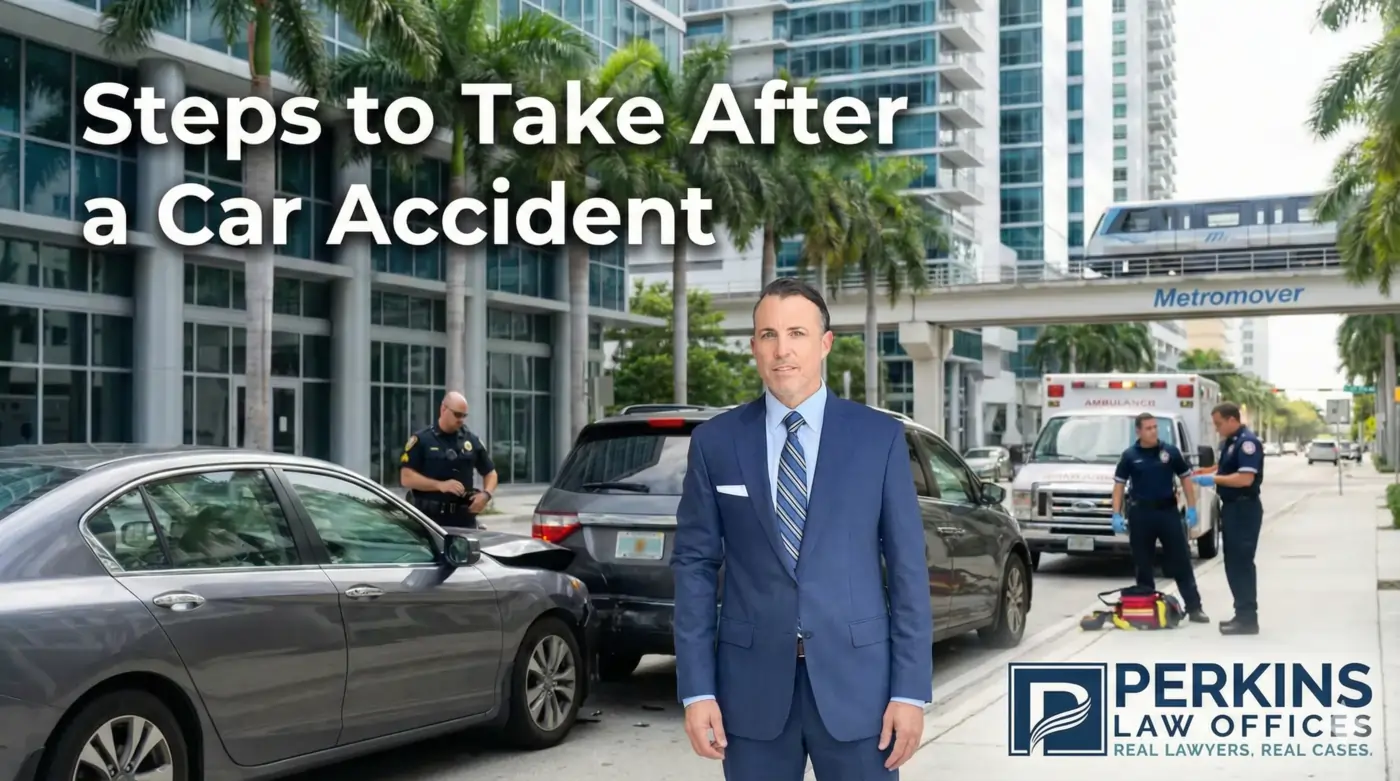
Steps to Take After a Car Accident
Do I legally have to call the police after a crash in Florida?
Yes. Reporting is required when injuries, death, or property damage of about $500 or more occur.
How soon must I see a doctor after a car accident?
In a serious accident, you would typically be take by ambulance to a hospital. But to qualify for PIP benefits at the very least you must get an emergency medical visit declared within 14 days to qualify for full PIP insurance benefits.
What information should I exchange with the other driver?
Name, contact details, driver’s license, vehicle registration, and insurance information.
Should I give a recorded statement to the insurance company?
Depends if it’s your own or the other drivers. But not before consulting a lawyer, because statements may be used to reduce or deny your claim later depending on what you say.
Can I still file a lawsuit in a no-fault state like Florida?
Yes. There needs to be a serious injury that’s not your fault.
Why is the police report so important?
It is the start of most car accident investigations as they provide an official third party independent documentation essential for insurance and legal claims.
Speak With a Miami Car Accident Lawyer Today
The Steps to Take After a Car Accident are not merely safety recommendations.
They are legal actions that protect evidence, preserve compensation rights, and determine case value.
If you were injured in Florida—or in a crash connected to Florida jurisdiction—timing matters.
Evidence fades. Deadlines pass. Insurance companies move quickly.
A qualified Miami car accident lawyer can secure proof, calculate damages, and pursue full financial recovery under Florida law.
Perkins Law Offices – Miami, Florida
Serious representation for serious injuries.
If you need guidance after a crash, the next correct step is clear:
Speak with an attorney who handles Florida car accident cases every day.