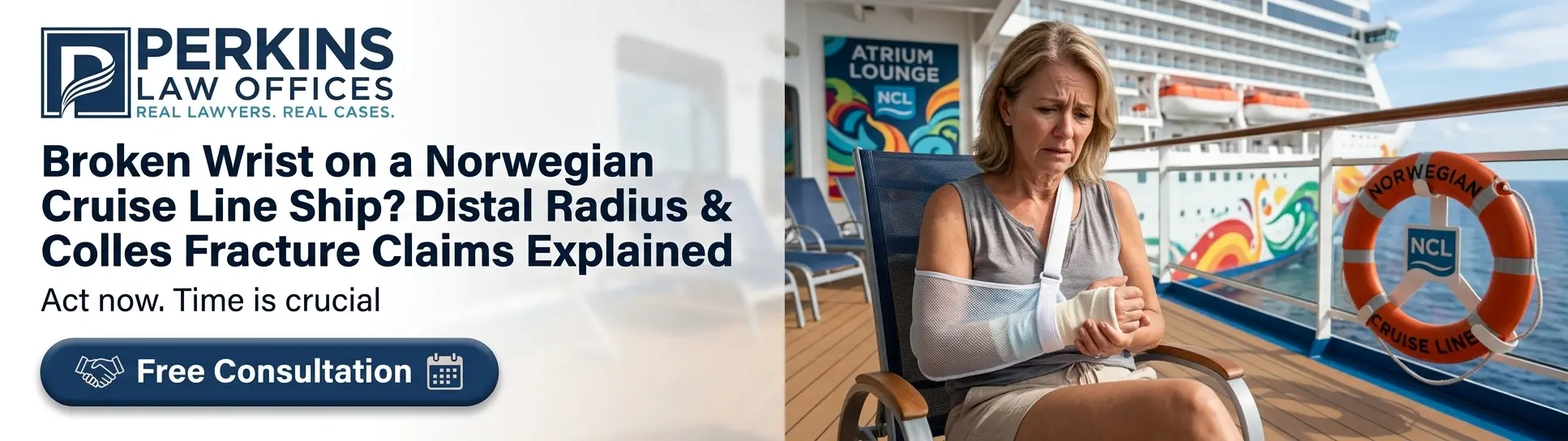
 Broken Wrist on a Norwegian Cruise Line Ship? Distal Radius & Colles Fracture Claims Explained
A broken wrist is not a minor injury. A distal radius fracture, commonly called a Colles fracture, can require closed reduction, weeks in a cast, or open reduction internal fixation (ORIF) surgery with permanent hardware left in the arm. For a working adult, that means lost income, physical therapy, and in many cases a wrist that never fully regains its pre-injury range of motion. If you broke your wrist aboard a Norwegian Cruise Line vessel because of a wet deck, an unmarked threshold, a tender boat transfer, or a hazardous gangway, you may have a viable claim against NCL under federal maritime law. I represent injured passengers against Norwegian Cruise Line and the other major cruise operators, and I am admitted to practice in the United States District Court for the Southern District of Florida, where nearly all NCL passenger injury lawsuits must be filed. Cruise ship, wrist, injury claims are not the same as those that occur on land because of the special rules in laws that apply to maritime case cases. My firm represents clients from all over the country and even the world who get injured on Norwegian cruise ships. Strict deadlines apply, and compensation may be available to passengers who live anywhere in the United States.
What Is a Distal Radius (Colles) Fracture?
The radius is the larger of the two forearm bones on the thumb side of the wrist. A distal radius fracture is a break at the end of that bone, nearest the wrist joint. When the break displaces the bone fragment backward toward the top of the hand, orthopedic surgeons classify it as a Colles fracture, the most common type of wrist fracture seen in adults who fall onto an outstretched hand. On imaging, this injury is coded under ICD-10 as S52.5, with more specific subcodes depending on whether the fracture is displaced, comminuted, or intra-articular, meaning it extends into the wrist joint itself.
Passengers typically break a wrist this way when they instinctively put a hand out to break a fall on a slick pool deck, a wet tile floor outside a buffet or bathroom, an uneven threshold between interior and exterior decks, or a tender boat gangway with an unstable step. Elderly passengers and passengers with osteoporosis are at heightened risk of a comminuted or intra-articular fracture from even a low-energy fall, which is why cruise lines that allow slippery or defective conditions to persist expose an entire class of passengers to foreseeable harm. Breaking a wrist can lead to permanent injury. We often see clients need surgery with open reduction and internal fixation. After sometime in the body, the hardware needs to be removed, which requires a second surgery to remove the metal screws and plates. In addition to the broken bones, you can have wrist ligament surgery, which is a nagging painful injury. This can also lead to carpal tunnel situations where you need a decompression or release of the carpal tunnel nerve.
How These Injuries Happen Aboard Norwegian Cruise Line Vessels
In my experience litigating cruise ship injury claims, wrist fractures most commonly arise from one of a handful of recurring, preventable conditions:
- Wet or freshly mopped floors near pool decks, buffet lines, spa entrances, and bathrooms without adequate warning signage
- Uneven or unmarked deck thresholds transitioning between interior carpet and exterior teak or composite decking
- Defective or missing handrails on interior staircases or exterior stairwells leading to lower decks
- Tender boat and gangway hazards, including unstable steps, gaps between the vessel and the tender, or crew failing to properly assist passengers during boarding
- Debris or spilled substances left uncleaned in high-traffic corridors and dining venues
- Malfunctioning cabin fixtures, such as a shower door or closet track that gives way and causes a passenger to fall
- Glass bottom boat slip and falls
- Excursion Accidents
Each of these scenarios can support a negligence claim, but only if the evidence establishes that NCL knew, or reasonably should have known, about the hazard before the fall occurred.
Norwegian Cruise Line’s Legal Duty to Its Passengers
Cruise lines are not held to a strict liability or “insurer” standard for injuries aboard their vessels. Under general maritime law, the controlling standard was set by the United States Supreme Court in Kermarec v. Compagnie Generale Transatlantique, which held that a shipowner owes everyone lawfully aboard the duty of exercising reasonable care under the circumstances of each case.1 Federal courts, including the Eleventh Circuit, which governs nearly all NCL litigation because the company’s tickets require suit in the Southern District of Florida, have applied and refined that standard specifically for cruise ship passenger injury claims.
Duty
NCL owes every fare-paying passenger a duty of reasonable care to maintain safe conditions throughout the vessel, including public decks, dining areas, cabins, stairwells, and tender operations. They also owe a duty to warn of dangers which they knew or should’ve known about
Notice:
To establis NCL had that duty, a passenger generally must show that NCL had actual or constructive notice of the risk-creating condition before the injury occurred.2 Constructive notice can be established by showing the hazardous condition existed long enough that the crew should have discovered and corrected it, or by identifying substantially similar prior incidents that put NCL on notice of the same type of danger.3 This is precisely having a lawyer who is familiar with the cruise line and their fall history and injury, history is of the upmost importance and can make or break your case from the outset. Knowing the history of claims and cases against the cruise lines and certain vessels is more important than ever because of the strict pleading requirements that the federal courts are now mandating. To be able to survive a motion to dismiss in the Southern District of Florida now requires a ridiculous level of factual detail that some might argue is unconstitutional. The federal bench requires much more than just notice pleading. A photograph of the wet floor, the absence of a warning sign, or an incident report referencing prior falls in the same location can make or break the notice element of a wrist fracture claim.
Causation
causation is another part of the elements of a negligence claim that is often hotly debated during the litigation. This usually involves the use of medical expert testimony and Daubert challenges. The claim must connect NCL’s breach directly to the fall and the resulting fracture. This is typically supported by the shipboard incident report, medical records from the ship’s infirmary, and imaging and treatment records obtained after disembarkation. This may seem fundamental in a fracture case, but if there is ligament involvement or a prior history of wrist complaints, the defense will argue. This was a pre-existing condition and not caused by the fall. This type of defense is typically used in knee and spinal cases which in many circumstances passengers will have treated at some point in their life for their body parts, and there may very well be degenerative changes superimposed on top of an injury, making the distinction hard for a doctor to opine on objectively. It is this battle of the experts that will often determine whether there is enough medical evidence to carry the day on causation.
Damages
Recoverable damages in a Colles or distal radius fracture claim can include past and future medical expenses, lost wages and diminished earning capacity if the dominant hand is affected, and pain and suffering. Under Florida law, which frequently governs NCL claims by choice-of-law provision, pain and suffering includes mental anguish, loss of capacity for the enjoyment of life, and any permanent loss of grip strength or range of motion.
Medical Treatment for a Broken Wrist Sustained on a Cruise
Treatment depends on the severity and displacement of the fracture. A stable, non-displaced break may be treated with closed reduction and a cast for six to eight weeks. A displaced, comminuted, or intra-articular fracture, the type more common in falls on hard cruise ship decking, frequently requires ORIF surgery, where a surgeon realigns the bone and secures it with a plate and screws. Recovery from ORIF surgery routinely involves months of occupational or physical therapy, and some patients never fully regain pre-injury grip strength or wrist rotation. These are the medical realities that must be documented and connected to the incident aboard the ship in order to maximize the value of a claim.
Notice Deadlines and Statute of Limitations for NCL Claims
Norwegian Cruise Line’s passenger ticket contract imposes two separate, strictly enforced deadlines that are unrelated to and shorter than ordinary personal injury statutes of limitations:
- Written notice of claim must be provided to NCL within 180 days of the incident, detailing the particulars of the injury.
- Lawsuit filing deadline is one year from the date of the injury. If suit is not commenced within that year, the claim is permanently barred, regardless of the merits.
These contractual deadlines are enforceable because passengers accept the ticket contract terms at the time of purchase. Missing either deadline, even by a few days, has ended otherwise strong claims I have reviewed for prospective clients who waited too long to consult counsel.
Venue: Where an NCL Wrist Injury Lawsuit Must Be Filed
Norwegian Cruise Line’s ticket contract contains a forum selection clause requiring passenger injury lawsuits to be filed in the United States District Court for the Southern District of Florida in Miami, regardless of where the passenger lives or where the cruise departed. Courts have consistently enforced these clauses as fundamentally fair, provided the forum was not selected to discourage legitimate claims, there was no fraud or overreaching, notice of the clause was adequate, and the passenger had a reasonable opportunity to reject the contract. This is why a passenger from Ohio, Texas, or California who breaks a wrist on an NCL ship must retain counsel admitted to practice in federal court in Miami, not simply a personal injury lawyer licensed in their home state.
National Representation for NCL Passenger Injury Claims
Because nearly every Norwegian Cruise Line claim is litigated in the same Miami federal courthouse regardless of the passenger’s home state, I represent injured passengers from across the country. Whether you boarded in Miami, Port Canaveral, New York, Los Angeles, or Seattle, if you were injured aboard an NCL vessel, your case will almost certainly proceed in the Southern District of Florida, and my firm is positioned to handle it from intake through trial without requiring you to travel to Florida except when your presence is genuinely necessary, such as a deposition or mediation.
Major Cruise Lines We Sue for Passenger Injuries
Wrist fractures and other slip-and-fall injuries occur across the industry, not just aboard NCL. Perkins Law Offices represents injured passengers against the following cruise lines:
- Norwegian Cruise Line
- Carnival Cruise Line
- Royal Caribbean International
- Celebrity Cruises
- Princess Cruises
- MSC Cruises
- Holland America Line
- Disney Cruise Line
Each cruise line has its own ticket contract terms, notice deadlines, and forum selection clause. Holland America and Disney claims, for example, involve different federal venues than NCL and require coordinated counsel admitted in those districts. Do not assume the rules that apply to one cruise line apply to another.
What to Do After Breaking Your Wrist on a Cruise Ship
- Get medical treatment immediately from the ship’s infirmary and request copies of all records before disembarking.
- Report the incident to ship security and request a copy of your written statement, without speculating about fault.
- Photograph the hazard, including the floor surface, any missing warning signage, and your injury as it progresses.
- Collect witness information from anyone who saw the fall or the condition that caused it.
- Preserve your footwear and clothing, since the cruise line will likely argue your shoes, not their deck, caused the fall.
- Contact a cruise ship injury lawyer promptly so the 180-day notice letter and one-year suit deadline are never at risk.
Frequently Asked Questions
How much is a broken wrist claim against Norwegian Cruise Line worth?
Value depends on the severity of the fracture, whether surgery was required, lost income, and any permanent loss of function. A non-displaced fracture treated with casting alone typically resolves with less permanent impairment than a displaced or intra-articular fracture requiring ORIF surgery. There is no fixed settlement chart; each case is evaluated individually based on medical documentation and the strength of the liability evidence.
Do I need a lawyer to sue Norwegian Cruise Line for a wrist injury?
Yes. NCL retains experienced defense counsel and will not voluntarily hand over surveillance footage, prior incident reports, or maintenance logs. Because the case must be filed in federal court under a compressed one-year deadline, and because notice must be provided to NCL within 180 days in the correct form, most passengers benefit from retaining a maritime injury lawyer immediately rather than attempting to negotiate directly with the cruise line’s claims department.
What if I already signed the ship’s incident report?
Signing an incident report does not waive your right to pursue a claim, but statements in that report, including anything that could be read as self-blame, can be used against you later. If you have already signed a report, discuss its contents with your attorney before any further communication with the cruise line.
Can I still sue if I live outside Florida?
Yes. NCL’s ticket contract requires suit in the Southern District of Florida in Miami regardless of your home state, so residency elsewhere does not prevent you from bringing a claim; it simply means your case will be litigated in Miami federal court.
How long do I have to file a claim after a wrist fracture on an NCL ship?
NCL’s ticket contract requires written notice within 180 days of the incident and requires that any lawsuit be filed within one year of the date of injury. Both deadlines are strictly enforced, and missing either one can permanently bar an otherwise valid claim.
What if the cruise line blames my shoes or my own carelessness for the fall?
Comparative fault arguments are common in cruise ship litigation. Cruise lines routinely argue that footwear, inattention, or alcohol consumption contributed to a fall. This is why preserving your shoes, documenting the condition of the deck, and avoiding self-blaming statements to crew or medical staff are critical steps immediately after the incident.
Contact Perkins Law Offices for a free, confidential consultation. Call or text (305) 741-5297, or email perkins@perkinslawoffices.com. Alex Perkins has over 25 years of litigation experience and represents injured cruise passengers nationwide against Norwegian Cruise Line and every other major cruise operator. There are no fees unless we recover compensation for you.
Perkins Law Offices | 1728 Coral Way, Suite 702, Miami, FL 33145 | 6560 W. Rogers Circle, Suite 15, Boca Raton, FL 33487 | Licensed in Florida, Illinois, and Washington, D.C. | Admitted to the United States District Court for the Southern District of Florida.
Case citations: [1] Kermarec v. Compagnie Generale Transatlantique, 358 U.S. 625, 632 (1959). [2] Holland v. Carnival Corp., 50 F.4th 1088, 1094 (11th Cir. 2022). [3] Guevara v. NCL (Bahamas) Ltd., 920 F.3d 710, 720 (11th Cir. 2019). This page is for general informational purposes only and does not constitute legal advice. No result is guaranteed in any case, and past results do not predict future outcomes. Submitting a contact form or sending a message does not create an attorney-client relationship.