Recent Arrests of Crew Members for Sexual Misconduct Raises Awareness of a Real Problem
By Alex Perkins (Perkins Personal Injury Lawyers) Miami, FL.
I have been alarmed hearing the news of a recent string of busts against crew members for sexually deviant conduct aboard cruise ships. In particular involving children as potential victims. The good news is that law enforcement was proactive in forming a task force to thwart these criminals before they could happen.
Child sexual abuse material (CSAM/CSEM) — “Operation Tidal Wave”
Customs and Border Patrol and Homeland Security Investigations have run three coordinated phases against cruise crew this year:
- Phase 1 – San Diego, late April 2026: 27 crew from six vessels deported, including several from Disney Magic (widely misreported on social media as a “28-person, all-Disney trafficking ring”
- Phase 2 – San Juan, PR, June–July 2026: 14 crew processed for removal, one prosecuted federally.
- Phase 3 – Boston, Aug 14–16, 2026: 11 foreign crew arrested off Holland America’s Volendam and Norwegian Cruise Line’s Norwegian Breakaway, 9 to be returned to the Philippines, 1 to Nicaragua, 1 to Indonesia. Cruise HiveCruise Hive
Separately, in April 2026 four more crew were deported from Port Everglades after CSAM was found on their phones during routine screening, pushing the cumulative CSAM-arrest total for cruise crew past 200.
Sexual Abuse & Assault Onboard Cruises Has Always Been a Cruise Line Problem
While there has always been an undercurrent of sexual assaults by crew passengers in cruising, it seems there has been an uptick in the amount of incidents and number of crew involved. A main concern besides obviously the victims to these crimes, is that this uptick may not be accurately reflected in the official stats kept by DOT for U.S. based cruises. Much of that relies on self-reporting by the cruise lines themselves. Ever since the 2010 CVSSA (Cruise Vessel Safety and Security Act) was passed by congress, reporting became mandatory but with no real way for it to be enforced, ir to know if its wasn’t being done accurately and in good faith. But is was a step in the right directions, as before that time we have no insight whatsoever. It’s the first federal law to impose safety and security requirements on the cruise industry, driven largely by advocacy from the International Cruise Victims (ICV) organization after years of unreported shipboard crime. It was amended in 2014 to refine reporting mechanics. https://www.congress.gov/event/112th-congress/senate-event/LC2252/text
Who it applies to, and why: Any cruise ship that embarks or disembarks passengers at a U.S. port — regardless of the ship’s flag or where the cruise line is headquartered. Jurisdiction comes from the U.S. port call itself, not the nationality of the vessel or operator. That’s why foreign-flagged lines like Carnival, Royal Caribbean, MSC, and Norwegian are all covered: as long as they’re picking up or dropping off passengers in Miami, Port Everglades, San Diego, etc., they’re subject to the Act.
Who has to report, and to whom: The cruise line itself is responsible for reporting qualifying incidents to the FBI. This is pure self-reporting, no independent auditor verifies what does or doesn’t get reported, which is the central criticism of the system
Who collects and publishes the data: The FBI receives the reports, then the data flows to the Department of Transportation, which is statutorily required to publish it. DOT posts a quarterly “Cruise Line Incident Report”. It’s a spreadsheet/PDF broken down by cruise line, crime category, and whether the alleged perpetrator was a passenger, crew member, or other, on transportation.gov. Reports reflect the quarter the incident was reported to the FBI, not necessarily the quarter it occurred.
Reportable categories:
- Homicide
- Suspicious death
- Missing U.S. national
- Kidnapping
- Assault with serious bodily injury
- Firing or tampering with the vessel
- Theft over $10,000
- Sexual assault
- Sexual assault–rape
(Sexual assault and rape were reported as one combined category until Q1 2023, when DOT began splitting them.)
In my mind this method and what is required to supposedly be reported really misses the mark as you can’t get an accurate sense of the sheer number of incidents.
What’s notably excluded — There is a real limitation of the data. Many categories are crimes aren’t covered and a large swath of crimes that are in covered do not get reported if the victims are not U.S. citizens or involved a U.S. port. That’s a huge gap in transparency. While I get Congress is is an American entity and the FBI is our American legal authority, what is the har in reporting all of the crimes to everyone on a cruise regardless of whether the FBI has jurisdiction. It’s valuable information for the all to know, including law enforcement and the industry itself. For example, I represented a Canadian woman who was r*ped by a cabin steward crew member who used his access card to to access her stateroom after he saw her stumble drunk back to her room. The FBI field office in Miami would not conduct an investigation and directed me to call the Royal Mounted Canadian Police. Below is a s list of crimes not required to be self-reported to the FBI.
- Crimes where neither the victim nor the perpetrator is a U.S. national (this excludes almost all crew-on-crew crime, since most crew are foreign nationals)
- CSAM/child exploitation material possession, distribution, or production
- Drug smuggling
- Video voyeurism
- Physical assaults that don’t meet the undefined threshold of “serious bodily injury” — cruise lines make that call themselves
- Thefts under $10,000
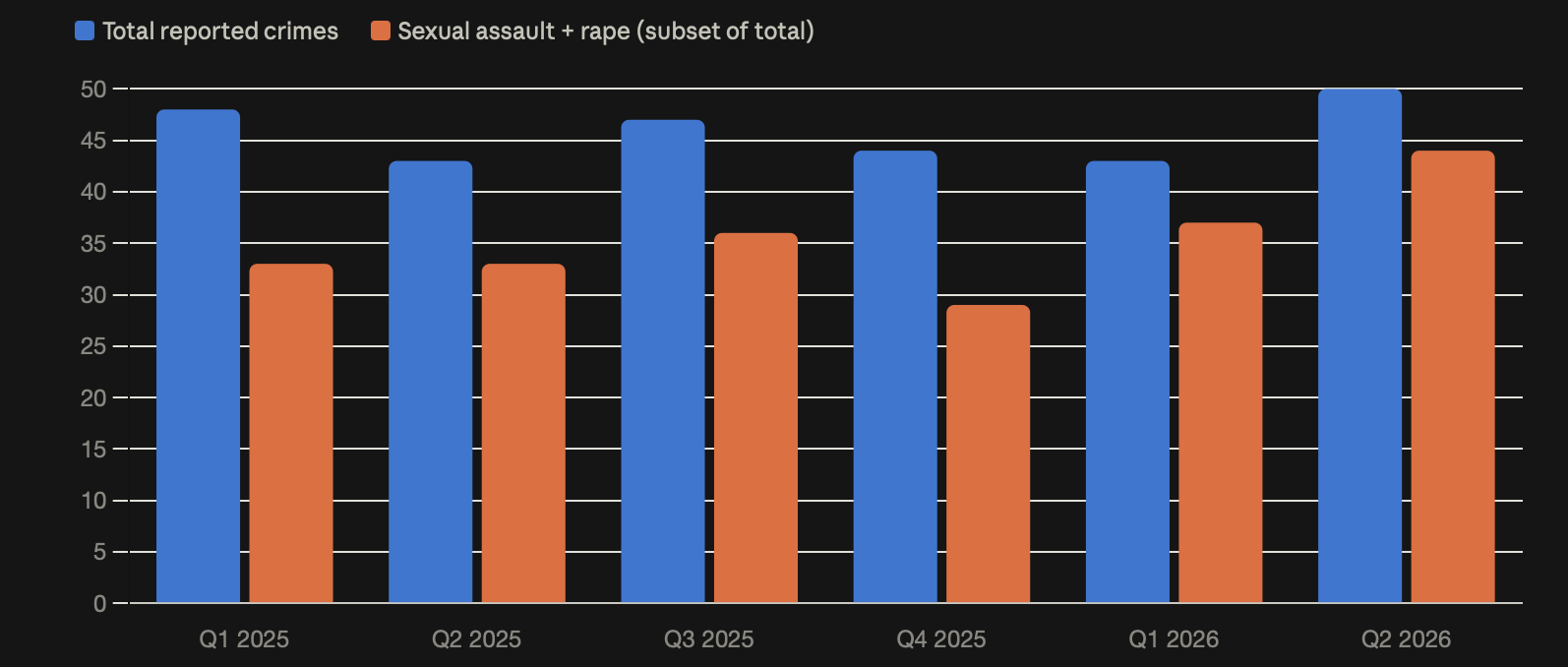 2026 Passenger sexual assault/battery
CBP/HSI have run three coordinated phases against cruise crew this year:
- Phase 1 – San Diego, late April 2026: 27 crew from six vessels deported, including several from Disney Magic (widely misreported on social media as a “28-person, all-Disney trafficking ring” — Snopes found that was part true, part exaggerated). The Boston GlobeSnopes
- Phase 2 – San Juan, PR, June–July 2026: 14 crew processed for removal, one prosecuted federally. The Boston Globe
- Phase 3 – Boston, Aug 14–16, 2026: 11 foreign crew arrested off Holland America’s Volendam and Norwegian Cruise Line’s Norwegian Breakaway, 9 to be returned to the Philippines, 1 to Nicaragua, 1 to Indonesia. Cruise HiveCruise Hive
Separately, in April 2026 four more crew were deported from Port Everglades after CSAM was found on their phones during routine screening, pushing the cumulative CSAM-arrest total for cruise crew past 200. Cruise Law News
A worthwhile note for your practice: crew-on-crew incidents like the Celebrity Xcel case aren’t captured in DOT’s quarterly cruise crime data, because reporting under the CVSSA is only mandatory when the assailant or victim is a U.S. citizen — so the public numbers likely understate actual incident volume. Want me to pull DOT’s most recent CVSSA quarterly report, or dig further into any one of these (e.g., full docket on the Celebrity Xcel or Virgin
Are Cruise Ships Safe for Kids?
Generally speaking, cruise lines are a safe mode of travel and vacationing. In my opinion, there is obviously safety in numbers. When you are part of a big group and partaking in activities operated by larger corporations, you can take some solace in knowing that some vetting is done. But ultimately big business still rely on people. Things can easily fall through the cracks. or worse intentionally ignored or hidden for the sake of profit. Cruise lines market their ships as floating resorts built for families, complete with water parks, supervised youth clubs, and round-the-clock entertainment. What they advertise less prominently is that a cruise ship is also a common carrier under federal maritime law, and that status comes with legal obligations to every child passenger aboard. Attorney Alex Perkins has spent over 25 years litigating cruise line negligence cases in the United States District Court for the Southern District of Florida, including cases involving children.
The Legal Duty Cruise Lines Owe to Child Passengers
Under general maritime law, a cruise line owes every passenger lawfully aboard the vessel — adult or minor — a duty of ordinary reasonable care under the circumstances. This standard was established by the U.S. Supreme Court in Kermarec v. Compagnie Generale Transatlantique, 358 U.S. 625 (1959), and has been applied consistently by the Eleventh Circuit, which controls almost all major cruise line litigation because the largest lines require suit to be filed in Miami federal court. To prove negligence, a family must establish four elements: (1) the cruise line owed a duty to protect the child from the particular danger, (2) the cruise line breached that duty, (3) the breach actually and proximately caused the injury, and (4) the child suffered real harm. Chaparro v. Carnival Corp., 693 F.3d 1333, 1336 (11th Cir. 2012). In most premises-type claims — a wet pool deck, a defective railing, a malfunctioning water slide — the family must also show the cruise line had actual or constructive notice of the dangerous condition. Keefe v. Bahama Cruise Line, Inc., 867 F.2d 1318, 1322 (11th Cir. 1989); Sorrels v. NCL (Bahamas) Ltd., 796 F.3d 1275 (11th Cir. 2015); Guevara v. NCL (Bahamas) Ltd., 920 F.3d 710 (11th Cir. 2019). Cruise lines are not insurers of a child’s safety. But they are not permitted to advertise supervised kids’ clubs, hire the staff who run them, and then disclaim responsibility when supervision fails.
Where Children Are Actually Getting Hurt Aboard Cruise Ships
Pools, Water Slides, and Splash Zones
Onboard water attractions are unsupervised or under-supervised more often than parents assume. Lifeguard coverage varies by cruise line and has been the subject of industry criticism for years. Slip-and-fall injuries around wet decks, entrapment hazards in pool drains, and drowning or near-drowning incidents involving young children are recurring categories in cruise litigation.
Kids Clubs and Youth Programs
Every major line sells parents on the idea that a supervised youth center lets the adults enjoy the ship while children are safely occupied. That promise creates a legal obligation. When a cruise line negligently hires, trains, retains, or supervises youth staff, and a child is injured or abused as a result, the cruise line can be held directly liable for its own negligence — separate from any liability for the staff member’s individual conduct.
Balconies, Railings, and Overboard Risk
Cabin balcony railings on most ships meet minimum height requirements for adults but were never designed with young children in mind. Falls from balconies and open deck railings are a serious, if statistically rare, category of catastrophic cruise ship injury.
Onboard Illness and Medical Care
Norovirus and other foodborne or contagious illness outbreaks spread quickly in the close quarters of a cruise ship, and children are frequently among the hardest hit. When a child requires medical attention onboard, the quality of that care matters. Following Franza v. Royal Caribbean Cruises, Ltd., 772 F.3d 1225 (11th Cir. 2014), cruise lines can be held vicariously liable for the negligence of onboard medical staff under theories of actual or apparent agency, reversing decades of near-total immunity for shipboard medical malpractice.
Crew Misconduct: What Parents Need to Know
This is the part of cruise ship safety that gets the least attention. Cruise lines employ thousands of crew members from dozens of countries, many working long contracts in close proximity to passengers, including children in youth centers, kids’ pools, and cabin hallways. They may have parents who let their guard down under the impression that things on a cruise are safe because it’s a big corporation with plenty of cameras and crew to watch out for their tweens and teens. Heck, they even have security crew members and a jail onboard. The overwhelming majority of crew members are hardworking and trustworthy. But when a cruise line fails to properly screen, train, or supervise its staff, the consequences for a child can be severe, and the law does not let the cruise line look away.
Federal law enforcement has been actively targeting this exact problem. In 2026, U.S. Customs and Border Protection and Homeland Security Investigations carried out a multi-phase initiative known as Operation Tidal Wave, specifically aimed at cruise ship crew members suspected of possessing or distributing child sexual abuse material. The first phase, in San Diego in April 2026, resulted in enforcement action against 27 crew members from six vessels, including staff connected to Disney cruise ships. A second phase in San Juan, Puerto Rico that summer led to enforcement action against 14 more crew members, and a third phase in Boston in August 2026 resulted in the arrest of 11 additional crew members aboard the Volendam and Norwegian Breakaway. These were not isolated incidents. They reflect a pattern serious enough to draw sustained federal law enforcement attention across multiple cruise lines and multiple ports. Credit the Trump administration for being proactive in saving children.
Criminal prosecutions of individual crew members for hands-on abuse of children have occurred as well, involving lines across the industry including a youth center employee on a Celebrity ship who was federally charged after abusing a six-year-old girl in the ship’s supervised kids’ club, a Disney crew member arrested after an incident involving a 13-year-old passenger, and a Carnival steward arrested after an incident involving a teenage passenger in an onboard sauna and shower area. Every one of these cases sits on top of a duty of care question: what did the cruise line know, or what should it have known, about the risk it was creating by placing that individual in a role with access to children?
The Eleventh Circuit has already recognized that a cruise line’s duty of ordinary reasonable care extends squarely to protecting passengers from foreseeable sexual assault by crew members, and that a cruise line which knows or should know of this industry-wide risk cannot simply plead ignorance. K.T. v. Royal Caribbean Cruises, Ltd., 931 F.3d 1041 (11th Cir. 2019); Doe v. Celebrity Cruises, Inc., 394 F.3d 891 (11th Cir. 2004). Cruise lines can be held strictly liable for the intentional acts of their crew members against passengers, and negligently liable for failing to screen, train, or supervise the staff placed around children in kids’ clubs, youth pools, and daycare-style programs. If your child was the victim of abuse, misconduct, or an inappropriate encounter with a crew member, Perkins Law Offices handles these cases with discretion, and full details of how our firm approaches these claims are available on our Cruise Ship Rape & Sexual Assault page and our Child Sexual Abuse practice page.
Protecting a Child’s Identity in a Legal Claim
A common question from parents considering legal action is whether their child’s name will become part of the public record. It does not have to. Courts routinely permit minor victims, particularly in sexual abuse and assault matters, to proceed under initials or a Jane Doe or John Doe pseudonym to shield their identity from public court filings and press coverage. Perkins Law Offices routinely structures filings this way to protect a child’s privacy while still pursuing full accountability against the responsible cruise line.
How a Minor’s Claim Gets Resolved: Are Court Approval and Guardianship Requirements
Yes and no. Generally speaking in most state court injury cases, a settlement or verdict recovered on behalf of a child is not simply typically handed to the parents. A recovery for a child’s injury claim often requires court approval depending on the amounts involved, the jurisdiction of the injury case, or the state residence of the minor and whether suit has been filed. Sometimes suits are filed in settled cases just to get Court approval. This is called a “minor’s compromise” or a friendly lawsuit, even if the case never would have otherwise required litigation. Interesting while most state laws in standard injury cases mandate some form of Court approval, under Maritime law, that is not necessarily the case. Rule 17 and some judges do not require it unless there is some sort of known conflict. Although we still suggest folks comply with their home state approval process and we suggest financial advisors who provide products like annuities to keep the money safe and compounding, it can be said that in Southern District of Florida, Maritime courts do not generally have jurisdiction of settlements. For example, we have recently filed Motions For Permission to Consummate Settlement in abundance of caution. Depending on the amount of the settlement and the jurisdiction, the court may appoint a guardian ad litem — an independent attorney whose only job is to evaluate whether the settlement is genuinely in the child’s best interest, review the proposed allocation of funds, and report back to the judge before the settlement can become final. Once approved, settlement funds belonging to the minor are typically placed into a restricted account, a court-supervised guardianship, or a structured settlement that the child cannot access until reaching the age of majority, unless the court authorizes an earlier disbursement for a specific need. This process exists to protect the child, not to slow the family down, and an experienced maritime attorney manages it as a routine part of resolving the claim.
Filing Deadlines Are Shorter Than Parents Expect — With One Key Exception
Most cruise line ticket contracts require written notice of any injury claim within six months of the incident and require that a lawsuit be filed within one year, far shorter than the two-to-four-year statutes of limitations that apply to ordinary personal injury cases on land. Courts have, however, recognized that the one-year clock can be tolled while a child remains a minor, particularly before a parent or guardian ad litem has formally stepped into the case on the child’s behalf. Gibbs v. Carnival Cruise Lines, 314 F.3d 125 (3d Cir. 2002). That tolling doctrine is fact-specific and should never be relied upon as a substitute for prompt action, cruise lines and their defense counsel will dispute it aggressively. If your child was injured or victimized on a cruise, the safest course is to contact a cruise ship injury lawyer immediately rather than assume extra time exists. We say 3 years is the SOL for minors.
We Handle Clients from All Fifty States
It does not matter if you do not live in Florida, you can still be our client. Nearly every major cruise line’s ticket contract now designates a specific federal venue for all voyages that touch a U.S. Port and involve a U.S. Citizen, most commonly the Southern District of Florida in Miami, with some lines routing to the Middle District of Florida or families across the entire United States end up needing a Miami-based maritime attorney regardless of where they live or where they boarded the ship. Perkins Law Offices represents injured children and their families nationally, is licensed in Florida, Illinois, and Washington, D.C., and is admitted to practice in the Southern District of Florida, where the majority of cruise line litigation must be filed.
The Major Cruise Lines We Handle Child Injury and Abuse Claims Against
- Carnival Cruise Line
- Royal Caribbean International
- Norwegian Cruise Line (NCL)
- Celebrity Cruises
- Princess Cruises
- MSC Cruises
- Holland America Line
- Disney Cruise Line
- Costa Cruises
- Virgin Voyages
- Margaritaville At Sea
- Regent Seven Seas
- Oceana
- Cunard
- Viking Cruises
Each line has its own jurisdiction, notice period, and claims-handling quirks buried in its ticket contract fine print — one more reason families searching “cruise ship injury lawyer for kids” nationwide consistently end up consulting a Miami maritime firm.
What to Do If Your Child Is Injured or Harmed on a Cruise
- Report it immediately to ship security and request a written incident report before disembarking.
- Get medical attention onboard and keep every record generated by the ship’s medical staff.
- Document everything — photograph the location, your child’s injuries, and any visible hazard, and do so again as the days pass.
- Collect witness information from any passenger or crew member who saw what happened.
- Avoid signing anything the cruise line presents onboard without legal advice, and avoid statements that could be read as blaming your child.
- Call a maritime attorney as soon as possible — even while still on the ship — given how short the notice and filing deadlines are.
Frequently Asked Questions About Cruise Ship Safety for Kids
Are cruise ships generally safe for children?
Most cruises for most children are uneventful. But “generally safe” is not the same as “risk-free,” and cruise lines are not exempt from liability just because the injury or misconduct happened at sea. When a cruise line’s negligence — inadequate lifeguard staffing, poor kids’ club supervision, negligent hiring of crew, or a known and unaddressed hazard — causes harm to a child, the family has the right to pursue compensation under maritime law.
Can I sue a cruise line if my child was injured in the kids’ club or pool area?
Yes, if the cruise line’s negligence contributed to the injury. This can include inadequate staffing ratios, poorly trained counselors, failure to enforce swim-test or supervision policies, or a known hazard the cruise line failed to fix or warn about.
What if my child was the victim of inappropriate contact or abuse by a crew member?
Cruise lines can be held strictly liable for intentional criminal acts committed by their crew members against passengers, and separately liable for negligent hiring, training, retention, or supervision of that crew member. These claims can proceed using your child’s initials or a pseudonym to protect their privacy.
How long do I have to file a claim on behalf of my child?
Most cruise line ticket contracts require written notice within six months and a lawsuit within one year, though courts have recognized tolling exceptions while a child remains unrepresented by a guardian ad litem. Do not wait to find out whether an exception applies to your situation — contact a maritime attorney immediately.
Will my child have to testify or appear in court?
Not necessarily. Many claims resolve through settlement, and even when court involvement is required for approval of a minor’s settlement, an experienced attorney works to minimize the burden on the child and can request that the child’s appearance be handled in the least invasive way the court will permit. However, Federal Court precedent does allow for minor’s to testify at depositions and trials. Carnival has taken the deposition of one of my 8-year-old clients and Disney has too.
Does a settlement for my child go directly to our family?
The settlement is own behalf of the injured minor. Settlements for minors generally require some type of court approval and are placed into a restricted account, guardianship, or structured settlement for the child’s benefit, protected until the child reaches adulthood unless the court authorizes an earlier, specific disbursement.
My family lives outside Florida — can Perkins Law Offices still represent us?
Yes. Because most major cruise line ticket contracts require lawsuits to be filed in Miami federal court, families nationwide retain Miami-based maritime counsel regardless of where they live. Perkins Law Offices represents clients across the United States on a contingency fee basis, with no upfront cost.
Cases where a child passenger onboard was actually the victim of hands-on abuse
These are the ones that map directly to your “child injured/abused on a cruise” claim type and are the strongest fit for the article’s crew-misconduct section:
- Celebrity Cruises — 6-year-old girl molested in the ship’s youth center (Fox News): https://www.foxnews.com/us/celebrity-cruise-staffer-accused-abusing-children-ships-youth-center-fbi.print
- Disney Cruise “Dream” — 13-year-old girl, crew member arrested for lewd/lascivious molestation (CBS Miami): https://www.cbsnews.com/miami/news/disney-cruise-crew-member-arrested-for-molesting-young-passenger
- Carnival Valor — teenage boy passenger, steward arrested for sexual battery/molestation (NBC News): https://www.nbcnews.com/news/us-news/carnival-cruise-employee-yovany-suazo-batiz-charged-molesting-teen-ship-n410696
Contact a Cruise Ship Child Injury Attorney
If your child was hurt, became seriously ill, or was the victim of misconduct on a cruise, contact Perkins Law Offices for a free, confidential consultation. There is no fee unless we recover compensation for your family. Call or text (305) 741-5297, or email perkins@perkinslawoffices.com.