Cruise Ship Sexual Assault
Cruise Ship Sexual Assault Legal help
National Representation for Victims of Sexual Assault at Sea On a Cruise Ship
Unfortunately, sexual assault aboard cruise ships is a stark reality that cruise lines don’t like to admit. It happens to both passengers and crew members alike and it happens way too often. The assault can be committed by other crew members or fellow passengers. These unwanted sexual assaults can come in many forms. Repeated physical touching and stalking, one time attacks, in cabin attacks, public space sexual assaults, and a variety of other situations. When there is no consent by the victim, or the victim is not in a position to ever consent to sexual contact, like in the case of a minor or when the victim is intoxicated or under the influence, there is no defense. Consent is required at sea in international waters just like it happened on land in any state in America. And no matter how drunk the victim was and no matter how the victim was dressed or looked, sexual assault is not ok. If a crew member took advantage of a drunk passenger or a minor, that is crime and civil liability for money damages is available whether the incident was reported to law enforcement or not. If a fellow passenger was able to sexually assault another passenger or a crew member and the cruise line knew or should have known of the problem, the cruise line can held liable for money damages.
Crew members and passengers are often scared to report sexual assault which is why it goes under reported. Understandably, the victims can be nervous, confused, fearful, ashamed or embarrassed. Young boys and girls may not want to tell their parents. Wives and husbands may be ashamed to tell their spouse. Boyfriends and girlfriends don’t want their partners to find out. In the case of crew members being sexual assaulted, the crew member may fear retaliation by the cruise line. They may not want to lose their job or fear the co-worker will harm them. Passngers victims of sex crimes my be concerned with going to the police, security or a lawyer for fear of the stigma of being sexually assaulted going into the public domain where their friends family, co-workers and employers may find. All of these are valid concerns. But the good news is is that Alex Perkins and Perkins Personal Injury Lawyers will fight for you in a discreet manner in which your name will not be part of a public record in any lawsuit. We file lawsuits and claims under a pseudonym, which is a fictitious name to protect the victims privacy and identity.
We have handle serious sexual assault cases against the cruise lines. We get it. It’s hard for some folks to come forward with their story. Sometimes it takes days or even weeks to piece together what happened and what to do next. But Perkins Law Offices wants victims of sexual assault on cruise voyages to know they are not alone that both passengers and crew members who get sexually assaulted have legal rights in the civil justice system under maritime law. This is true even if the criminal justice system has failed them. Victims have someone that can fight for them if this life changing type of assault and battery occurs. Cruise lines operate under strict duties of care. When those duties are breached and a passenger is harmed, federal maritime law provides a legal path to at least financial accountability.
At Perkins Law Offices, we represent victims nationwide who were sexually assaulted or sexually abused on cruise ships sailing from U.S. ports or operating under U.S. maritime jurisdiction. From our Miami headquarters—one of the world’s primary cruise ship litigation hubs—we handle cruise ship sexual assault claims across all 50 states, applying maritime law, international treaties, and federal statutes to pursue justice for our clients.
This page explains how cruise ship sexual assault cases work, who can be held liable, and why choosing the right cruise ship sexual assault attorney matters.
It Does Not Matter Where You Live. We Handle Cruise Ship Sexual Assault Cases for Victims from Across the United States
Although many cruise ships depart from from various states and countries, cruise ship sexual assault cases are not limited by state borders. These claims are governed primarily by federal maritime law, which allows victims from anywhere in the United States to pursue claims against cruise lines, operators, and third-party contractors. Most of the time the cases must be brought in Florida in federal court. This is because the ticket contract fine print says. This actually works out, even though victims can be anywhere in the country or in the world. The jurisdiction for the claim is going to be in Florida for the majority of the major cruise lines such as Carnival Cruise Line, Royal Caribbean Cruise Line, Norwegian Cruise Line, MSC Cruises, Disney Cruise Line, Virgin, Voyages, Celebrity Cruises, Princess Cruises, Regent Seven Seas, Oceana, Margaritaville at Sea, etc.
Perkins Law Offices represents clients nationwide, including passengers who live in:
- South Carolina
- Mississippi
- Missouri
- Indiana
- Nevada
- Vermont
- New Hampshire
- Maine
- Nebraska
- Virginia
- Rhode Island
- New Jersey
- Arkansas,
- Colorado,
- Connecticut,
- Delaware,
- Florida,
- Hawaii,
- Idaho
- Illinois
- Indiana,
- Iowa,
- Kansas,
- Kentucky
- Louisiana
- Maryland,
- Massachusetts,
- Minnesota
- Mississippi
- Missouri
- Montana
- Georgia
- Pennsylvania
- New Jersey
- Washington
- Massachusetts
- Oregon
- Arizona
- North Carolina
- Ohio
- California
- North Carolina
- Texas
- New York
And all other U.S. states and territories and internationally.
If the assault occurred aboard a cruise ship or during a cruise voyage excursion or port of call subject to U.S. maritime jurisdiction, location does not limit your right to legal representation.
Understanding Sexual Assault on Cruise Ships
Sexual assault on a cruise ship can involve:
Passenger-on-passenger sex assault
Crew-on-passenger sexual assault
- Man on woman or Woman on Man or Man on Man or Woman on Woman
Assault involving alcohol over service, intoxication, drink spiking, date r#pe
- Massage Assault
Assault facilitated by inadequate security or supervision
- Unauthorized entry into cabins
Sexual abuse of minors aboard cruise vessels
- False imprisonment, human trafficking, and kidnapping
Federal data has repeatedly shown that sexual assault is one of the most commonly reported serious crimes on cruise ships, particularly incidents involving passengers and crew members. We represent passengers and crew members who have been sexually assaulted. Bartender beware. Many incidents are alcohol related. Like many other bad things that happen on a ship, alcohol is often a starting place. People put their guard down or can make bad decisions when under the influence of alcohol or drugs. Often the crew members that have the most access to victims are those that are serving them that alcohol or other illicit substance. Bartenders also have access to your drink which allow them to spike someone’s drink. Women and minors are not the only ones who can fall victim to over service of alcohol or drink spiking incidents. Men and boys can just as easily become victims of sexual assault from over service of alcohol or drink spiking.
Cruise lines are strictly liable when their crew member commits a sex assault on a passenger of fellow crew member. However, in other circumstances strict liability may not apply. Cruise lines are not insurers of safety—but they are legally obligated to take reasonable steps to prevent foreseeable criminal acts. Therefor when there is a passenger on passenger sex assault, we must prove the cruise line knew or should have known of the danger. For example, if a passenger complained about a specific passenger that was harassing or bothering them, and then later was sexually assaulted by that passenger and the cruise line did nothing to step in, then there could be a potential claim against the line. Also, if a suspicious person was hiding in dark areas of the ship and was lurking for an extended period or should not even have been on the ship in the first place, the cruise line may be held accountable for that negligence and failing to observe and remedy the danger.
When Cruise Lines Can Be Held Legally Responsible
A cruise ship sexual assault attorney must be able to plead and ultimately prove the cruise line was negligent in most personal injury cases. These elements are duty breach, causation, and damage. However this is not the case when the sexual assault was actually committed by a crew member on a passenger or on another crew member. If the bad guy was a crew member, typical negligence elements do not apply because the cruise line can be held strictly liable for the acts of their crew when it comes to intentional torts like sexual assault whether the cruise line was negligent or not.
Duty of Care
Cruise lines owe passengers a duty of reasonable care to provide reasonable security, trained staff, and safe environments. They are not the ensurer of your safety. However, in circumstances of crew member assault on passengers, this duty can be easier to establish in that they are liable for the sexual assaults of their crew. If it can be shown that the assailant was a crew member or other agent or employee of the cruise line, responsibility is essentially automatic. Negligence does not need to proved by the victim against the cruise line. They just need to establish the perpetrator was a cruise line employee. The burden or proof is lower, so to speak, when a crew member is the assailant in the sexual assault. A cruise line can be held strictly liable for the actions of their crew. In other words, if a crew member sexually assaulted a passenger, the cruise line is automatically deemed responsible under the law without needing to “notice” of the potential danger to trigger the duty of care. The cruise line is still permitted to rebut the presumption of liability if there is proof to the contrary that the assault happened or was somehow shown to be consensual. In crew member perpetrator sex assault cases, a cruise ship injury lawyer need not prove whether the cruise line itself knew of the dangerous propensity of that crew member. This is significant because in most cases in order to establish a duty to a passenger, a cruise ship injury lawyer must show the cruise line was on notice of the danger. For example, a cruise ship injury lawyer would need to find evidence that this crew member was problematic in the past and attempted to harm other passengers in a sexual manner previously, and the cruise line knew about it or didn’t do enough to learn about it and should have. In a passenger on passenger sex assault we must prove there is a duty to the passenger before the cruise line is held legally at fault. With strict liability imposed, we would not have to prove negligence. Whether the cruise line was negligent or not, if the crew member intentionally committed a tortious act like sexual assault, the cruise line is going to be held legally responsible for that crew member employee under the law. This is similar to dog bite laws in most states. Owners of dogs are strictly liable for their pet, whether they bit someone before or not.
Breach of Duty
Examples include:
Failure to monitor high-risk areas
Inadequate lighting or surveillance
Failure to respond to prior complaints
Improper hiring or retention of crew with a negative history
- Failure to do proper background checks
Alcohol over service without supervision
- Prior complaints of inappropriate behavior by this crew member
Causation
The beach of the duty must have contributed to the assault occurring and resulting injuries. In other words, the cruise lines’ actions or in actions could be reasonably pointed to as the approximate cause of the assault and the resulting injury damages.
Victims may suffer:
Physical injury
Psychological trauma
PTSD, anxiety, depression
Loss of income
Long-term emotional harm
When these elements align, a cruise ship sexual assault lawsuit may be pursued.
Common Defendants in Cruise Ship Sexual Assault Lawsuits
Depending on the facts, defendants may include:
The cruise line itself
Parent corporations
Ship operators
Security contractors
Onboard medical providers
Third-party excursion companies
Cruise lines often attempt to deflect blame. A skilled maritime sexual assault attorney knows how to identify all responsible parties and preserve evidence before it disappears.
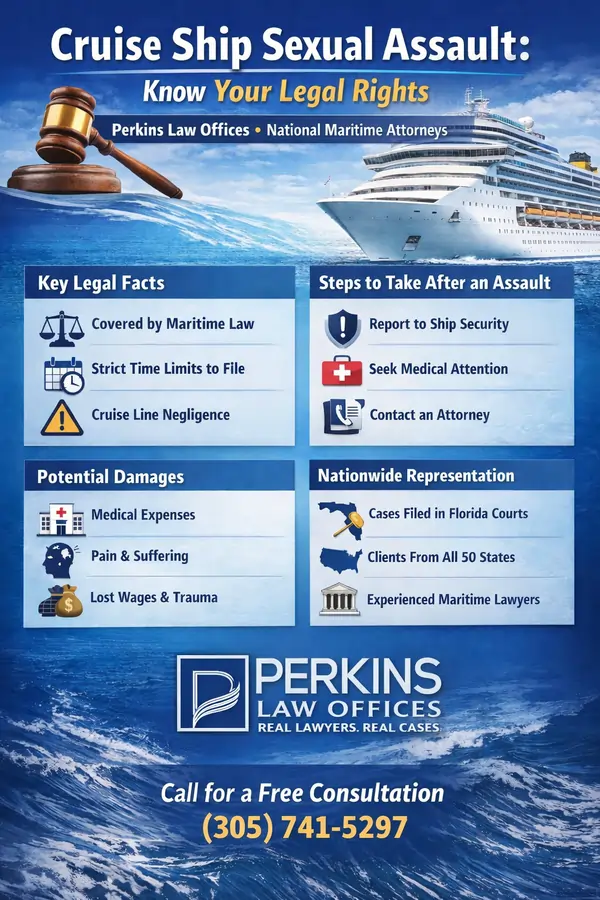
Cruise Ship Sexual Assault Infographics
Why Cruise Ship Sexual Assault Cases Are Legally Complex
Cruise ship sexual assault cases are governed by:
Federal maritime law
International maritime conventions
Passenger ticket contract provisions
Forum-selection clauses
Strict notice deadlines
Many cruise lines require lawsuits to be filed in specific federal courts, often in Florida. Missing a deadline or filing in the wrong jurisdiction can permanently bar a claim.
This is why victims are strongly advised to speak with a cruise ship sexual assault lawyer experienced in maritime litigation—not a general personal injury attorney unfamiliar with cruise law.
Real-World Example: Preventable Assault at Sea
In multiple cases handled nationwide, investigations revealed:
Prior reports of similar incidents ignored
Crew members with documented misconduct histories
Inadequate patrols in passenger corridors
Security cameras that were non-functional or unmonitored
These facts often emerge only after formal legal action begins. Cruise lines rarely disclose them voluntarily.
What Compensation May Be Available
A cruise ship sexual assault claim may seek compensation for:
Medical treatment
Psychological counseling and therapy
Lost wages and diminished earning capacity
Pain and suffering
Emotional distress
Long-term trauma care
Each case is fact-specific. No ethical attorney promises outcomes—but a properly built case seeks full and fair compensation under maritime law.
Addressing Common Defenses Raised by Cruise Lines
Cruise lines frequently argue:
The assault was unforeseeable
The perpetrator acted independently
The victim assumed risk
The claim was filed too late
These defenses are often challenged successfully when evidence shows prior warnings, negligent security practices, or systemic failures.
Why Victims Nationwide Choose Perkins Law Offices
Extensive experience with cruise ship litigation
Deep knowledge of maritime and federal law
National case handling from Miami’s cruise law epicenter
Strategic case preparation focused on accountability
Professional, discreet, victim-focused representation
We approach each case with seriousness, precision, and respect for the gravity of what our clients have endured.
Cruise Vessel Security and Safety Act (CVSSA): Federal Protections for Passengers
The Cruise Vessel Security and Safety Act (CVSSA) is a federal law designed to protect cruise ship passengers and ensure transparency when serious crimes occur at sea. Sexual assault is one of the primary offenses addressed by the Act. Under CVSSA, cruise lines that operate voyages embarking or disembarking from United States ports are legally required to follow specific reporting, security, and victim‑assistance protocols.
Cruise operators must promptly report allegations of sexual assault to the Federal Bureau of Investigation and the U.S. Coast Guard, preserve evidence, and maintain detailed crime logs. Ships are also required to carry medical supplies and equipment necessary to conduct forensic sexual assault examinations and to provide immediate medical care. In addition, cruise lines must make victim support resources readily available, including confidential contact information for law enforcement and victim advocacy organizations.
These requirements are not optional. When cruise lines fail to comply with CVSSA obligations, that failure can form the basis of a civil negligence claim. For victims, understanding CVSSA is critical because it establishes enforceable standards that cruise companies must meet to protect passenger safety.
Jurisdiction and Legal Authority in Cruise Ship Sexual Assault Cases
Jurisdiction is one of the most confusing aspects of cruise ship sexual assault cases. Unlike incidents that occur on land, crimes at sea may involve multiple legal systems depending on where the assault occurred, the nationality of the parties involved, and the cruise ship’s flag state.
In many cases involving U.S. passengers, the United States has jurisdiction when the cruise departs from or returns to a U.S. port, or when the victim or alleged perpetrator is a U.S. citizen. Even when an assault occurs in international waters, federal law may still apply. Additionally, cruise tickets often contain forum‑selection clauses requiring that civil lawsuits be filed in federal court, commonly in Miami, Florida.
Because jurisdictional rules can directly affect where and how a claim must be filed, victims should speak with a maritime attorney as early as possible. Filing in the wrong court or missing a contractual requirement can jeopardize an otherwise valid claim.
Criminal Prosecution vs. Civil Lawsuits
A cruise ship sexual assault may give rise to both criminal and civil proceedings, but these processes serve very different purposes. Criminal cases are handled by law enforcement agencies and prosecutors. Their goal is to investigate the crime, determine whether charges are warranted, and, if so, pursue punishment against the perpetrator.
Civil lawsuits, on the other hand, focus on compensation for the victim. A civil claim may be brought against the cruise line, the assailant, or both. These claims seek damages for medical expenses, psychological trauma, lost income, and pain and suffering. Importantly, a civil lawsuit may proceed even if no criminal charges are filed or if a criminal case does not result in a conviction.
Understanding this distinction helps victims make informed decisions about their legal options and expectations. An experienced maritime attorney can guide victims through both processes while protecting their rights.
Statute of Limitations and Notice Requirements
Cruise ship sexual assault claims are subject to strict deadlines. In many cases, cruise ticket contracts shorten the time a victim has to take legal action. These contracts may require written notice of a claim within a specific period and impose a shortened statute of limitations for filing a lawsuit.
Missing these deadlines can permanently bar a victim from seeking compensation, regardless of the severity of the assault. Because these time limits vary depending on the cruise line and the circumstances of the case, prompt legal consultation is essential. Early action also allows attorneys to preserve evidence and protect the victim’s legal position.
Preserving Evidence After a Sexual Assault at Sea
Evidence preservation is a critical factor in both criminal investigations and civil claims. After a sexual assault, victims may understandably want to clean themselves or leave the area, but doing so can unintentionally destroy valuable evidence.
Whenever possible, victims should avoid bathing or changing clothes until a forensic examination can be performed. Clothing, bedding, digital communications, and photographs may all serve as important evidence. Cruise ship surveillance footage, key‑card access logs, and witness statements can also play a crucial role in establishing what occurred.
Requesting immediate medical attention and reporting the incident helps ensure that evidence is documented and preserved. An attorney can also take steps to formally demand that the cruise line secure relevant records before they are lost or overwritten.
Cruise Line Duty of Care and Negligent Security
Cruise lines owe passengers a duty of reasonable care under maritime law. This duty includes providing adequate security measures to prevent foreseeable criminal acts, including sexual assault. When a cruise company fails to meet this obligation, it may be held legally responsible for resulting harm.
Examples of negligent security include inadequate surveillance systems, insufficient lighting, poorly trained security personnel, or a failure to respond appropriately to prior incidents. In some cases, cruise lines may ignore known risks or fail to enforce safety policies, increasing the likelihood of passenger‑on‑passenger assaults.
Demonstrating negligent security often requires a thorough investigation into the cruise line’s policies, staffing, and prior incident history. This is an area where experienced maritime counsel can make a significant difference.
Passenger‑on‑Passenger Sexual Assault Claims
When the alleged assailant is another passenger, cruise lines often attempt to deny responsibility. However, maritime law allows victims to pursue claims when the cruise company knew or should have known of a dangerous condition and failed to take reasonable steps to prevent harm.
These cases may involve evidence that the cruise line ignored warning signs, failed to monitor high‑risk areas, or inadequately responded to prior complaints. Establishing foreseeability and notice is key in passenger‑on‑passenger assault cases, and legal representation is essential to building a strong claim.
Sexual Assault Involving Minors on Cruise Ships
Sexual assault involving minors carries particularly serious legal and ethical implications. Cruise lines have heightened responsibilities when children are on board, including supervision policies, youth program safeguards, and background checks for staff.
When a minor is harmed, additional legal protections may apply, and the consequences for responsible parties can be severe. Families facing these situations should seek legal guidance immediately to ensure the child’s rights are protected and that appropriate action is taken against all responsible parties.
Why Immediate Legal Guidance Matters
Cruise ship sexual assault cases are complex, emotionally difficult, and governed by a unique body of maritime law. Acting quickly can protect a victim’s rights, preserve critical evidence, and ensure compliance with contractual and legal deadlines.
A knowledgeable cruise ship sexual assault attorney can handle communications with the cruise line, coordinate with investigators, and pursue compensation while allowing the victim to focus on healing. Legal support can make a meaningful difference in both the outcome of the case and the recovery process.
Frequently Asked Questions About Cruise Ship Sexual Assault Lawsuits
Can I pursue a claim if I did not report the assault on board?
Yes. While prompt reporting is helpful, victims may still have legal options even if the assault was reported later.
Can I sue the cruise line if the attacker was another passenger?
Yes, if the cruise line failed to provide reasonable security or ignored foreseeable risks.
How long do I have to file a lawsuit?
Deadlines vary and may be shortened by cruise ticket contracts. Speaking with an attorney quickly is critical.
What compensation may be available?
Victims may recover damages for medical expenses, emotional distress, lost income, and other losses related to the assault.
✔ Can I report sexual assault if I didn’t report it on the ship?
✔ What happens if the cruise line didn’t report it to law enforcement?
✔ How long do I have to file a lawsuit?
✔ Can I sue the cruise line even if the perpetrator is a passenger?
✔ Does the cruise line have to pay if their security was inadequate?
✔ Can I get emotional distress damages and punitive damages?
Can I sue a cruise line for sexual assault on a cruise ship?
Yes, if a crew member committed the assault the cruise line can be held strictly liable. Under circumstances where no employee committed the crime, if the cruise line’s negligence contributed to the assault, a lawsuit may be possible under maritime law.
How long do I have to file a cruise ship sexual assault lawsuit?
Many cruise lines require written notice within six months and a lawsuit within one year. These deadlines are strict.
Do cruise ship sexual assault cases have to be filed in Florida?
Often yes. Many passenger contracts require lawsuits to be filed in federal court in Florida, regardless of where the victim lives.
What if the assault was committed by another passenger?
Yes, cruise lines may still be liable if they failed to provide reasonable security or ignored warning signs.
Can I file a claim if the assault involved alcohol?
Alcohol overservice is a common factor. Cruise lines may be liable if intoxication was foreseeable and unmanaged.
What if the cruise ship left from a U.S. port but sailed internationally?
Yes, we can bring a claim here in Florida. U.S Maritime law will still apply. Jurisdiction depends on the ship, ticket contract, and location of the incident but most suits must be brought in Florida
Can family members file a claim on behalf of a minor?
Yes. Parents or legal guardians may pursue claims involving sexual abuse of minors aboard cruise ships.
Will my case be kept confidential?
Yes. Sexual assault cases are handled with discretion. Protective orders and confidentiality measures may apply. We file lawsuits with initials or Jane or Jon Doe.
How much is a cruise ship sexual assault case worth?
A lot. There is no fixed value. Compensation depends on injuries, severity of incident, long-term impact, and legal factors.
Do I need a maritime sexual assault attorney?
Yes. Cruise ship cases involve unique laws that most personal injury attorneys do not handle.
Speak With a Cruise Ship Sexual Assault Attorney
It’s free. If you or a loved one suffered sexual assault aboard a cruise ship, legal options may still be available—but time matters.
Perkins Law Offices represents victims nationwide in cruise ship sexual assault cases. Our firm understands the law, the tactics cruise lines use, and the seriousness of these claims.
Consulting with a qualified cruise ship sexual assault attorney is the first step toward accountability. We do not charge any upfront fees whatsoever. We only get paid if we get compensation for you.