When Cruise Ship Automatic Doors Malfunction Causing Injury, You May Have Federal Maritime Case
By Alex Perkins of Perkins Personal Injury Lawyers. A National Cruise Ship Maritime Injury Lawyer based in Florida.
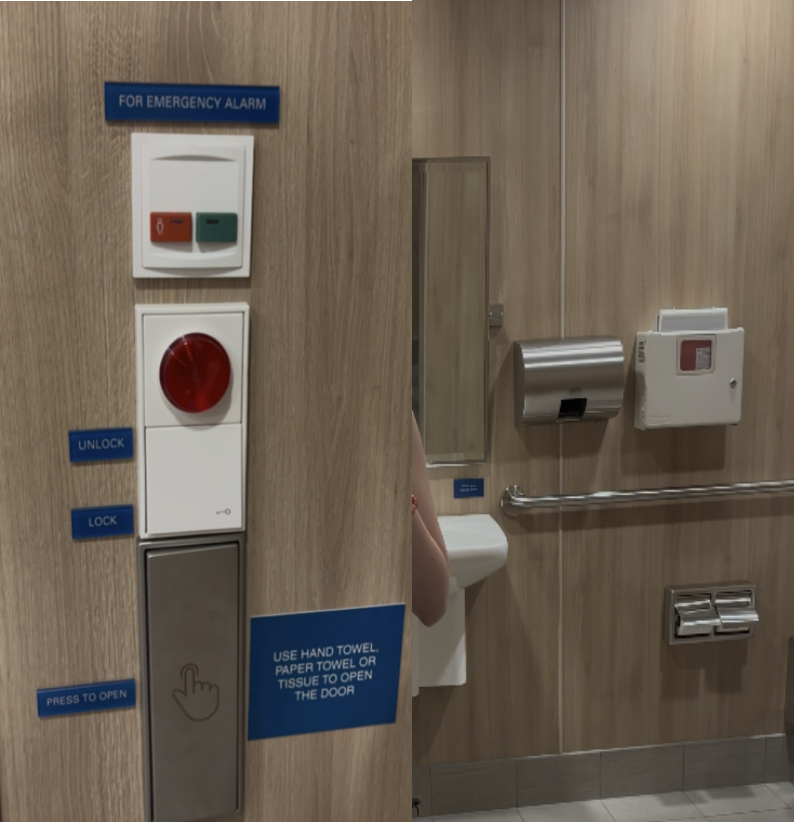
Yes, cruise ship automatic door injuries are a real thing that occur with enough frequency that I am writing an article about it. There are all sorts of different automated doors on cruise ships that can lead to injury of passengers when they malfunction due to lack of proper inspection and maintenance. Of course, elevator doors fall into this category of an automatic doors. So too are those double glass doors leading from interior of the ship to the exterior that slide open and closed. But have you seen some of these Star Trek-like pocket doors to bathrooms on newer ships that slide open real quick from one side that you have to press a button to operate and there is no door handle.

We have seen these modern pocket doors catch, cut and crush fingers, especially kids’. These doors are surprisingly dangerous and often have inadequate or confusing signage. In one case we handle, we had a young lady who was using the public bathroom on the ship that had one of these automatic sliding pocket doors. When it opened on its own while she was trying to use the restroom, she reached out and grabbed for it. But there was no door handle, only a little hole. Her finger got caught in the little hole and closed on her. She couldn’t get the door open and her hand was painfully trapped 10 minutes while crew members had to try to figure out how to extract the finger. We were successful arguing to the cruise line that not only did the door malfunction by opening when she was in it, all of the signage and buttons inside or confusing and did not help in an emergency situation like that. Look belowat this set up!
Another type of automatic door are fire doors. They can release and slam shut automatically when there is emergency as well as any door that has a handicap button to help the disabled, infirm, germaphobes and, the lazy, open doors by the just a push of button. Most disability cabins are equipped with such automation nowadays. Wind tunnel effects can also plays a role in causing passenger injuries from both regular and automated doors.
Everyone can imagine or has been close to experiencing elevator doors or grocery store doors almost closing on them and “sandwiching” them the cream in an Oreo double stuffed cookie. That is the most common thing people think of when they think of a automatic door malfunction and injury. But as we know from the many calls we get, there seem to be an infinite amount of possibilities of how passengers can get injured by automatic doors on a cruise ship.
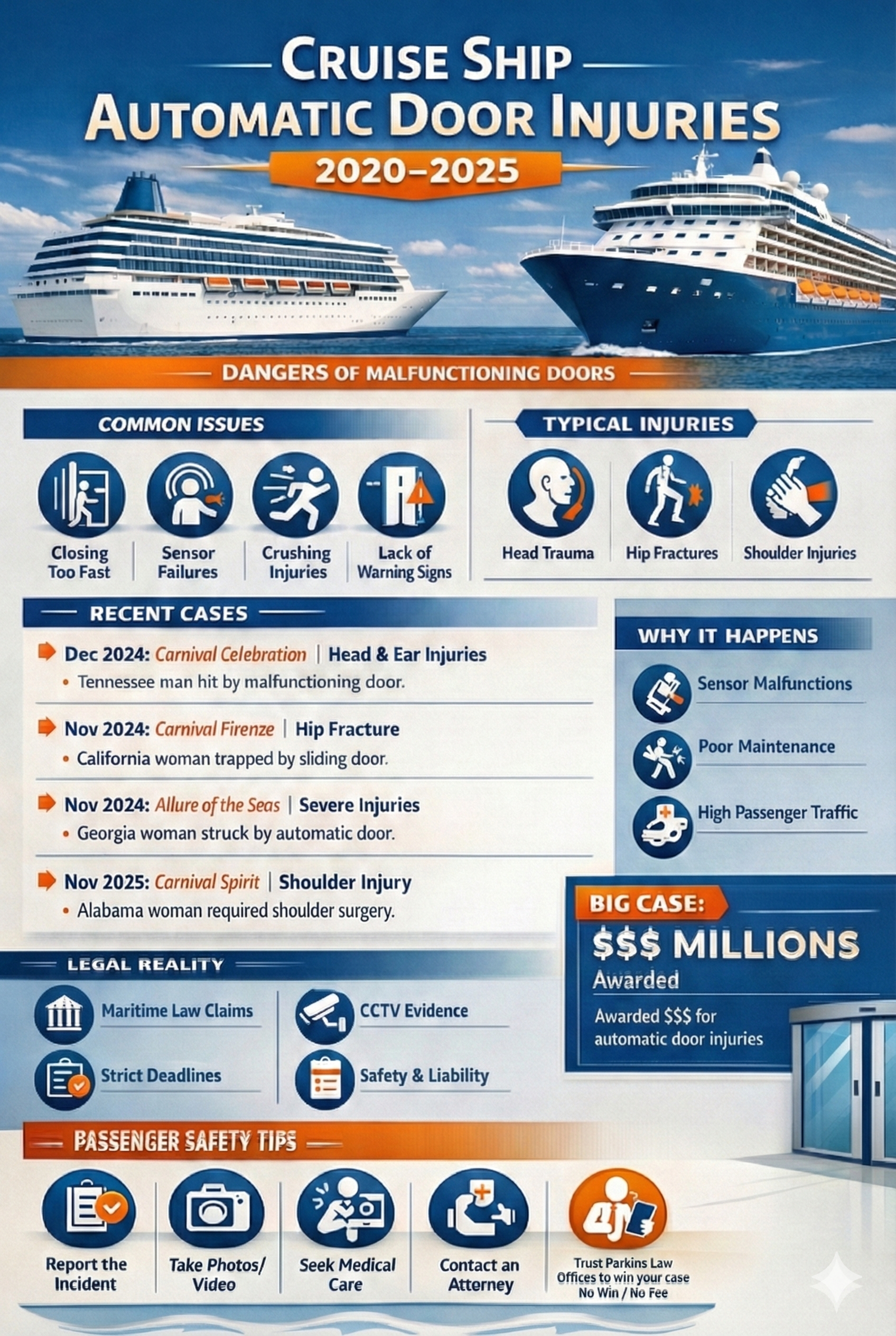
When an automatic sliding doors or powered door system closes on a passenger, fails to detect a person, or strikes someone in the head, shoulder, or hand, the result is often immediate trauma—crush injuries, fractures, tendon damage, head injury, and permanent impairment. These cases are also time-sensitive and legally technical because cruise claims are governed by federal maritime law and the cruise ticket contract—not the rules most people assume apply.
At Perkins Law Offices in Miami, attorney Alex Perkins handles cruise injury claims for clients across the United States. You do not have to live in Florida to hire a Miami maritime firm, and in many cruise cases you should not rely on a local lawyer who has never litigated in federal maritime jurisdiction. Cruise lines routinely require cases to be filed in a specific forum—often Miami federal court—and delay can destroy your evidence and your claim.
(This page is written for people searching “cruise ship automatic door injuries” because they want one thing: a lawyer who can sue the cruise line and win. The analysis below is built around the only framework that matters in these cases: duty, breach, causation, and damages—and how we prove each element when the door is the weapon.)
What Counts as a Cruise Ship Automatic Door Injury?
A cruise ship automatic door injury typically involves one of these situations:
An automatic sliding door closes on a passenger despite a clear path
A sensor fails (door does not detect a person or mobility device)
The door “strikes” a passenger as it opens or closes
A door traps fingers, hands, or arms causing crush injuries
A powered door closes too fast or with excessive force
A door fails to “reverse” when it contacts a person
On a cruise ship, these doors appear everywhere: cabin corridors, buffet entrances, theater portals, medical center doors, elevator areas, and staff-only transition zones. That is why searches often include variations such as cruise ship sliding door injury, cruise ship door malfunction injury, cruise ship door sensor failure, cruise ship door closing on passenger, cruise ship door crushed hand, and cruise ship door struck passenger.
The legal significance is simple: a malfunctioning power-operated pedestrian door is not “bad luck.” It is a safety system with known failure modes—sensor alignment, presence detection, timing, maintenance intervals, and incident history.
Cruise Ship Automatic Door Injuries – Legal Help
The Legal Standard: Negligence Under Maritime Law
Cruise ship injury claims are not ordinary premises liability cases. Cruise ships operate under maritime law, and the cruise line’s responsibility is evaluated through that lens. Perkins Law Offices emphasizes that cruise injury cases involve unique jurisdictional and procedural issues, and that acting quickly matters because evidence disappears and deadlines are strict.
The Four Elements We Must Prove
1) Duty
The cruise line owes passengers a duty to use reasonable care under the circumstances. In practical terms, that means the cruise line must operate and maintain automatic doors so they do not strike, trap, or crush passengers in normal use.
2) Breach
A breach occurs when the cruise line fails to do what a reasonable operator would do. In an automatic door case, breach often involves:
Poor inspection and maintenance
Faulty sensor calibration or obstructed safety zone
Known door problems ignored or repeatedly “patched”
Inadequate warnings or barricades when a door is malfunctioning
Design or installation defects (including component selection)
Standards matter here. Automatic sliding doors and powered pedestrian doors are commonly governed by industry safety frameworks such as ANSI/BHMA A156.10 (power operated pedestrian doors) and related provisions defining presence sensors and protected safety zones.
3) Causation
We must connect the breach to the injury. That requires proof that the door malfunction (or negligent maintenance) caused the impact, crush, fall, or head injury.
4) Damages
We must prove measurable harm—medical bills, future care, lost income, disability, and pain. Door crush injuries can involve fractures, tendon injuries, nail-bed trauma, and even amputations in severe cases. Medical literature on door-related crush injuries documents serious finger damage, including fractures and amputations in pediatric cases, underscoring the mechanism of injury when body parts are trapped by closing force.
Why Automatic Door Cases Can Be Strong—If You Act Fast
Cruise lines control the scene. They control the surveillance system. They control the maintenance logs. They control the employee reports. That is why Perkins Law Offices repeatedly stresses speed, documentation, and early preservation of evidence in maritime injury cases.
A single delay can cost you:
CCTV footage overwritten
Maintenance records “lost” in normal retention cycles
Witnesses dispersed across states and countries
Door components repaired or replaced without preservation
A Real-World Example of the Risk
One widely reported case involved a major cruise line being hit with a multi-million-dollar verdict after a passenger was struck by an automatic sliding door captured on security video—an illustration of how powerful door footage can be when preserved.
You do not need a “headline case” to win. But you do need evidence—and the cruise line will not hand it to you voluntarily.
Common Injury Patterns in Cruise Ship Automatic Door Accidents
Cruise ship doors do not just “bump” people. They injure in predictable ways:
Cruise Ship Door Crushed Hand / Finger Injury
A door closes on fingers at the edge, compressing soft tissue and bone. These cases can involve:
fractures
tendon injuries
nerve injury and long-term numbness
nail bed damage
complex regional pain syndrome (in severe cases)
Door-related finger trauma is well-documented as a crush mechanism with meaningful complication rates in clinical studies.
Cruise Ship Door Struck Passenger (Head / Shoulder / Back)
If a door swings or slides into a passenger, especially in a tight corridor, the impact can cause:
concussions / traumatic brain injury symptoms
cervical strain
shoulder injury
falls (secondary impact injuries)
Secondary Fall Injuries
A door strike can knock someone off balance. If the deck surface is wet, crowded, or uneven, the fall becomes the real damage driver—fractures, head strike, hip injuries.
cruise ship automatic door injuries lawyer infographics
Where These Incidents Happen Onboard (And Why It Matters)
Your claim becomes stronger when we can explain why the location made the risk foreseeable:
Cruise ship cabin door injury: narrow corridors, luggage, kids, reduced visibility
Cruise ship balcony door injury: heavier door panels, track issues, pinch points
Cruise ship elevator door injury: crowd pressure, mis-timed closures, sensor blind spots
Cruise ship restaurant door injury: high traffic, hands full, rapid cycling
Cruise ship medical center door injury: mobility limitations, injury vulnerability
Foreseeability matters because it supports duty and breach: high-traffic zones require higher safety discipline.
The Evidence That Wins Cruise Ship Door Injury Claims
If you are asking, “Will the cruise line give me the CCTV footage?” the realistic answer is: not until litigation forces it in most cases. Perkins Law Offices openly addresses that cruise lines rarely volunteer surveillance footage pre-suit.
Here is what we seek immediately:
1) CCTV / Security Video
hallway cameras
doorway cameras
adjacent area cameras showing traffic and conditions
2) Door Maintenance & Inspection Records
service tickets
sensor recalibration logs
prior complaints about the same door
replacement parts records
3) Incident Reports + Medical Records
onboard injury report (time, location, narrative)
ship medical visit notes
shore-side ER/urgent care records after disembarkation
4) Witness Statements
passengers
staff (sometimes anonymously at first)
travel companions
5) Photographs and Measurements
door location
warning signs (or lack of them)
the “approach path” and lighting conditions
“Do I Have a Case?” The Questions People Ask Before They Hire a Lawyer
These are the exact questions we hear from injured passengers nationwide:
“Can I sue a cruise ship for an automatic door injury?”
Yes—if negligence caused the malfunction or unsafe operation and we can prove duty, breach, causation, and damages under maritime law.
“Do I need a Miami cruise injury lawyer if the cruise happened somewhere else?”
Often, yes. Cruise contracts frequently require claims to be filed in a specified forum, and Miami is a common venue in cruise litigation. Perkins Law Offices describes Miami federal court as a frequent requirement and highlights that many clients come from outside Florida.
“What if the cruise line says it was my fault?”
They almost always do. It’s to be expected. Comparative fault arguments are standard defense tactics. The legal response is evidence: video, maintenance history, and sensor failure proof. Doors are engineered systems. Many years ago, I was involved in a case against a major cruise line and during the litigation we obtain the close circuit TV video of the incident itself when it closed on my 80-year-old client resulting in her falling and breaking her hip. The defense lawyer came in at mediation and argued that the door actually never touched my client and that, she got scared by the sound of the closing doors and overreacted resulting in her own fall. Somehow her hip mysteriously spontaneously combusted. We overcame that defense and got the case settled for good money.
“How long do I have to file a cruise ship door injury lawsuit?”
This is where people lose valid cases. Cruise ticket contracts can impose short notice deadlines and short suit limitations, and delay also destroys evidence. Perkins Law Offices emphasizes acting quickly because maritime cases are deadline-driven and evidence-sensitive. Usually a 6 month written notice requirement and one year statute of limitations is required by the ticket terms.
“What is my cruise ship door injury claim worth?”
Value depends on damages: severity, permanency, lost income, and future care needs. Perkins Law Offices discusses compensation categories and contingency fee structure in cruise injury matters.
A National Case Law Firm. You Can Hire Perkins Law Offices From Anywhere in the U.S.
Most of the major cruise lines must be sued or their claims brought in Florida. The good news is most qualified cases do not require travel to Florida. People search for a cruise ship automatic door injury lawyer in their home state—California, Texas, New York, Illinois thinking they need a local lawyer or worse, that they can’t bring a claim because the incident happened in international waters were in a foreign country. Perkins Law Offices positions itself as a cruise injury firm that represents clients nationwide because we are based where the cruise lines are headquartered and where suit must be filed. The preferred jurisdiction and most terms and conditions is the United States District Court for the southern district of Florida Miami division.
You do not need to travel to Miami just to start your case.
Safety Standards and Why They Matter in Door Malfunction Claims
Cruise lines and their contractors know automatic door injuries happen. That is why door systems are designed around detection, time-delay, and safety zones. Industry standards describe concepts such as presence sensors and protected areas where the door should not operate if a person is present.
Separately, injury reporting outside the cruise context reinforces the seriousness of automatic door hazards. A 2024 investigative report citing CPSC estimates stated that in 2022, more than 1,300 people nationwide were injured by automatic doors.
This data does not “prove” your cruise case by itself. But it supports an important legal point: automatic doors are a known injury mechanism, and operators must treat them as safety-critical equipment—not as an afterthought.
Counterarguments Cruise Lines Use (And How We Respond)
“It Was a Sudden Mechanical Failure”
A “sudden failure” defense often collapses when we obtain maintenance history, prior complaints, or evidence of repeated repairs. Mechanical systems almost never fail “without warning” when properly inspected.
“No One Else Was Hurt”
Irrelevant. Negligence can injure one person. The legal question is whether the door was unreasonably unsafe at the time of your incident and whether the cruise line had actual or constructive notice.
“You Should Have Been More Careful”
This defense is common—especially when the passenger was carrying food, luggage, or guiding a child. The counter is basic: a door designed for pedestrian traffic must accommodate normal use and detect people reliably.
What To Do Immediately After a Cruise Ship Automatic Door Accident
If you are still onboard—or you just disembarked—act like a lawyer is already building the case:
Report it to ship security and insist on a written incident report number.
Photograph (video) the door, the area, signage, and any visible defect.
Get medical attention and keep all records.
Write down witness names, contact info and cabin numbers (people scatter quickly).
Preserve your clothes and any blood-stained items if relevant.
Contact a maritime lawyer quickly—because footage and logs do not last.
FAQs About Cruise Ship Automatic Door Injuries (With Real Data)
How common are automatic door injuries in general?
A 2024 investigative report citing CPSC estimates reported over 1,300 automatic-door injuries nationwide in 2022.
Are finger crush injuries from doors “serious” medically?
Yes. Clinical literature on door-related finger crush injuries documents nail plate damage, wounds, fractures, and even amputations in a subset of cases—showing this is not trivial trauma.
Do safety standards exist for automatic sliding doors?
Yes. Industry standards for power operated pedestrian doors (such as BHMA/ANSI A156.10) define safety concepts including presence sensors and protected zones intended to prevent door operation when a person is in harm’s way.
Can I sue Norwegian, Royal Caribbean, Carnival, MSC, or Celebrity for an automatic door injury?
Potentially, yes—if negligence caused the door’s unsafe operation and the legal elements are met. The cruise line brand matters less than evidence, maintenance history, and the venue and deadline rules in the ticket contract.
Do I have to live in Florida to hire a Miami maritime lawyer?
No. Perkins Law Offices describes representing cruise injury clients from outside Florida and emphasizes the importance of federal maritime handling and early evidence preservation.
What compensation can I recover for a cruise ship door injury?
Compensation often includes medical expenses, future care, lost income, and pain and suffering—depending on severity and permanency. Perkins Law Offices discusses compensation expectations and contingency representation in cruise injury matters.
Speak With Perkins Law Offices a Cruise Ship Automatic Door Injury Lawyer Who Handles Cases Nationwide
If you were injured by an automatic door onboard a cruise ship—whether it was a cruise ship sliding door injury, cruise ship door sensor failure, cruise ship elevator door injury, or a cruise ship door crushed hand event—your case will rise or fall on evidence and timing.
Perkins Law Offices in Miami handles cruise injury claims for clients nationwide and focuses on the realities of maritime litigation: federal venue, strict deadlines, and immediate evidence preservation.
If you want to sue the cruise line, you start by protecting the proof.