What Evidence Do I Need for a Cruise Ship Injury Claim? A National Legal Leaders by Perkins Law Offices
When someone is injured on a cruise ship, the strength of the injury claim almost always comes down to evidence. It about what can you prove, not necessarily what actually happened or what is fair and just. When something bad happens on a cruise, it does not mean the cruise line is automatically liable for the incident. It sure would be nice, but the cruise lines are big corporations. They have legal departments and legions of lawyers chomping at the bit to defend their lawsuits. After all, cruise lawyers get paid by the hour and cruise lines have deep pockets to fight the most trivial or minimal of cases. Its best maritime lawyer practice is to inform the injured passengers upfront at the beginning of the claim that they have to work closely with the lawyer in pursuit of the case which includes helping in gathering evidence. A claim always starts with establishing liability, which means who is to blame for the accident. You don’t get to talk about all of your injuries and damages unless you can prove liability. Just because you got hurt on a cruise and it seems obvious the accident was not your fault, that is not enough. The cruise line will not just pay out of the kindness of their heart. They will deny, delay, and deflect responsibility unless the injured passenger and their cruise attorney presents documented, verifiable proof of negligence—proof that satisfies maritime legal standards and withstands federal court scrutiny.
At Perkins Law Offices, we handle cruise ship accident cases nationwide, and one pattern is consistent in every claim, the more evidence you can collect and the earlier the evidence is preserved, the stronger the case outcome. You are going to be in the stronger position with evidence than without. This page outlines the exact forms of cruise ship injury claim evidence required to establish liability under maritime law and position a case for maximum compensation.
The Elements of Negligence That Must be Plead and Proved for a Cruise Ship Injury Claim
Any lawsuit for cruise line negligence starts with being able to0 state a claim that the federal judges will not dismiss outright before engaging in discovery. To sue for negligence, an injure passenger must assert with factual support the following elements in the Complaint for Damages:
Duty — The cruise line owed a legal duty to provide a safe environment. This is tricky in cruise ship cases because Federal law has been changing in favor of cruise lines and against inured passengers and their lawyers. In order to establish that the cruise line had a duty to the passenger now requires a factual showing in most circumstances that the cruise line was on notice of the dangerous condition that caused the injury. In other words, you can’t just say the cruise line had a duty to maintain their vessel in a safe condition. You have to establish that the cruise line knew or should’ve known that the danger existed. This is very hard to show in a slip and fall on a transit substance like water on a floor. How can you establish that the cruise line actually knew there was water on the floor at that very moment. Further, how can you establish how long that water was there, in order to establish the cruise line should have known about it and cleaned it up. Perkins Law Offices has developed some tactics in order to circumvent some of these almost almost impossible proof issues. Obviously, if you have a photograph of the floor that you slipped on immediately after your fall that is quite helpful. However, that’s not the end of it. You have to establish that that puddle or wet spot had been there for a sufficient amount of time for it to have been cleaned up by a crew member or that it happened with such regularity that they should have known it was going to happen and prevented it sooner.
Breach — Breach just means that the cruise line failed in that duty of reasonable care. The cruise line can be said to have failed to correct a dangerous condition or created one, thereby breaching that duty of reasonable care owed to the passenger.
Causation — Sometimes causation can be the trickiest part. And federal court, as in most courts, causation must be proved by specific evidence. When we were talking personal injuries, the best personal injury lawyers know that you want to show that with a medical expert, who can opine within a reasonable degree of medical probability that the incident actually was the proximate cause of the passenger’s injury. For example, it can’t be from a pre-existing injury that could’ve happened prior, or even that could’ve happened after the incident in the gap between the time of the incident and when the claim was reported or the treatment was obtained by the client. In order for the cruise line to be liable, a cruise ship injury lawyer must be able to prove that the breach by the cruise line directly caused the injury.
Damages — The victim suffered quantifiable physical, financial, or emotional harm.
Each of these elements must be supported by evidence that meets maritime law standards, not assumptions or verbal statements.
Below you will find a detailed breakdown of the exact proof for a cruise ship injury claim, how to gather it, and why it matters.
Essential Evidence Required to Prove a Cruise Ship Injury Claim
1. Photographs and Videos of the Scene
High-quality evidence begins with cruise ship accident photos that capture:
The hazardous condition (wet floor, defective railing, loose carpeting, poor lighting)
The surrounding area
Lack of warning signs
Weather or lighting conditions
The victim’s visible injuries
Clothing or footwear at the time
Cruise ship lawyers frequently encounter defendants who claim the danger “did not exist” or was “open and obvious.” Time-stamped photos or videos undermine these defenses.
2. Witness Statements Supporting the Injury
Statements from:
Other passengers
Cruise ship employees
Medical staff
Family members present
These statements help establish how the incident occurred and confirm the condition existed before the fall, collision, or assault. Witness testimony is one of the strongest forms of cruise ship injury claim evidence, especially when multiple people corroborate the same dangerous condition.
3. The Cruise Ship’s Official Incident Report
Every cruise line—including Carnival, Royal Caribbean, Norwegian, Disney, MSC, and others—requires crew members to create an incident report.
This report is critical because it documents:
The victim’s immediate complaints
The crew’s response
Actions taken (or not taken)
The condition of the scene at the time
However, cruise lines often write these reports in ways that minimize their liability. Never rely solely on the cruise line’s report. It is merely one piece of the puzzle.
4. Surveillance Footage (CCTV)
Modern cruise ships have thousands of cameras. Surveillance footage often captures:
Slip and fall incidents
Food spills or hazards left unattended
Crew members ignoring safety protocols
Prior accidents in the same area
Cruise lines rarely release footage voluntarily. Immediate legal intervention is often required to preserve the footage before it is overwritten—sometimes within 14 to 30 days. This is why victims must contact a cruise ship personal injury attorney as soon as possible.
5. Medical Records and Treatment Documentation
For a successful maritime injury claim, victims should retain:
Shipboard medical center records
Doctor and nurse notes
Diagnostic imaging (X-rays, MRIs, CT scans)
Photographs of injuries over time
Post-cruise medical evaluations
Prescription records
Records of recommended treatment
Shipboard infirmary records often reveal significant clues: delayed treatment, failure to assess injuries properly, or inadequate medical equipment—all of which may show negligence.
6. Evidence of Causation and Prior Knowledge
Maritime law requires proof that the cruise line knew or should have known about the hazardous condition.
Key evidence includes:
Prior complaint logs
Maintenance records
Previous passenger complaints
Safety violations
Expert testimony
Internal investigations
Crew member statements
This is the category of evidence cruise lines fight hardest to conceal. It is also where national maritime experience matters most.
7. Documentation of Damages
Every successful injury claim requires clear evidence of damages, including:
Medical expenses
Therapy and rehabilitation records
Lost wages
Future earning capacity loss
Pain and suffering documentation
Expert assessments
Long-term disability evaluations
Travel costs related to treatment
Without documented damages, the claim cannot reach its full value.
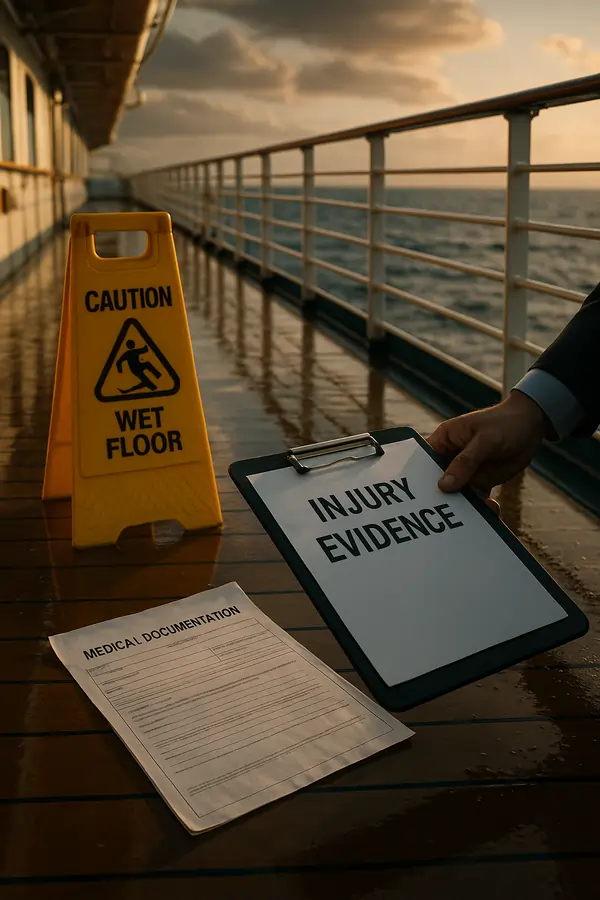
What evidence do I need for a cruise ship injury claim?
How Perkins Law Offices Builds Strong Cruise Ship Injury Claims Nationwide
Perkins Law Offices is uniquely positioned to handle national cruise ship accident cases due to extensive experience litigating:
Slip and falls
Trip and falls
Food poisoning
Shipboard medical malpractice
Assaults by crew or passengers
Negligent security incidents
Excursion injuries
Overboard incidents
Unsafe deck conditions
Our firm uses a high-evidence, low-assumption approach, mirroring the legal strategies used in successful federal maritime cases.
We immediately:
Issue preservation letters
Demand surveillance videos
Secure witness statements
Collect maintenance logs
Examine ship design hazards
Analyze staff training procedures
Consult maritime engineering experts
Reconstruct accident scenarios
This is why victims across the United States choose Perkins Law Offices: we understand exactly how to prove a cruise ship injury and what evidence is needed to withstand the defenses of billion-dollar cruise lines.
Counterarguments and Legal Challenges
Cruise lines often raise defenses such as:
“No notice of the hazard”
“The danger was open and obvious”
“Passenger was intoxicated”
“Passenger failed to follow warnings”
“Passenger refused treatment”
These defenses can be dismantled with the right evidence.
For example:
Prior complaint logs defeat lack-of-notice arguments.
Surveillance footage disproves “open and obvious” claims.
Medical records disprove intoxication allegations.
Photos demonstrate missing warnings.
This underscores why evidence determines the outcome—not assumptions, and not the cruise line’s version of events.
FAQs: Real Questions People Ask Before Hiring a Cruise Ship Injury Lawyer
1. What evidence do I need for a cruise ship injury claim?
You need photos, incident reports, witness statements, medical records, surveillance footage, proof of hazardous conditions, and documentation of all damages.
2. Do I need a lawyer to obtain cruise ship surveillance video?
Yes. Cruise lines almost never release footage without legal pressure in the form a of a lawsuit.
3. Will the cruise line try to deny my injury claim?
Most likely. Cruise companies commonly challenge liability unless strong evidence exists, gene then they deny deny deny..
4. Can a lawyer help even if I am from another state?
Yes. Perkins Law Offices handles national cruise ship cases regardless of where the client lives. It does not matter where you live, we can help.
5. How long do I have to file a cruise ship injury lawsuit?
Most tickets limit claims to one year. Some cruise lines require written notice within 180 days.
6. What if I did not take photos at the time of the incident?
A lawyer can still secure evidence through surveillance footage, witness interviews, ship logs, and medical documentation.
7. Can I file a claim if the cruise line blames me?
Yes. Comparative fault does not bar recovery. Evidence can disprove cruise line defenses.