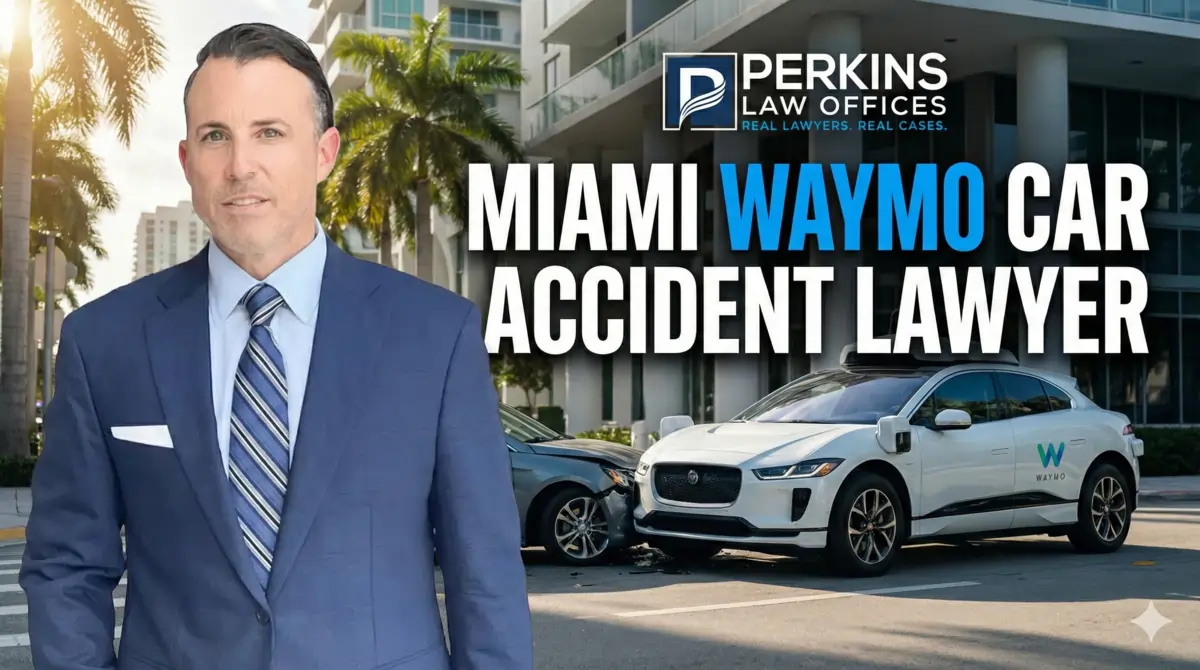
Miami Waymo Car Accident Lawyer – Florida Attorneys Handling Self-driving Car Accident (Autonomous Vehicle) Injury Claims
By Alex Perkins, Esq. Perkins Personal Injuries Lawyers Miami, FL.
TL;DR
Waymo and other Self driving car companies have liability insurance and can be sued if their vehicles cause an accident with injuries as they expand operations says well respected, Miami personal injury lawyer Alex Perkins.
Since November 2025, Waymo has been legally allowed to operate its self-driving fleet in Miami without a human behind the wheel, paving the way for fully autonomous ride shares within the city. Waymo is owned by Alphabet Co. otherwise known as Google. You probably have seen these white Waymo cars with contraptions on the roof and sticking out the sides and hood. They have been driving around South Florida for years. But now they are open for business and intend to compete against Uber, Lyft for market share in the ride share space as well as Tesla’s Robotaxi and Amazon’s Zoox. Uber and Lyft are now trying to make their own autonomous fleet to stay in the fast evolving autonomous driving game.
The Waymo car itself is currently a Jaguar I-Pace, which is an electric vehicle. Apparently that is set to change as Waymo expands its operations across the globe. Miami is one of six U.S. cities where Waymo fully self-driving is legal and operational. San Francisco, Los Angeles, Phoenix, Austin and Atlanta are the other U.S. cities. The more Waymo vehicles there are on the road, the more accidents causing injuries can be expected, as not even robots are perfect drivers…yet. It will be interesting to see which technology company has the least amount of accidents and how they will interact with each other. Imagine this, a Google Waymo collides into an Amazon owned Zoox or a Tesla Robotaxi. Who gets the ticket?
It is going to be a whole new landscape of proving fault. Instead of relying on eye witness testimony as much, personal injury car accident lawyers will need to get the data downloads from the trip computers which should actually have dash cams, speed and other telemetry recorded. Passengers in the backseat probably will not even be paying attention to the drive. While the frequency of car accidents should go down in the long term once adaptation of the self-driving is realized across the country, in the meantime the good news is Waymo has insurance and is a huge company with money to pursue when the inevitable car accident injury or death happens.
A Miami Waymo Car Accident Lawyer must evaluate learn to evaluate the liability differently moving forward. Software, sensor data, fleet operations, and corporate safety protocols—not just driver behavior is going to take precedence. At Perkins Law Offices, we have been litigating trucking accidents and Uber accidents for years. We have dealt with complicated data and software downloads in both vehicle and other product defect cases so we are ready for the transition of autonomous vehicles. We handle Waymo-related cases with the same disciplined framework that governs every serious injury claim.
Headquartered in Miami, our firm is structured to handle Waymo accident cases nationwide with strategic relationships. Autonomous vehicle collisions can often implicate federal regulations, multi-state operations, and corporate defendants with national footprints. We are prepared to litigate these matters wherever the evidence leads and wherever the law allows.
How Do Waymo Vehicles See the Road?
I own a Tesla CuberTruck. My wife tried to talk me out it when I bought it because they are so big, and in her opinion U-G-L-Y. It was love at first sight for me though. I got on the original wait list when Elon Musk touted the concept. I did not follow through though until 2025. And by that time, Tesla’s “auto-pilot” was already in supervised FSD (fully self-driving). As soon as I pushed the autopilot button on the 836 South in Miami, a notoriously dangerous highway that is always under construction with confusing lanes and crazy Florida drivers, a lightbulb went on in my head. I knew the future was here at that moment. The Cybertruck stayed in the swerving lines better than I ever could. It evaded cars cutting me off and changed lanes predicting slow downs ahead. It even came to a complete stop at stop signs in my neighborhood. In Miami, I don’t think anyone fully stops, ever. It was so atypical and unexpected, my wife asked me, “what’s wrong, why did it stop?”. The Cybertruck actually stoped behind the stop sign, waited, then edged out and then carefully went through the intersection. We weren’t used to the feeling of the deli in actually completely stopping!
Just like politics, facts that are not mainstream and go against the narrative, take time to overcome the bias. People don’t realize it yet that autonomous vehicles are already here and for the most part are safer than any human driver. They are still leaning to accept electric vehicles as opposed to gas, so this is going to take a little time, but it will be mainstream sooner than we think because all of the major companies developing the tech see the money and are in a race to be on top.
I have not been in a Waymo yet which is different tech involving Lidar than Tesla’s amazing self-driving software which is based on cameras, but if its efficacy is on par, you can feel safe in these cars, even while they work out the kinks. Many years and miles of testing has been performed, unlike some of the pharmaceutical products we all take.
Waymo vehicles rely on a complex integration of LiDAR, radar, mapping data, and proprietary decision-making software. When a crash occurs, the cause it may involve a perception failure, a flawed prediction model, a delayed braking command, or an unsafe operational decision—each raising distinct liability questions.
A Waymo self-driving car accident Miami claim often requires rapid evidence preservation, vehicle logs, sensor feeds, remote operator records, maintenance histories, and third-party integrations. Delay can mean lost proof. That is why early legal intervention matters.
Who Owes the Duty of Care in a Waymo Accident?
Autonomous vehicle cases expand the traditional list of responsible parties. Depending on the facts, liability may rest with:
The autonomous vehicle operator responsible for fleet deployment and safety oversight
The manufacturer and software developer responsible for perception, planning, and control systems
Maintenance or mapping vendors whose failures affected vehicle performance. While ownership of the vehicle can be based on dangerous instrumentality laws, companies may try to point the finger at third parties in complex accidents.
Rideshare or commercial partners involved in Waymo robotaxi operations
A qualified Waymo accident attorney Miami identifies every duty owed to the injured person and tests whether each duty was breached.
Proving Breach in an Autonomous Vehicle Case
In conventional crashes, breach often means speeding, distraction, or impairment. In autonomous vehicle litigation, breach can include:
Failure of sensors to properly detect pedestrians or cyclists
Inadequate response to predictable traffic scenarios
Software updates that introduce known safety risks
Insufficient remote supervision or emergency override protocols
- Disconnects from communications causing latency issues and software malfunction.
A Waymo AV accident claim in Miami succeeds when technical failures can be translated into clear legal violations—supported by witness testimony and objective data.
Linking Software Decisions to both the Crash and the Physical Harm
Causation is where autonomous vehicle cases are won or lost. This includes reconstructing the seconds before impact, analyzing alternative actions the system could have taken, and comparing those choices to accepted safety standards. When the evidence shows that a safer response was available—and not executed—causation can become clearer. Defense teams frequently argue that a third party caused the collision or that the system responded reasonably.
Proving who or what caused an accident is called liability causation. But then the burden is on the plaintiff to also prove injury causation. In some cases it’s rather obvious when the injuries are serious. But defense will seek discovery on pre-existing physical conditions or injuries. For example in neck and beck injury cases, the defense may argue the injury was not from the accident and the injure person already had a herniated disc or torn ligament, or that the injury was due to age not the accident. More complex can be arguments of causation pertaining to seat belt use. They can blame the passenger for not wearing a seatbelt for the serious injury even though they caused the crash.
Our role as an autonomous vehicle accident lawyer Miami is to demonstrate how the autonomous system’s decision-making sequence led directly to the injury or malfunctioned leading to causing the accident, you then need to show that crash led to the actual injury suffered. And also how that crash caused the actual injury complained of.
Since Waymo is new to Miami and Florida, there is less data available on the number and nature or Waymo crashes but NATIONWIDE (All States Combined) there
- 1,429 total Waymo crashes reported to NHTSA from July 2021 to November 2025
- 1,512 total Waymo crashes as of December 15, 2025 (slightly different count)
- 117 injuries
- 2 deaths (both caused by human drivers hitting Waymo cars, not Waymo’s fault.Florida had 34 crashes involving Level 2 driver assistance systems (like Tesla Autopilot) from June 2021-May 2022
Damages in Waymo Accident Cases
Victims of autonomous vehicle crashes may face life-altering harm. Recoverable damages can include:
Past and future medical expenses
Lost income and diminished earning capacity
Permanent disability or disfigurement
Pain, suffering, and loss of enjoyment of life
Wrongful death damages for surviving families
A Waymo personal injury lawyer Miami must document not only the immediate costs but the long-term consequences of the collision.
Common Waymo Accident Scenarios We Litigate
Waymo Pedestrian and Cyclist Accidents
Autonomous vehicles must correctly identify and predict vulnerable road users. When they fail, injuries are often catastrophic. A Waymo pedestrian accident Miami case requires close examination of perception and prediction algorithms.
Waymo Rideshare and Robotaxi Crashes
Passengers injured while inside a Waymo that gets into an accident or is in another vehicle that the Waymo crashes into, can be result in an injury claim or lawsuit against Waymo for money damages for the injured party. A Waymo rideshare accident lawyer Miami evaluates contractual responsibilities and insurance coverage layers.
Waymo Wrongful Death Claims
When an autonomous vehicle collision results in fatal injuries, families deserve accountability. A Waymo wrongful death lawyer Miami pursues answers and justice through meticulous investigation.
Addressing Counterarguments Raised by Waymo Defendants
Defense teams often assert that autonomous vehicles are statistically safer than human drivers. Even if that were true in the aggregate, it does not excuse a specific failure that causes harm. Safety statistics do not override individual accountability. Each case stands on its own facts.
Others argue that autonomous technology is “still evolving.” The law does not grant experimental immunity on public roads. If a system is deployed, it must meet established safety obligations.
Florida State Reach for Waymo Accident Litigation
Waymo operates across multiple states, and its corporate structure reflects a national scope. Perkins Law Offices is prepared to pursue autonomous car accident attorney Florida claims and extend representation nationwide when jurisdiction and venue permit. Our experience with complex, high-stakes litigation allows us to confront well-funded defendants on equal footing.
Mandatory $1 Million Liability Insurance for Autonomous Vehicles in Florida
The good news in Florida is that, at least for autonomous vehicles, the companies placing these vehicles on public roads are legally required to carry a minimum of $1 million in liability insurance in the event of an accident resulting in injury or death. This requirement applies when the autonomous driving system is engaged and operating on Florida roads.
This insurance mandate closely mirrors the rules imposed on rideshare companies, which are also required by law to maintain $1 million in liability coverage when an accident causes bodily injury. While rideshare companies have attempted over time to reduce or erode the scope of coverage available to Florida citizens, autonomous vehicle operators remain subject to this higher insurance threshold.
As a result, autonomous vehicles currently carry significantly more insurance coverage than the vast majority of privately owned vehicles in Florida, largely because Florida’s general auto insurance requirements are among the weakest in the nation.
Why Autonomous and Rideshare Vehicles Carry More Insurance Than Most Florida Drivers
Florida does not require regular vehicle owners to carry bodily injury liability insurance in order to legally register or operate a vehicle. As a consequence, most drivers on Florida roads carry little to no coverage to compensate others they may seriously injure.
By contrast, autonomous vehicle operators and rideshare networks are required to maintain substantial liability coverage because the legislature recognized the heightened risk and public exposure created when commercial vehicles operate continuously on public roadways.
This disparity explains why personal injury lawyers are often more willing—and more able—to pursue cases involving autonomous vehicles than cases involving traditional passenger vehicles.
The Reality of Florida’s Inadequate Auto Insurance System
Many injured Floridians are shocked to learn, after a serious crash, that there is no bodily injury insurance available at all—even when liability is clear. In these cases, even the most experienced car accident lawyer cannot recover compensation if there is no insurance coverage and no meaningful assets to pursue.
As the saying goes, you cannot get blood from a rock. Florida’s insurance system routinely leaves injured motorists and pedestrians without recourse, despite catastrophic injuries.
Injured Floridians Discover There Is No Bodily Injury Coverage In Most Car Accidents, But the Good News is Waymo Does Have Insurance
Bodily injury (BI) insurance is not mandatory in Florida. Drivers are not required to purchase it to legally operate a vehicle. As a result, countless drivers carry zero BI coverage while believing they are “fully insured.”
Most Florida drivers carry only the statutory minimum Personal Injury Protection (PIP) coverage, typically capped at $10,000. PIP is often described as “no-fault” insurance because it pays limited medical expenses regardless of who caused the crash. This system offers minimal real-world protection to injured motorists and pedestrians.
The misconception that car owners are “fiully insured” leads to devastating outcomes for injured victims, who only learn after the accident that the at-fault driver had no coverage capable of compensating them for medical bills, lost income, or long-term disability
In practice, PIP benefits do not go directly to injured individuals. Instead, they are paid to medical providers such as emergency rooms, clinics, and chiropractors who treat accident-related injuries.
Insurance companies frequently dispute or delay these payments, and the injured person never sees the money. PIP exists largely as a statutory payment mechanism for providers—not as meaningful compensation for victims.
However, in Waymo accident cases where it can be shown Waymo was at fault, there will be adequate insurance coverage for a lawyer to pursue. This means, that in the unfortunate scenario that you are injured in a Waymo crash, there will be sufficient insurance available unlike in the majority of car accidents across Florida.
Why Mandatory $1 Million Coverage for Waymo and Robotaxis Matters
This is precisely why Florida’s requirement that autonomous vehicles carry at least $1 million in bodily injury and wrongful death coverage is so significant. Companies operating Waymo autonomous vehicles, Zoox vehicles, and future robotaxi services—including Tesla’s anticipated autonomous fleet—must maintain this coverage to legally operate.
In addition to the $1 million liability policy, these vehicles must also carry standard PIP coverage at the $10,000 minimum. While PIP remains inadequate, the primary liability coverage creates real recourse for injured motorists and pedestrians.
Florida Statute § 627.749: Liability Insurance for Autonomous Vehicles
Florida Statute § 627.749 was enacted in 2019 to specifically address liability insurance requirements for autonomous vehicles. The statute mandates no less than $1 million in primary liability coverage for death, bodily injury, and property damage when an autonomous system is engaged, particularly for on-demand or ride-hailing networks.
§627.749 also requires AV operators maintain crash records. This is in addition to federal requirements under NHTSA Standing General Order 2021-01. All manufacturers and operators of vehicles equipped with ADS (automated driving systems) or ADAS (advanced driver assistance systems) must report accidents within one day if they involve:
- Fatality (any person)
- Hospital-treated injury (any person)
- Vulnerable road user struck (pedestrian, cyclist)
- Vehicle tow-away (any vehicle in crash)
- Airbag deployment (any vehicle in crash)
This applies if ADS/ADAS was engaged within 30 seconds before crash, the crash occurred on publicly accessible U.S. road and and updated report due 10 days after initial report. All other types of crashes can report by the 15th of the following month. The following info must e in the reports:
- Vehicle Identification Number (VIN) – last 6 digits withheld as PII
- Crash date and time (month/year, day withheld)
- Location (city, state, GPS coordinates)
- Engagement status of ADS/ADAS
- Severity of injuries:
- Fatal
- Suspected serious injury
- Suspected minor injury
- Possible injury
- No apparent injury
- Subject vehicle damage level
- Pre-crash movement of vehicle
- Airbag deployment status for all vehicles
- Data availability from vehicle systems
- Narrative description of incident
- Source of crash notification
- Vehicle type and manufacturer
For what it’s worth, the reports must be made public. The NHTSA website is below. States may also maintain their own reporting requirements.
Website:https://www.nhtsa.gov/laws-regulations/standing-general-order-crash-reporting
This law reflects legislative recognition that autonomous vehicle operations require heightened financial responsibility.
The rapid expansion of self-driving robotaxis across American cities, including Miami, has introduced unprecedented legal questions about liability when crashes occur. Unlike traditional vehicle accidents where a human driver’s negligence typically determines fault, autonomous vehicle crashes involve complex questions about corporate responsibility, software failures, sensor malfunctions, and manufacturing defects. With companies like Waymo already operating fully driverless vehicles in Miami since January 2026, Tesla planning expansion into Florida, and Zoox conducting extensive testing, Florida residents need to understand that autonomous vehicle companies carry significantly higher insurance coverage than traditional vehicles—Waymo maintains $5 million policies in California and $1 million in Florida—but these companies also employ sophisticated legal strategies including arbitration clauses, liability limitations, and data control provisions designed to minimize their exposure in injury claims. Through November 2025, fully autonomous vehicles have been involved in over 5,200 reported crashes nationwide, with 451 injuries and 65 fatalities, creating an emerging body of case law that will shape liability determinations for years to come.
Florida’s Early Legalization of Fully Driverless Vehicles (2016–2019)
Florida was among the first states to fully legalize autonomous vehicle operation. In 2016, House Bill 7027 expanded autonomous vehicle use on public roads, removed testing restrictions, and allowed driverless operation without requiring a human operator to be present.
This early legalization positioned Florida as a national testing ground for autonomous technology—making strong insurance protections essential.
How Autonomous Vehicle Insurance Laws Differ From Rideshare Insurance Laws
Traditional rideshare insurance is governed under Florida Statute § 627.748, enacted in 2017 for human-driven rideshare vehicles. Autonomous rideshare networks, however, are governed differently.
Florida Statute § 316.85 bridges these frameworks by applying rideshare rules to autonomous networks while eliminating human-driver requirements and imposing the higher $1 million insurance threshold under § 627.749 instead.
This distinction ensures that when autonomous systems—not human drivers—are responsible, injured victims are not left without compensation.
Why Perkins Law Offices for Waymo Accident Claims
Trusted and well respected
Experience with complex corporate defendants
Rapid evidence preservation and expert coordination
When you need a self-driving car accident law firm Miami residents and national clients trust our firm is prepared to act.
Miami Waymo Car Accident Lawyer
Frequently Asked Questions About Waymo Accident Lawsuits
Can I sue Waymo after a self-driving car accident?
Yes. If a Waymo vehicle caused or contributed to your injuries, you may pursue a claim against the responsible parties, including corporate operators and technology developers.
Who is liable in a Waymo autonomous vehicle crash?
Liability depends on the cause. It may involve Waymo, software developers, maintenance contractors, or other entities responsible for vehicle operation and safety. But if its a Waymo car and Waymo caused the accident, we can pursue Waymo.
How long do I have to file a Waymo accident lawsuit?
2 years in Florida is the Statute of Limitations. Time limits vary by state. In Florida, personal injury claims are generally subject to the 2 years SOL statute of limitations. Delaying action can jeopardize critical evidence so you should not wait until the time is about to expire.
What evidence is important in a Waymo accident case?
Vehicle data logs, sensor recordings, maintenance records, dash cams, trip data in the App, and eyewitness testimony are often central to proving fault in autonomous vehicle cases.
Are Waymo accidents covered by insurance?
Yes. A Waymo insurance claim attorney Miami evaluates all applicable policies to pursue full compensation. Waymo is a big company owned by Google, so you can go over that limit potentially if the case involves death and serious injuries
Can Perkins Law Offices handle Waymo cases outside Florida?
Yes. We affiliate with local counsel equipped to handle Waymo accident litigation nationwide, subject to jurisdictional requirements.
Take the Next Step
Autonomous vehicle technology does not eliminate responsibility. When a self drying car causes owned or operated by Waymo causes harm, victims have the right to compensation. A Miami Waymo Car Accident Lawyer from Perkins Law Offices will evaluate your case with precision, authority, and an unwavering focus on accountability.
If you or a loved one has been injured in a Waymo-related collision, contact Perkins Law Offices to discuss your legal options.